Can Tether burn my USDT once it's frozen? Yes. After Tether calls
addBlackListto freeze an address, its owner can calldestroyBlackFundson that address to permanently reduce the token supply — this is the function that makes frozen USDT irretrievable at the source wallet, not just blocked. The function is defined in the USDT smart contract on Ethereum (0xdAC17…1ec7) and mirrored on Tron. If your USDT was destroyed as part of a US federal case, Tether's Token Recovery process has historically paired the burn with a fresh mint of equivalent USDT to the seizing agency or a court-designated wallet — the tokens at your address are gone, but the value can reach identified victims via the court, not directly back to you.
The USDT smart contract exposes a function called destroyBlackFunds that lets Tether permanently burn the USDT balance at a previously blacklisted address, decrementing the total token supply on that chain. Unlike a plain freeze, which only blocks an address from moving its USDT, a destroy is irreversible at that address. The specific tokens are gone, and no on-chain path can recover them. But "destroyed" does not always mean "lost to the victim." In the recovery flow, Tether's Token Recovery policy commonly pairs the burn with a fresh mint of equivalent USDT to a court-designated or victim address, so the tokens are gone while the value is not.
BlockSec's 2025 blacklist analysis put the volume this function moved in 2025 at roughly $698 million, out of the roughly $1.26 billion that Tether blacklisted across Ethereum and Tron. Destroy is not a rare edge case. It is roughly half of what a freeze eventually resolves to.
This guide is the code-level walkthrough of that mechanic: the exact function on the USDT contract, who can call it, when Tether uses destroy versus a plain freeze, the burn-and-reissue victim-recovery pattern, the notable 2026 destroy events, and how researchers and journalists should frame destroy volume when reporting on it.
The burn function itself: destroyBlackFunds
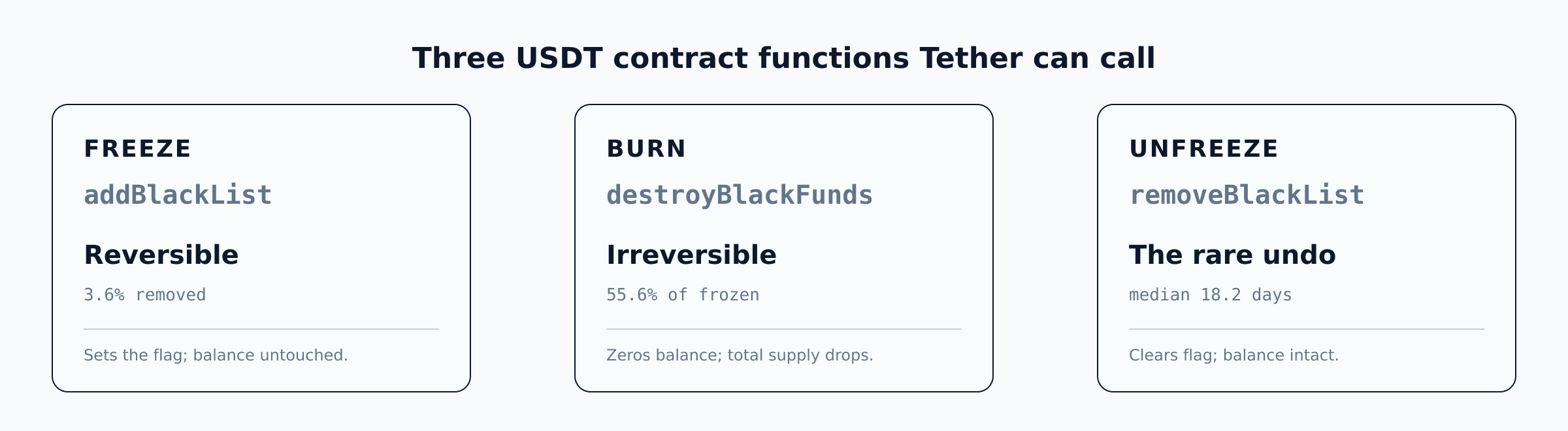
The destroyBlackFunds(address) function is the third in the USDT contract's three-function enforcement set, the other two being addBlackList (the freeze) and removeBlackList (the unfreeze). It is the only one of the three that changes the target's USDT balance and the total token supply on-chain.
The actual code from the deployed USDT contract
Here is the relevant snippet from the deployed Ethereum USDT contract at 0xdAC17F958D2ee523a2206206994597C13D831ec7 (pragma solidity ^0.4.17, so event emission uses the pre-0.4.21 syntax: the function name alone, no emit keyword):
function addBlackList (address _evilUser) public onlyOwner {
    isBlackListed[_evilUser] = true;
    AddedBlackList(_evilUser);
}

function removeBlackList (address _clearedUser) public onlyOwner {
    isBlackListed[_clearedUser] = false;
    RemovedBlackList(_clearedUser);
}

function destroyBlackFunds (address _blackListedUser) public onlyOwner {
    require(isBlackListed[_blackListedUser]);
    uint dirtyFunds = balanceOf(_blackListedUser);
    balances[_blackListedUser] = 0;
    _totalSupply -= dirtyFunds;
    DestroyedBlackFunds(_blackListedUser, dirtyFunds);
}
Five lines of Solidity encode the entire destroy mechanic: verify the address is blacklisted, read its balance into a local variable named dirtyFunds, zero out the balance, decrement _totalSupply, and emit an event.
The require: destroy can only follow a freeze
The require(isBlackListed[_blackListedUser]) check is the guard in the deployed contract. If the target address is not already blacklisted, the transaction reverts. Destroy always follows a freeze, every destroy event on-chain has a precursor freeze event, both publicly indexable in order.
The event, and the two non-reversible effects
Every successful destroy call emits DestroyedBlackFunds(_blackListedUser, dirtyFunds), indexed on Etherscan, Tronscan, and the BlockSec tracker. Two on-chain effects are non-reversible: the target address's balances mapping is zeroed (no undoDestroy function exists), and _totalSupply is permanently decremented by the burned amount. Tether can compensate the value via a fresh mint elsewhere, but the original tokens and supply-slot are gone.
Only the destroy call mutates real state. The freeze just flips a flag and blocks transfers; the unfreeze clears that flag. Only destroy zeroes the balance and decrements the total supply.
Who can call destroyBlackFunds
Destroy is an onlyOwner call on both the Ethereum USDT contract and the TRC-20 USDT contract. The owner is not a single hot key. It is a multisig address controlled by Tether Ltd., with a delay period between transaction proposal and execution.
No external actor can trigger a destroy at the contract layer. No court, regulator, exchange, DAO, or other issuer can trigger it. When a court order for civil forfeiture arrives, the sequence is: court order → Tether compliance receives and internally validates → Tether's multisig proposes and executes the destroy → the on-chain event lands. Tether is the actor of record on-chain even when a government agency is the underlying authority.
The multisig delay is public information. Anyone watching Tether's owner-multisig activity can see a proposed destroy before it executes. The delay-window issue that lets a subset of freeze targets move their USDT before a freeze lands is a freeze-side concern, not a destroy-side concern: by the time a destroy is proposed, the target's isBlackListed flag is already true, so the tokens are already immobilized.
The same three-function set exists on the TRC-20 contract with equivalent owner-only controls. The BlockSec USDT Freeze Report Archive shows Tron dominates USDT destroy volume in 2026, typically 85-97% of activity by both count and value in a given week, but the mechanic is identical: same guard, same event structure, same _totalSupply decrement.
When Tether uses destroy vs just freeze
Tether uses a freeze alone (no destroy) when the situation is under active investigation. Tether calls destroy only when the case has resolved into a formal disposition: a court order for civil forfeiture, an OFAC designation with an implied disposition path, or a Tether-verified victim petition for recovery-via-reissue.
The pattern breaks into a two-tier authorization structure.
The first tier is freeze only. A freeze runs on Tether's discretion, no court order required, minutes to hours from a law-enforcement information request to the executed block. The USDT is immobilized on-chain, balance intact.
The second tier is destroy plus reissue. A destroy, especially when paired with a fresh mint, requires a stronger legal predicate: a court order for civil forfeiture (typical timeline of months from freeze to destroy for civil cases; faster with criminal proceedings), or a Tether-verified victim petition with tracing evidence that meets Tether's internal compliance bar. Tether internally re-audits the tracing before pulling the trigger, because destroying tokens belonging to an innocent third party would expose Tether to conversion and breach-of-fiduciary-duty risk.
The categorical breakdown of what ends up destroyed: sanctions-related destroys (OFAC, terror-financing programs), which move fastest once the underlying determination is final (see BlockSec's on-chain analysis); fraud-recovery cases where the victim has been identified, almost always paired with a reissue; and law-enforcement seizures (civil or criminal forfeiture) where the reissue goes to a government-controlled custodian wallet.
Destroy volume in 2025 came in at roughly $698 million against roughly $1.26 billion of same-year freeze value, about 55.6%. That number describes pipeline throughput across the year rather than the fate of any specific 2025-blacklisted dollar, because some 2025 destroys resolve freezes from 2023-2024. What matters for a compliance operator is the direction: a large share of blacklisted USDT ends up burned, and that burn is very often paired with a reissue somewhere on-chain, as the next section covers.
"Destroyed" doesn't mean "lost": the burn-and-reissue mechanism
When Tether calls destroy, the tokens at that address are permanently burned. But Tether often pairs the burn with a fresh mint of equivalent USDT to a court-designated or victim address, so the tokens are gone; the value is not. This is the single most misunderstood aspect of the destroy mechanic in 2022-era SERP content, and it changes how the same-period destroy-to-freeze ratio should be interpreted.
How burn + reissue works: the 2-step
The pattern has two distinct on-chain steps:
- Destroy at the bad address.
destroyBlackFunds(bad_address). Balance goes to zero,DestroyedBlackFundsfires, total supply decrements. - Mint at the good address. Tether calls the standard issuance function (also
onlyOwner) to mint an equivalent amount of USDT to a court-designated or victim address. Total supply increments back by the same amount.
Net effect on USDT total supply: zero. Net effect on the specific tokens that were at the bad address: gone. Net effect on the value: it now sits at a different address, controlled by the rightful owner or a government custodian.
Why the two-step rather than "reassign balance"? Because the USDT contract has no such function. transfer and transferFrom, the standard ERC-20 movement primitives, require the private key of the sending address, and by definition the good-faith victim doesn't have that key. Burn-and-reissue is the mechanism that lets the value reach the victim without needing the attacker's private key or reversing the source address.
Tether's official recovery policy
Tether publishes a formal Token Recovery policy that spells out the process for victims:
- Recovery requests accepted for amounts greater than $1,000.
- Fee: up to 10% of the recovery amount, or $1,000 minimum, whichever is greater.
- Tether's evaluation is at "sole and absolute discretion" and is final.
- Formal channel: the Tether Information Requests team.
The 10% fee is not trivial for large recoveries, and "sole discretion" means there is no formal right to recovery. But the pathway exists and it is used at real scale.
Tether's internal secondary audit
Before executing a destroy-and-reissue, Tether's compliance team performs a secondary internal audit of the tracing evidence: re-running address clustering, cross-checking the ownership claim, and verifying no innocent third-party wallet is entangled with the destroy target. The motive is legal exposure: destroying USDT that belonged to an innocent counterparty (a fresh custodial deposit, an exchange hot wallet, a downstream OTC party) exposes Tether to conversion and breach-of-fiduciary-duty risk. This is why the freeze-to-destroy timeline typically runs many months for civil forfeiture cases, and why the destroy volume in any given month tends to be freeze cases from months prior.
What "destroyed" actually means for the value
The ~55.6% same-period destroy-to-freeze ratio is often reported as "$698 million lost." For the address that was blacklisted, yes: the USDT is gone. But for the value those tokens represented, the destroy is often paired with a fresh mint to the rightful owner or a government custodian. That new USDT then goes to law enforcement, to the victim, or to a court-controlled disposition process.
The right frame is that destroy is a recovery primitive, not a punishment. Journalists writing about a specific destroy event should always ask whether the destroy was paired with a reissue somewhere on-chain, and where the reissued tokens landed. That is the story of what actually happened to the value.
Notable destroy events
Destroy-relevant cases on the 2024-2026 docket, most recent first.
- $131M Iran IRGC freeze (July 14, 2026): Treasury Secretary Scott Bessent announced OFAC designations against four Tron wallets tied to Iran's IRGC and Central Bank under Executive Order 13902, part of Operation Economic Fury. Tether executed the freeze on all four within hours. Combined with the April action, publicly-disclosed Iran-linked USDT freezes in 2026 total at least $475M ($344M plus $131M), a conservative floor since additional Iran-linked freezes are not always individually announced. All candidates for destroy-and-reissue as forfeiture proceedings mature.
- $344M Iran freeze (April 23, 2026), the largest single Tether freeze on record: two Tron addresses (
TNiq9...QZH81at $213M andTTiDL...pjSr9at $131M), executed in coordination with U.S. authorities. OFAC designated both addresses as property of Iran's Bank Markazi (Central Bank of Iran) with linkages to the IRGC-Qods Force and Hizballah; both addresses' behavior fit sovereign reserve storage rather than active laundering. Tether CEO Paolo Ardoino confirmed the coordination in the official announcement. Frozen USDT is expected to progress through civil forfeiture to government custody via the burn-and-reissue pathway. - Drift Protocol (April 2026): a Solana perp DEX exploit that drained ~$285M initially, revised to ~$295M in user losses after Mandiant attributed the operation to DPRK-linked actors who had spent months infiltrating the team. Tether then led a rescue package of up to $147.5M ($127.5M from Tether plus $20M from partners) with USDT replacing USDC as Drift's settlement layer at relaunch. The nine-figure scale in a single victim-recovery event shows the burn-and-reissue pattern operates well beyond one-off five-figure cases.
- January 2026 $182M across 5 Tron wallets: an earlier tranche of Operation Economic Fury, largely undisclosed as to specific attribution but part of the ~$1B in Iranian crypto that Treasury Secretary Bessent said the U.S. had seized since the campaign began.
- Iran IRGC $6.76M (2024): Tether coordinated with U.S. and Israeli authorities to freeze USDT tied to Iran's Islamic Revolutionary Guard Corps and Houthi forces (BlockSec case study). BlockSec's on-chain tracking shows portions have progressed through destroy.
- Hamas terrorist-financing patterns (2023-2025): multiple freezes targeting USDT flows to Hamas-affiliated wallets. Destroys have followed for the subset tied to formal designations.
For aggregate destroy volume, the BlockSec USDT Freeze Report Archive publishes daily, weekly, and monthly counts across both chains. Recent samples: June 2026 monthly, 65 burns, $37.58M destroyed (Tron $29.08M / Ethereum $8.50M); Week 29 (July 13-19, 2026), 12 burns. Destroy activity runs lower than freeze activity in any given week. Freezes are the front door and destroys are the back door of the same pipeline, with 6-18 months of case-processing latency between the two.
Turning that pipeline into an operational picture on your own book is where wallet screening and event monitoring come in.
What "destroy" means for compliance and receivers
For the receiver whose address gets destroyed against, contract-level recovery is nil, no undoDestroy, no admin path to restore the burned balance. The only route is Tether's recovery policy, pursued as a petition with tracing evidence. Realistic outcome depends on demonstrating innocent ownership to Tether's satisfaction; if the address was flagged for legitimate cause (sanctions match, LE request), the odds of a reissue are effectively zero.
For the compliance operator monitoring their book, a destroy event on an address you had exposure to is a case-management trigger even after the initial freeze workflow closed. Regulatory reporting obligations continue through the destroy-and-reissue lifecycle. The audit-trail artifact should record all three events on that address: AddedBlackList, DestroyedBlackFunds, and (if visible) the paired reissue on the destination address.
For the tax and accounting picture, treatment varies by jurisdiction. In some jurisdictions the destroy is treated as a loss and the reissue as a fresh acquisition (potentially triggering a taxable event even though economically the victim is back where they started); in others, the paired transactions are treated as a single continuous holding. The IRS has not issued specific guidance on destroy-and-reissue pairs as of mid-2026, and the EU MiCA framework is silent on the tax side. Document both legs on-chain with block numbers and timestamps, and engage tax counsel in your jurisdiction. For OTC desks and merchants, destroy risk is downstream of freeze risk. By the time destroy fires the OTC exposure is usually already resolved via the freeze case; the playbook is the same pre-transaction screening plus post-transaction event monitoring.
Academic and industry context
The academic-industry connection here is our broader work on illicit on-chain fund flows, including the SIGMETRICS 2026 paper Shedding Light on Shadows, which introduces the MFTracer framework for tracing money flows through complex on-chain paths. That analytical lineage is what informs BlockSec's USDT Freeze Tracker instrumentation of the blacklist / destroy / reissue event stream. The tracing side (following the money) is complementary to the discretion side (what Tether does with what it finds). Treating destroy volume in any period as an independent compliance signal misreads the data, because destroy is a lagging function of freeze volume from months prior.
The regulatory implication is that destroy capability is becoming a de-facto licensing prerequisite for payment stablecoin issuers. Under the U.S. GENIUS Act (2025), permitted payment stablecoin issuers are treated as regulated financial institutions under the Bank Secrecy Act, with Recordkeeping / Travel Rule obligations for transfers of $3,000 or more and mandatory sanctions-list screening under Treasury's proposed implementing rule. Freeze (and downstream destroy under a formal legal disposition) is no longer a nice-to-have; it is a licensing precondition. Hong Kong's Stablecoins Ordinance (effective August 1, 2025) implies the same capability through its AML/CFT and sanctions-cooperation requirements, and the EU's MiCA regime pushes issuers in the same direction. Expect every payment stablecoin issuer (USDC, PYUSD, RLUSD, FDUSD, and future HKD-referenced tokens) to build equivalent destroy and reissue capabilities as licensing regimes mature.
Frequently asked questions
Can destroyed USDT be recovered? Not at the address it was destroyed against. Destroy zeros the balance and decrements the total supply, with no contract-level reverse. But when Tether pairs the destroy with a fresh mint to a victim or court-designated address (the burn-and-reissue pattern), the value is recovered as newly-minted USDT. Victims should pursue this via Tether's official Token Recovery process.
What's the difference between destroyBlackFunds and a normal token burn?
A normal burn requires the token holder's private key. The holder calls the burn function on their own balance, in line with the ERC-20 movement model. Tether's destroy is onlyOwner, works on someone else's balance, and is guarded by a require check that the target address is already blacklisted. It is an issuer-controlled enforcement/recovery mechanism, not a user-facing burn.
Who can call destroyBlackFunds?
Only Tether's owner multisig, on both the Ethereum USDT contract at 0xdAC17F958D2ee523a2206206994597C13D831ec7 and the TRC-20 USDT contract at TR7NHqjeKQxGTCi8q8ZY4pL8otSzgjLj6t. No court, regulator, or exchange can trigger the destroy at the contract layer.
Does destroyBlackFunds work on Tron USDT?
Yes. The same three-function set exists on both chains with equivalent owner-only controls. In 2026, the BlockSec USDT Freeze Report Archive shows Tron dominating destroy activity, typically 85-97% of a given week's total.
How much USDT has been destroyed to date?
BlockSec's 2025 report recorded roughly $698 million destroyed against roughly $1.26 billion blacklisted in the same year, a same-period flow ratio of about 55.6% (not a cohort survival rate, since some destroys correspond to freezes from earlier years). Monthly destroy volumes in 2026 have been in the tens of millions (e.g., $37.58M in June 2026). Cumulative all-time volume can be reconstructed from the DestroyedBlackFunds event stream on both chains via Etherscan and Tronscan.
If my USDT was destroyed, can I still get compensated? If you are a legitimate third-party victim (not the flagged address holder), yes: submit a recovery request via Tether's official process. Requests above $1,000 are accepted; fee up to 10% or $1,000 minimum. If you were the flagged address holder and the freeze was for legitimate cause, practical odds are effectively zero.
Related reads
- USDT Freeze: The Complete 2026 Guide
- How to Unfreeze a USDT Address
- How to Check If a USDT Address Is Frozen
- The USDT Blacklist, Explained (2026)
- The OTC Desk USDT Freeze Playbook
About the author

Andy is co-founder of BlockSec. BlockSec builds MetaSleuth, Trace AI, and Phalcon Compliance. He is also an Associate Professor at The Chinese University of Hong Kong, where his research focuses on system and blockchain security. Personal homepage: yajin.org.
Follow: X / Twitter · LinkedIn