For OTC desks, a USDT freeze is a timing problem, not a compliance abstraction. Value received on-chain can become unspendable seconds after receipt; value about to be sent can become a compliance incident before the fiat wire clears. On a mid-size desk running $50M monthly volume at typical net margin, a single credited-then-frozen deposit at recent trade size can wipe months of desk margin.
This playbook covers the three phases every OTC compliance program needs (pre-transaction screening, real-time monitoring, and post-freeze response) with the SLA math, policy templates, and live 2026 data.
OTC compliance in one page: what regulators expect
An OTC crypto desk that handles USDT is a Money Services Business (or the local equivalent) in every major jurisdiction. The regulatory perimeter is roughly the same everywhere; the specific citations differ.
- US — FinCEN registration as an MSB, Bank Secrecy Act reporting, OFAC SDN screening on every counterparty.
- EU — MiCA regulation VASP authorization; 6AMLD transaction monitoring.
- Singapore — MAS Payment Services Act DPT license.
- Hong Kong — HKMA stablecoin ordinance for USD-referenced stablecoin issuance and dealing.
For a desk handling USDT specifically, the freeze risk is the single most disruptive compliance failure mode: a frozen incoming address takes an otherwise-clean transaction and turns it into an incident. Everything downstream in this playbook — the pre-transaction screening SLA, the real-time freeze monitor, the post-freeze response templates — is how to detect and respond within the 15-minute window that distinguishes recoverable positions from writeoffs.
Why OTC desks are uniquely exposed
Exchanges absorb some freeze risk into their order book. Payment processors sit behind merchant contracts that push loss to the counterparty. OTC desks have neither buffer. Every trade is bilateral, settlement runs in minutes not days, and a single frozen receipt is visible to every future counterparty running due diligence on your desk.
Three structural factors sharpen the exposure:
- Bilateral trade, no exchange intermediary: if USDT gets frozen after credit, the loss is on your desk's balance sheet.
- T+0 settlement versus multisig-delay freezes: your customer expects the fiat wire the same minute the USDT confirms. Tether's owner multisig proposes a freeze and executes it after a delay; BlockSec's analysis of 8,310 executed
addBlackListproposals across Ethereum and Tron (2017–2026) documents a median 77-minute proposal-to-execution window, with the fastest observed target escape moving funds within 3 seconds of the proposal landing. Credit before the proposal executes and you are holding an unspendable balance. - Reputation cost: OTC is a relationship business. One counterparty telling five peers your desk took a $500K frozen deposit closes doors that took months to open.
The dollar math is stark. On July 25, 2026, the largest single Tron freeze was $4.75M at TNJ1tmw...nKchef. Illustrative: a mid-size OTC desk running $50M monthly volume at a hypothetical 25 bps net margin earns about $125K per month. A receipt that size, credited then frozen, wipes roughly 38 months of desk margin.
Pre-transaction: address screening as gate
Every OTC ticket has two addresses that need screening: the counterparty's deposit address (where they send you USDT) and their payout address (where you send them USDT). Skipping either is where most desks first get hit.
2.1 Policy: what to screen on
Three screening surfaces per ticket:
- Counterparty deposit address: check at quote, re-check at credit. Status can change between the two.
- Counterparty payout address: check before you send. Moving funds to a flagged wallet can trigger your own compliance liability.
- Recent address history: any prior flag, even if currently removed, warrants elevated review. The same 2025 blacklist analysis found only 3.6% of blacklisted addresses were removed within the year (2025 same-period flow ratio, not strict cohort survival), and a "removed" flag does not clear the underlying attribution.
2.2 How to screen: three options for OTC desks
| Option | Fit | Cost | SLA |
|---|---|---|---|
| BlockSec USDT Freeze Checker | One-off spot check | Free | Few seconds, single address |
| Phalcon Compliance self-service | Small desk, low volume | 3 free scans/month, then pay-as-you-go | Few seconds per address, web UI |
| Phalcon Compliance API | Production OTC volume | Pay-as-you-go, volume tiers | Sub-second, batch endpoints |
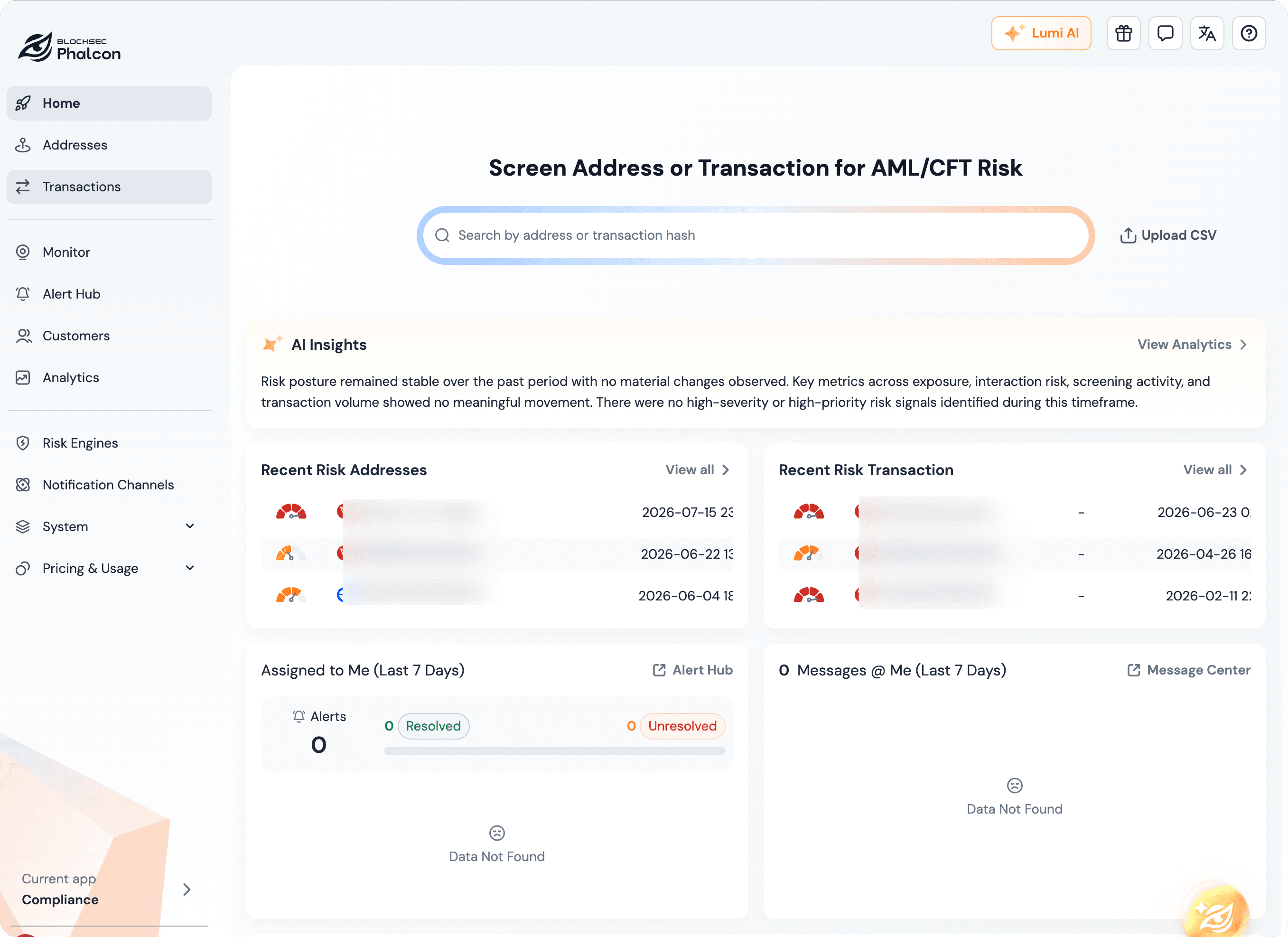
The Freeze Checker is the correct tool for a one-off spot check. Once your desk quotes more than a handful of tickets per day, the Phalcon Compliance web UI is the natural next step: paste a single counterparty address into the top search bar, or upload a CSV of the day's payout / deposit wallets, and get the AML/CFT risk verdict, current freeze status, and the address's recent risk context in one dashboard. The Home view also surfaces the Recent Risk Addresses and Recent Risk Transactions the desk has touched, so a compliance operator can eyeball the day's flow without leaving the screen. Pricing is pay-as-you-go, so a quiet week costs quiet-week rates and only spikes when ticket volume does; when volume outgrows the web UI, the same account exposes an API + webhook feed for programmatic integration.
2.3 The 5-second SLA for OTC screening
Your screening SLA is bounded by the customer conversation, not the technology. When a counterparty says "sending USDT now, wire the EUR," you have roughly five seconds of natural conversation latency to get an answer before the desk operator credits, holds, or declines. Anything slower creates one of two failure modes:
- You credit before you screen: compliance risk lands on your desk if the address is flagged.
- You wait to screen, and the customer waits with you: friction shows up in the next ticket routed to a faster desk.
Full API screening with sub-second lookups is the only path that hits this SLA at production volume. A cached in-memory blacklist copy, backed by a real-time API for cache-miss addresses, is the standard architecture.
2.4 Sample screening policy template
A minimum viable OTC screening policy fits on one page:
1. Screen every counterparty deposit address at quote and
   re-screen at settlement.
2. Screen every counterparty payout address before the send
   transaction is signed.
3. Tools: Phalcon Compliance API.
4. Result "flagged": decline the ticket. No credit, no payout.
   Escalate to Head of Compliance.
5. Result "clean, prior flag history": hold for secondary
   review. May proceed with enhanced KYC and a risk memo.
6. Result "clean, no history": proceed normally.
7. Log every result with timestamp, ticket ID, address, and
   tool response. Retain for 5 years.
The retention window matches most AML record-keeping requirements (5 years under 31 CFR 1010.430 for the US BSA, and the minimum in most FATF-aligned regimes via Recommendation 11). Verify against your local reg before adopting.
Real-time monitoring: catching freezes on your desk's flow
Screening at transaction time is necessary but not sufficient. The bigger operational risk is an address you already accepted getting frozen after the fact. Every hot wallet, counterparty payout wallet, and customer withdrawal address on your book is a monitoring surface.
3.1 What to monitor
- All hot wallets you control (deposit, settlement, treasury). If any get flagged, desk operations halt.
- All counterparty payout addresses on active tickets: an outbound send in-flight becomes an incident if the destination is flagged.
- All counterparty deposit addresses from the last 30 days: post-deposit freezes can still be actioned (hold fiat, notify counterparty, open a case) if you catch them.
- All customer withdrawal addresses paid out in the last 90 days: reputation and reporting surface.
3.2 Alert triage: N alerts per day into K actions
At current market cadence, the Tracker shows 10 new freezes landed in the last 24 hours across both chains, and the Report Archive puts the first half of 2026 at 2,116 Tron freezes freezing $1.58B. Most will not touch your book. Turn 10 daily events into the 0-2 that matter:
- Address-match filter: event address must be on your monitored set. Drops 99%+ of events.
- Risk scoring: score by proximity to active tickets, wallet type (hot vs. cold), and time since last transaction.
- Deduplication and case linking: related events on the same counterparty roll into one case.
- Human queue: only residual events land in front of a compliance operator, with context pre-populated.
The multisig delay window matters. Tether's owner is a multisig with a delay between transaction proposal and execution, visible on public data. A subset of watched addresses have empirically used the window to move USDT before the freeze lands. The Archive documents proposals executed against addresses whose balances had already moved. Watch for the proposal transaction; the executed freeze is a lagging signal.
3.3 Real-time monitoring at production scale
Phalcon Compliance's monitoring API covers this workload directly: address-book upload, webhook subscription to blacklist events on Ethereum and Tron, and case management for alerts that clear triage. Pay-as-you-go pricing scales with the monitored set.
Post-freeze response playbook
When the alert fires, the next 15 minutes decide whether the incident becomes a $500K loss or a documented case with a defensible response. Five stages:
4.1 Immediate actions (first 15 minutes)
- Freeze the derivative fiat leg: if the counterparty was owed fiat that has not wired, put the wire on operational hold.
- Notify Head of Compliance and CEO: above a documented dollar threshold, freeze events get an immediate two-person notification.
- Preserve evidence: save the freeze transaction hash, block number, proposal number (if via Tether's multisig), and every internal message log on the counterparty.
- Do not communicate with the counterparty yet: confirm the fact pattern first.
4.2 Legal and regulatory
Obligations vary by jurisdiction, but the common set:
- US desks: SAR filing via FinCEN within 30 days (per 31 CFR 1022.320), referencing the freeze transaction hash and counterparty KYC file.
- EU desks: MiCA notification and, depending on member state, a national FIU report. Most FIU regimes want notice within 24-72 hours.
- UK desks: Suspicious Activity Report to the NCA under the "as soon as practicable" standard (POCA 2002, Part 7).
- Hong Kong desks: under the HK Stablecoins Ordinance (effective August 1, 2025) and the broader AML/CFT regime, notification to HKMA and the JFIU is required for stablecoin-linked incidents.
Filing capacity is a compliance-program precondition, not a during-incident scramble. If your team cannot file a SAR the same day, you have a gap.
4.3 Customer communication template
Once the fact pattern is confirmed and legal has cleared outbound communication, the note is short and factual:
Subject: USDT deposit [ticket ID] – compliance hold

We received an on-chain notification that the address for your
recent USDT deposit ([address]) has been flagged on the USDT
contract. Under our compliance policy, we are holding the
corresponding fiat payout pending review.

Status update within [3 business days]. If you have
documentation on source of funds or the flagging event,
forward to compliance@[desk].com.

We cannot release the fiat payout until review is complete.
Depending on the outcome, we may be required to report the
incident to the applicable financial regulator.
Keep it factual, avoid speculation, and only commit to a timeline you can honor. Every sentence is one your legal team could defend in a deposition.
4.4 Recovery: the 3.6% odds
If your desk holds the flagged address (post-deposit freeze on a wallet you control), the three-path unfreeze process applies: direct petition to Tether, legal challenge in an appropriate jurisdiction, or in US forfeiture cases, an innocent-owner defense. Realistic 2025 baseline: 3.6% removed by year-end, median 18.2 days for the subset removed. Plan for the loss while pursuing recovery. Full decision matrix: How to Unfreeze a USDT Address.
If the flagged address is the counterparty's and your desk never took custody, recovery is not your problem, but documenting the interaction is. Your compliance file is the artifact regulators will ask for.
4.5 Post-mortem and root-cause
Every incident closes with a written post-mortem: how the flagged address reached your book, what screening step should have caught it, and what changes prevent recurrence. Most OTC freeze incidents trace to one of a few gaps: no re-screening at settlement, no monitoring on prior counterparty addresses, or a delayed webhook that fired after the payout was sent. Each has a known fix.
Live snapshot: what OTC desks face today
From the Tracker and Report Archive, as of July 26, 2026:
| Metric | Value |
|---|---|
| Total USDT frozen (all-time, all chains) | $5,685,941,960 |
| Blacklisted addresses (all chains) | 9,597 |
| New freezes in last 24 hours | 10 |
| Frozen on Tron | $3,709,576,603 (6,901 addresses) |
| Frozen on Ethereum | $1,976,365,356 (2,696 addresses) |
| 2026 H1 Tron freezes | 2,116 addresses / $1.58 billion |
Two observations for OTC compliance:
- Tron dominates OTC-relevant risk: the first half of 2026 saw 2,116 Tron freezes freezing $1.58B versus a fraction on Ethereum. TRC-20 USDT concentration is visible directly on-chain via the Tronscan USDT dashboard versus the Etherscan USDT contract. Ethereum-only monitoring misses the majority of the freeze surface.
- Freeze cadence is steady, not episodic: 10 freezes per day is a typical day on the Tracker. Compliance programs sized to a quarterly-incident calendar are structurally under-resourced.
Compliance program checklist
A one-page audit for OTC compliance leads. Tick each item honestly:
- [ ] Pre-transaction screening for every counterparty deposit and payout address, at quote and settlement.
- [ ] Screening SLA under 5 seconds at production volume, measured monthly.
- [ ] Monitored address book covers hot wallets, active-ticket payouts, last-30-day counterparty deposits, last-90-day customer withdrawals.
- [ ] Post-freeze SOP written and rehearsed with a defined first-15-minutes action set.
- [ ] SAR / FIU filing capacity in-house or via retained counsel, with a same-day filing SLA.
- [ ] Customer communication template approved by legal.
- [ ] Multisig-delay-window monitoring for early warning on proposals versus executed freezes.
- [ ] Case-management system with per-incident audit trail retained at least 5 years.
- [ ] Operational loss reserve sized against a plausible single-incident scenario (e.g., 3x median freeze size).
- [ ] Annual policy review aligned with regulatory changes (HK Stablecoins Ordinance, MiCA, and the US GENIUS Act).
If more than two boxes are unchecked, close the gaps before the next quarterly compliance review.
Frequently asked questions
How fast can an OTC desk realistically screen a deposit address? With an API-based screening service, sub-second per address is standard. End-to-end SLA (address received to answer surfaced to the desk operator) should sit under 5 seconds at production volume. Manual checkers work for one-off tickets, not desk-level throughput.
What happens if we credit USDT and it gets frozen the next day? The balance becomes non-transferable. You still owe your customer the fiat leg. Realistic odds are covered in the full unfreeze guide. Tether's Token Recovery process is the formal channel. Plan for the loss and pursue recovery in parallel.
Do we need to file a SAR every time an address on our book gets flagged? Jurisdictional. In the US, per 31 CFR 1022.320, a SAR is required for transactions involving funds derived from illegal activity, intended to evade BSA requirements, or with no apparent lawful purpose. A freeze on an incoming address is a strong indicator that at least one test is met, and most US compliance teams file. When in doubt, file.
Is monitoring both Ethereum and Tron necessary? Yes. Tron accounts for roughly 72% of blacklisted addresses and 65% of frozen value as of mid-2026 (6,901 of 9,597 addresses, $3.71B of $5.69B), and the first half of 2026 saw 2,116 Tron freezes. Ethereum-only monitoring misses the majority of the risk surface.
How much does an OTC-grade compliance stack cost? Varies by volume and build-vs-buy. Phalcon Compliance's pay-as-you-go pricing scales with usage. Against a single frozen incident wiping months of desk margin, the stack line item is small.
Related reads
- USDT Freeze: The Complete 2026 Guide
- How to Check If a USDT Address Is Frozen
- How to Unfreeze a USDT Address
- How Tether Burns USDT and Reissues to Victims
- BlockSec Freeze Report Archive
- $1.26B Frozen: 2025 Blacklisting Analysis
About the author

Andy is co-founder of BlockSec. BlockSec builds MetaSleuth, Trace AI, and Phalcon Compliance. He is also an Associate Professor at The Chinese University of Hong Kong, where his research focuses on system and blockchain security. Personal homepage: yajin.org.
Follow: X / Twitter · LinkedIn