Can USDT be unfrozen? Short answer: Yes, but rarely — only about 3.6% of the addresses Tether blacklisted in 2025 were later unfrozen (roughly 150 of 4,163). For that small share, the median gap between freeze and unfreeze was 18.2 days. Three paths exist to pursue an unfreeze: (1) a direct petition to Tether, (2) a jurisdiction-of-choice legal challenge, and (3), for US federal seizures, an innocent-owner defense under 18 U.S.C. § 983.
Yes, a frozen USDT address can be unfrozen when Tether calls removeBlackList(address) on the USDT smart contract, which emits a RemovedBlackList event on-chain and restores the address's ability to send, receive, and transfer USDT. But the practical odds are low: BlockSec's 2025 blacklisting report tracked only about 3.6% of blacklisted addresses as removed that year, with a median 18.2 days between freeze and unfreeze for the subset removed. Every other unfreeze happens on a longer timeline, and most freezes are never lifted at all.
Three real paths exist to pursue an unfreeze: (1) a direct petition to Tether with KYC and transaction evidence via Tether Token Recovery, (2) a legal challenge to Tether Ltd. in a chosen jurisdiction, and (3), for US freezes tied to civil forfeiture, an innocent-owner defense in federal court. Which path fits depends on why your address was frozen and whether the underlying reason (a sanctions match, a law-enforcement request, a Tether risk-model flag) is resolvable in the first place.
This guide walks the mechanic on-chain, the three paths in detail, the honest odds, the canonical unfreeze case (Poly Network, August 2021), and what to actually do if the frozen address is yours, or if it isn't.
For the companion mechanic (destroyBlackFunds, the burn function that Tether often pairs with a fresh mint to a victim address), see How Tether Burns USDT and Reissues to Victims.
Can a frozen USDT address really be unfrozen? The short answer
Yes, and it happens more often than most people assume, but the odds are still small. About 3.6% of the addresses Tether blacklisted in 2025 were later unfrozen. Roughly 150 addresses out of the 4,163 blacklisted that year returned to normal transferability by year-end. That is small in percentage terms; it is not zero.
Whether your specific address gets unfrozen is downstream of three questions:
- Why was it frozen? A freeze tied to an OFAC designation behaves very differently from a scam-cluster flag from Tether's internal models. Reasons that resolve (an OFAC de-listing, a case closed without charges, a mistaken sanctions match) can trigger an unfreeze. Reasons that don't resolve typically don't.
- Is the underlying reason resolvable at all? If the address is on the OFAC SDN List and OFAC has not de-listed it, no direct petition to Tether will help, the freeze is downstream of the government designation, and the designation has to change first.
- Which path do you pursue? The three paths below have very different cost structures, timelines, and success profiles. Picking the wrong one can burn a year of legal fees on a strategy that had no chance.
The honest headline: plan for the loss while pursuing recovery. A single-digit removal rate means unfreeze cannot be your compliance strategy. It is a legitimate path when the facts fit, but it is not a plan.
The mechanic: how removeBlackList works on-chain
The unfreeze function is real and publicly visible on Tether's Ethereum USDT contract. Tether has called it on hundreds of addresses since 2017, all indexed on the BlockSec USDT Freeze Tracker. Understanding what it does, and does not do, is the foundation for every decision downstream.
The code
Here is the actual function from the deployed USDT contract on Ethereum (0xdAC17F958D2ee523a2206206994597C13D831ec7):
function removeBlackList (address _clearedUser) public onlyOwner {
    isBlackListed[_clearedUser] = false;
    emit RemovedBlackList(_clearedUser);
}
Three things to note:
onlyOwner: only the contract's owner address, Tether's multisig, can call it. No court, regulator, exchange, or DAO can force this at the contract layer.isBlackListed[_clearedUser] = false, the change is a single storage-slot flip. The address moves fromtruetofalsein Tether's on-chain mapping.emit RemovedBlackList(_clearedUser), the event fires immediately, and every indexer (Etherscan, Tronscan, the Tracker) picks it up in real time.
The naming (_clearedUser versus _evilUser in the freeze function) reflects the contract authors' 2017 framing of the mechanism as punitive in one direction and rehabilitative in the other. The variable names have been part of the on-chain record since deployment.
What changes after the unfreeze
The instant the transaction confirms:
- Balance transferability is restored. The USDT at the address becomes sendable, receivable, and transferable again. Transfers involving the address no longer revert.
- Tokens are intact. Nothing was destroyed. If the address held 4,745,173 USDT before the freeze, it holds the same amount after. This is the crucial difference from destroy, which permanently burns the balance.
- The on-chain flag flips to false. Any wallet or explorer querying the contract reports the address as clean again.
There is no "partial unfreeze": the flag is cleared or it isn't. There is no per-amount unfreeze primitive in the USDT contract source.
On-chain visibility
Because the unfreeze event is emitted publicly, every unfreeze is a searchable, auditable record. Compliance teams can subscribe to the event stream and build historical audit trails: which addresses were unfrozen, when, and (by correlating with the earlier freeze event) how long the freeze lasted. The Tracker surfaces the event stream on a public dashboard; Etherscan and Tronscan index the event on the USDT contract's event log.
The three paths to unfreeze
There are three realistic paths to pursue an unfreeze, each with different odds, costs, and timelines. Which path fits depends on the reason for the freeze and the jurisdiction of the parties involved.
Path 1: Direct proof to Tether
The most straightforward path is a direct petition to Tether. The owner (usually via counsel) submits KYC documentation and transaction evidence through Tether's official compliance channel (the Information Requests team for law-enforcement or theft-related matters, Tether Support for general recovery), arguing that the freeze was mistaken or that the underlying reason has resolved.
- How it works: you (or your lawyer) submit a package containing identity documentation for the address owner, transaction history showing legitimate provenance of the USDT balance, and a legal argument for why the freeze should be reversed. Tether's compliance team evaluates the package internally.
- Time: weeks to months. Straightforward cases resolve fastest; complex cases can drag on considerably longer.
- Success profile: only if the underlying reason has been resolved (OFAC de-listing, criminal case closed without charges) or if you can affirmatively demonstrate innocent ownership with clean documentation. Individual petitions submitted without counsel rarely succeed at scale; Tether receives many such requests and defaults to caution.
- Cost: legal fees for preparing the package are the main line item; expect a compliance-attorney engagement, not a nominal filing fee. Tether itself does not charge for evaluating an unfreeze request. Ask any firm for a scoped estimate before engaging.
- Authority: Tether's evaluation is at "sole and absolute discretion" per its published Tether Token Recovery policy. There is no formal right of appeal within Tether's process.
Path 2: Legal challenge in a chosen jurisdiction
When Path 1 fails or when the facts don't support a direct petition, the second path is to file a lawsuit against Tether Ltd. Jurisdiction strategy matters as much as the underlying facts.
- Jurisdictions: Tether relocated to El Salvador in January 2025 after previously being registered in the British Virgin Islands, with prior operations across Hong Kong and other financial centers. Direct suit against a stablecoin issuer typically leans on the EU's MiCA framework rather than home-jurisdiction commercial litigation, and cross-border service alone can add months to any timeline.
- Time: long. Often a year or more to a first substantive decision, and cross-border service adds months on top.
- Cost: substantial. Full-scope litigation against a stablecoin issuer runs into legal fees at the scale you would expect for international commercial litigation. Most matters settle before trial, but even settlement negotiations require substantial preparation. Get a scoped estimate before committing.
- Success profile: best when Tether has already declined a Path 1 petition AND you have strong documentary evidence of innocent ownership. Rarely succeeds without both.
Path 3: US federal-forfeiture innocent-owner defense
If the freeze is part of a US federal civil forfeiture proceeding, because the government is trying to seize the funds through the courts, you have a specific procedural path under US law: the innocent-owner defense codified in 18 U.S.C. § 983(d).
- How it works: you must prove by a preponderance of the evidence that you either (a) did not know the property was subject to forfeiture, or (b) did all that reasonably could be expected to terminate the illegal use, under the statutory prongs codified at 18 U.S.C. § 983(d). In practice, this means demonstrating that you purchased the tokens "for value without knowing the funds were tainted."
- Trigger: a successful innocent-owner defense results in the federal agency dropping its forfeiture claim and, in practice, instructing Tether to unfreeze the address.
- Documented cases: federal civil forfeiture requires the government to establish a nexus between the property and the underlying offense; where the tracing evidence is thin or misattributes downstream innocent transfers, the DOJ civil forfeiture guidance directs prosecutors to dismiss or decline. In practice this is the pattern most day-to-day federal forfeiture defenses rely on: not headline wins, but rescissions on nexus-failure or tracing-error grounds.
- Time: many months to over a year from petition to resolution, depending on court schedule and case complexity.
- Cost: mid five- to six-figure legal fees are typical for a fully-defended case. Free consultations are available from many firms in this area; use them to scope both cost and viability before committing.
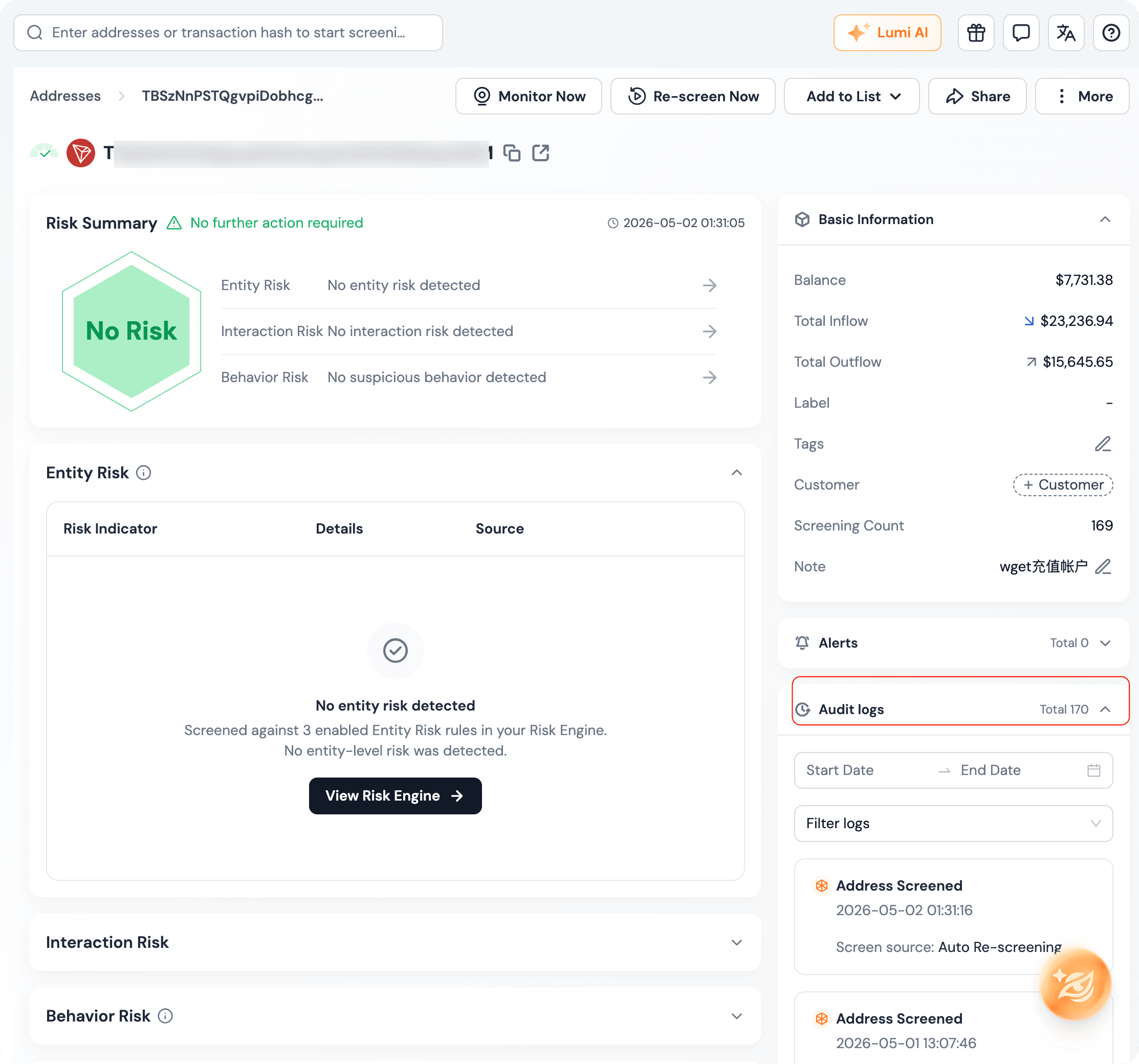
Contemporaneous AML-screening records make or break the innocent-owner argument. A dated Phalcon Compliance check run at the time of receipt (showing the address was clean by then-current signals) is documentary evidence that you did all that reasonably could be expected. Without the record you are arguing pure inference; with it you have a paper trail of due diligence.
When each path fits
The paths are not interchangeable. Picking the wrong one is expensive:
| If your freeze reason is… | Best path |
|---|---|
| A tracing error or innocent-owner claim tied to a US federal case | Path 3 (federal-forfeiture innocent-owner defense) |
| A jurisdictional or non-US innocent-owner claim | Path 2 (legal challenge, jurisdiction-first strategy) |
| A resolvable sanctions match (delisting has been granted) | Path 1 (direct Tether petition after the delisting) |
| A pending investigation with no clear timeline | Wait; pursue Path 1 after the investigation concludes |
| A confirmed OFAC designation that has not been lifted | No viable path until OFAC de-lists |
Do not DIY on Path 2 or Path 3. Both require substantive legal work (filings, discovery, expert declarations) that non-lawyers cannot execute effectively. Path 1 (a Tether Token Recovery petition) can be attempted without counsel but success rates are much lower than with representation.
Realistic odds and timelines
The temptation, when your USDT is frozen, is to reach for hope. The honest data pushes the other way: unfreeze is possible, it is not likely, and the median case takes weeks.
The 3.6% removal rate
From BlockSec's 2025 USDT blacklisting research:
- Of 4,163 addresses Tether blacklisted in 2025, approximately 150 (~3.6%) were removed by year-end. Read this as a same-period flow ratio (removals booked in 2025 divided by freezes booked in 2025), not a strict cohort-survival number: some of 2025's removals apply to addresses first blacklisted in earlier years.
- The removal proportion has stayed in single digits year over year, even as blacklist volume itself has escalated. 2025 was a record-breaking year for freezes, but removals stayed near the base rate; enforcement scaled while reversals did not.
- The rate is aggregate. It mixes fast unfreezes of clear tracing errors with slow resolutions of sanctions cases and freezes that will never be lifted.
The 18.2-day median
For the subset removed, the median time from freeze to unfreeze was 18.2 days. The distribution is wide:
- Fastest: ~2 days. Typically law-enforcement error corrections: flagged in error, caught quickly, cleared without a full compliance review.
- Middle: 15–45 days. Most direct Tether petitions that succeed land in this window.
- Longest: 100+ days. Cases requiring legal proceedings or jurisdiction-specific resolution before Tether will act.
What the numbers mean practically
- Plan for the loss while pursuing recovery. Do not model unfreeze as a business-continuity plan. If your workflow depends on those tokens returning, the workflow is under-hedged.
- Don't rely on unfreeze as a compliance strategy. For teams handling other people's USDT, post-freeze recovery is not a substitute for pre-transaction screening. See USDT Freeze: The Complete 2026 Guide for the pre-freeze playbook.
- Treat any "unfreeze service" promising >20% success as a scam signal. Tether's process is not gameable. No external party has back-channel access to the owner-only multisig. If the pitch beats the observed rate by 5×, the pitch is the tell.
Case study: Poly Network, August 2021, the canonical unfreeze
The Poly Network hack of August 2021 remains the canonical unfreeze case. After the attacker returned all other assets voluntarily, Tether unfroze the address holding $33.4M USDT and released the funds back to Poly Network's multisig, 15 days after the initial freeze. It is the cleanest publicly-documented example of the full unfreeze mechanic operating at scale.
The timeline
August 10, 2021. Poly Network, a cross-chain interoperability protocol, was exploited for approximately $610 million across Ethereum, BNB Chain, and Polygon, one of the largest DeFi hacks recorded at that point. Within hours, Tether CTO Paolo Ardoino publicly announced Tether had frozen 33,431,200 USDT on the attacker's Ethereum address as an emergency response.
August 10-25, 2021. In an unusual turn, the attacker (whom the community called "Mr. White Hat") began returning stolen assets voluntarily. Over the following days, the attacker sent back the ETH, BNB, and other assets that had not been frozen. In on-chain messages, the attacker cited the frozen USDT as one reason for delay in fully returning everything, the USDT could not be moved back until Tether reversed the freeze.
August 25, 2021. With all other assets returned and Poly Network confirmed as the rightful recipient, Tether executed the unfreeze on the flagged address, and the 33,431,200 USDT was sent back to Poly Network's designated multisig. Full recovery of the $610M attack was complete.
Why this worked, and why it's not repeatable at scale
Three conditions aligned that rarely align:
- Full cooperation from the attacker. Ownership of the frozen USDT was uncontested: everyone agreed it belonged back with Poly Network.
- Clear rightful ownership. Poly Network was a well-known, publicly-identified protocol with a designated multisig. Tether had no doubt about where the funds should go on release.
- Fast verification. Because the facts were uncontested, Tether's compliance procedures completed in about two weeks. No litigation, no forfeiture proceeding, no jurisdictional dispute.
Most unfreeze cases have none of these. Attackers do not usually cooperate; rightful ownership is usually contested across exchanges, users, and counterparties; and the full $610M recovery was possible only because the attacker chose it, the freeze alone touched $33M of that. The Poly Network case shows the mechanic operating cleanly. It should not be read as evidence that most freezes end in unfreeze. Most do not.
What to actually do if your USDT address is frozen
If you've read this far and your address (or an address you handle) is currently frozen, here is the operational sequence.
Step 1: Verify the freeze
Confirm the freeze on-chain. Do not act on a rumor or a screenshot. The fastest way is the BlockSec USDT Freeze Checker: paste the address, get a yes/no answer plus the freeze date. For alternative methods (direct queries against the USDT contract on Etherscan or Tronscan via isBlackListed(address)), see our companion guide on how to check if a USDT address is frozen.
Step 2: Figure out WHY
This is where most reader-facing content stops. It shouldn't. The reason for the freeze governs which path (if any) has a chance:
- Cross-reference public sanctions lists: check the address against OpenSanctions and the OFAC SDN List. A hit means the freeze is downstream of a government designation, and the designation must change before Tether will act.
- Check for entity clustering, for manual analysts, MetaSleuth can show whether the frozen address is clustered with known scam, ransomware, or terror-financing entities. That context matters for the legal strategy.
- If nothing matches publicly, the freeze likely originates from Tether's internal risk models, and there's no way to know the specific trigger without a formal Tether inquiry.
Step 3: Pick the right path
Return to the decision matrix above. The reason for the freeze plus your jurisdiction plus your evidence quality determines Path 1 vs Path 2 vs Path 3 vs "wait."
Step 4: Engage counsel early
Do not DIY on Path 2 or Path 3. Both require professional legal work. Path 1 (a Tether Token Recovery petition) can be attempted without counsel, but success rates are dramatically higher with representation. Budgets scale with path complexity. Path 1 is the least expensive (compliance-attorney petition prep), Path 2 the most expensive (full international litigation), Path 3 in between (federal court defense). The baseline observed removal rate applies regardless of path. Many firms in this space offer free consultations; use them to sanity-check both cost and viability before committing spend.
Step 5: If you're the victim, not the frozen party
A common confusion worth clearing up. If your USDT was stolen from you and now sits at a frozen address (because Tether flagged the thief's wallet), you are not pursuing an unfreeze. You do not own the frozen address; the thief does. Even if unfreeze succeeded, funds would return to the thief's control, not yours.
The correct path for the victim is reissue via Tether's official recovery process (recovery requests accepted for amounts >$1,000, fee up to 10% or $1,000, whichever is greater). Tether will typically destroy the tokens at the thief's address and mint an equivalent amount to a victim- or court-designated address. See How Tether Burns USDT and Reissues to Victims for the full mechanic.
Whichever recovery track you pursue, evidence quality decides speed and outcome. Tether and law enforcement both need the same thing: a clean, referenceable trace from the theft address to the current holder(s), with entity attribution where possible. Running that trace yourself with Trace AI or MetaSleuth turns raw on-chain data into a report you can attach to a Tether Token Recovery petition, a police filing, or an SAR. For high-stakes cases (six-figure-plus losses, contested provenance, or complex mixer / bridge routing), engage a professional forensics firm. BlockSec's incident response team runs full attribution against real cases, and a professionally-produced report typically carries more weight in a Tether or law-enforcement review than a self-produced timeline.
A warning about "unfreeze services"
There is an entire cottage industry of scams targeting people whose USDT has been frozen. The pattern is predictable: an operator finds a public discussion of a frozen address (Reddit, Twitter, a Telegram support channel) and reaches out claiming to be able to unfreeze it for a fee, typically 10-20% of the frozen amount, paid upfront.
No external party can modify Tether's blacklist. The three enforcement functions (freeze, unfreeze, destroy) are all owner-only, restricted to Tether's multisig. There is no back door, no exploit, no "insider contact," no jurisdiction where you can pay a service to route around the process. Any promise otherwise is a scam.
Legitimate legal counsel will not promise a specific outcome, will not ask for a percentage of the frozen amount as an upfront fee, will charge standard billable-hours or a flat fee for defined work, and will walk you through the realistic single-digit odds and the specific path they intend to pursue. If someone contacts you claiming they can unfreeze your USDT for a fee, report them to your local financial regulator, to the exchange (if applicable), and to Tether's Information Requests team.
Frequently asked questions
Can any frozen USDT address be unfrozen?
Technically yes: Tether can call removeBlackList on any blacklisted address. Practically, only about 3.6% of 2025-blacklisted addresses were unfrozen by year-end. Whether yours will be depends on the reason for the freeze and whether that reason is resolvable.
How long does the unfreeze process take? Median for successful cases is 18.2 days. Fast cases (law-enforcement error corrections) resolve in about 2 days; complex cases involving legal proceedings can take 100+ days. Most freezes are never lifted at all.
Can I unfreeze a USDT address by contacting Tether directly? Yes, via Path 1: a direct petition to Tether's Information Requests team with KYC and transaction evidence. Individual petitions without counsel rarely succeed; petitions supported by legal representation succeed more often. Evaluation is at Tether's "sole and absolute discretion."
Are there "unfreeze services" I can pay to help?
Not legitimate ones. removeBlackList is owner-only, restricted to Tether's multisig. No external party has back-channel access. Any service promising to unfreeze a USDT address for an upfront percentage fee is a scam. Legitimate legal counsel can pursue Paths 1, 2, or 3, but no lawyer can guarantee an outcome.
What's the difference between unfreeze and burn-and-reissue?
Unfreeze (removeBlackList) reverses the freeze; the same tokens at the same address become transferable again. Burn-and-reissue (destroyBlackFunds plus a fresh mint) permanently burns the tokens at the flagged address and mints an equivalent amount to a court- or victim-designated address. Unfreeze is for the frozen party; burn-and-reissue is for the victim of theft. See How Tether Burns USDT and Reissues to Victims.
Does Tether ever unfreeze OFAC-designated addresses? Not while the OFAC designation is active. Tether's freeze in an OFAC case is downstream of the government designation: OFAC has to de-list the address first. When OFAC de-listings happen (as with the 2025 Tornado Cash de-listing), Tether processes the corresponding unfreezes.
Related reads
- USDT Freeze: The Complete 2026 Guide
- How Tether Burns USDT and Reissues to Victims
- How to Check If a USDT Address Is Frozen
- The USDT Blacklist, Explained (2026)
About the author

Andy is co-founder of BlockSec. BlockSec builds MetaSleuth, Trace AI, and Phalcon Compliance. He is also an Associate Professor at The Chinese University of Hong Kong, where his research focuses on system and blockchain security. Personal homepage: yajin.org.
Follow: X / Twitter · LinkedIn