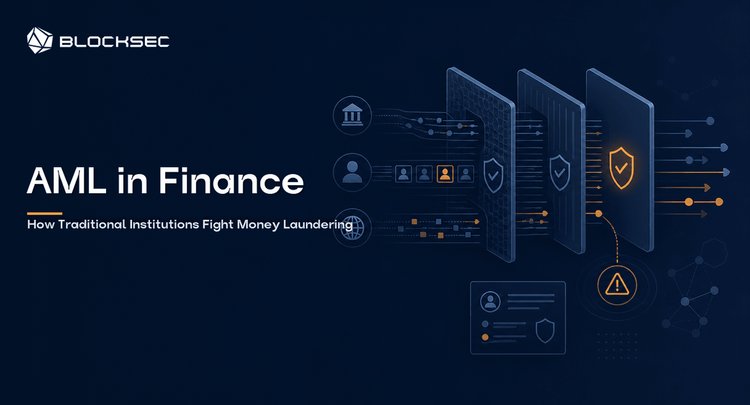
A new account opens on a Monday, clears onboarding, and by Friday the customer is moving funds in a pattern that has nothing to do with the stated business. The bank's AML program turns that pattern into a finding or misses it. AML in banking is a compliance program of onboarding identity checks, transaction monitoring, and suspicious reports that every regulated bank must run. The on-chain edge of that program is covered in the AML hub.
KYC at Account Opening
The program starts at the door. Before a bank opens an account, it establishes the customer's identity, beneficial ownership, and the nature of the business: a legal obligation, not a courtesy.
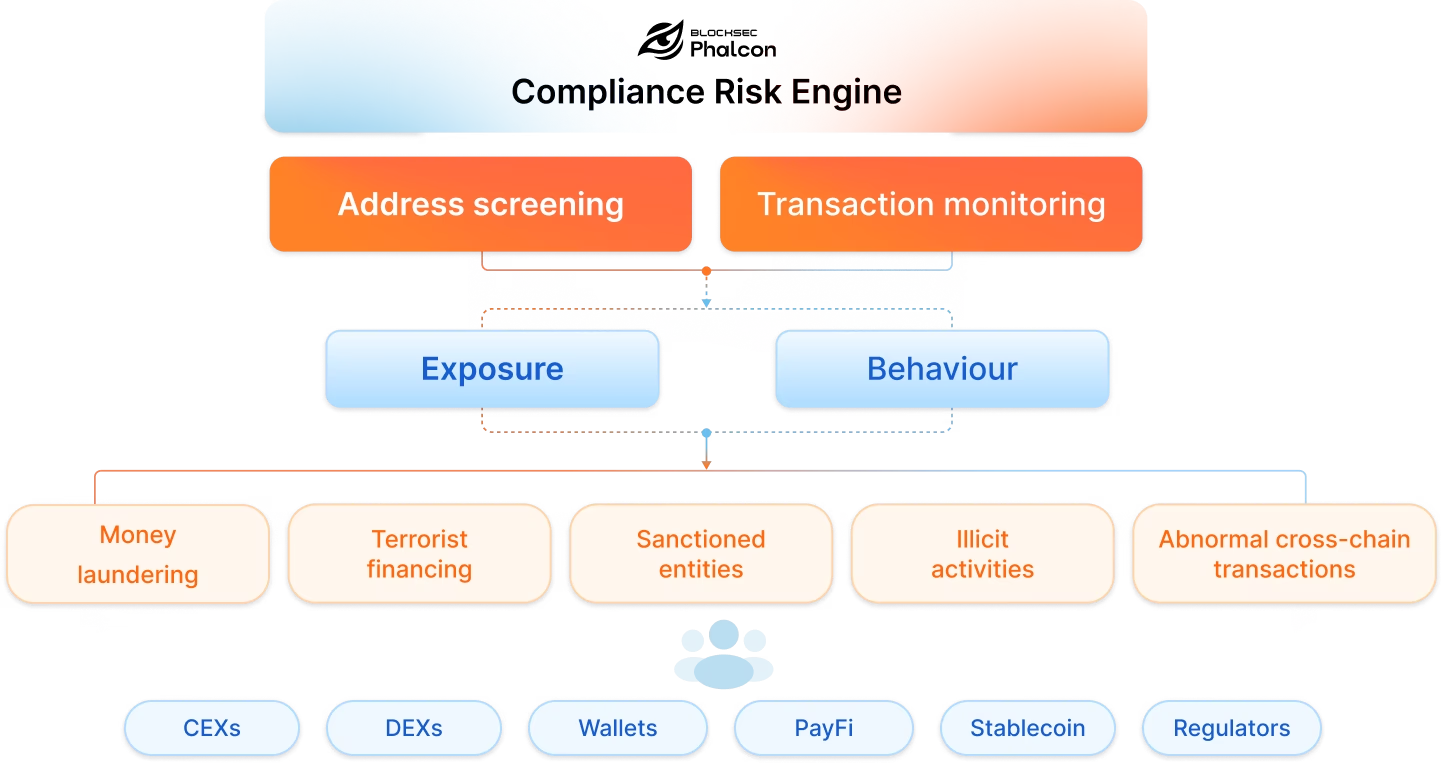
Banking AML begins with KYC at account opening, then applies risk-based monitoring and suspicious activity reporting across customer activity. FinCEN frames the risk onboarding due diligence exists to reduce. BlockSec does not provide KYC identity verification; Phalcon Compliance screens crypto addresses and transactions instead.
Transaction Monitoring
Once the account is open, the program watches it. Bank rule sets are tuned to the typologies examiners test: structuring deposits just under the currency transaction report threshold, rapid pass-through between newly opened accounts, and payroll accounts repurposed for third-party flows. Thresholds need tuning: too low floods the queue, too high lets risk pass. The generic monitoring-to-reporting loop every regime shares is covered in AML in Finance; what follows here is what banking adds. The European Banking Authority sets the AML/CFT expectations these programs are built against.
Filing Suspicious Activity Reports
When monitoring surfaces a confirmed pattern, the finding becomes a suspicious activity report. A bank generates the draft and submits it, the obligation sitting with the bank, not the tool. For the on-chain counterpart, Phalcon Compliance screens the address side; see What Is KYT? Crypto Transaction Monitoring Hub. A banking AML program lives on documented policies, so banks review their monitoring rules and filing procedures on a regular schedule.
A Risk-Based Approach
The alternative, a static program written once and left alone, is the version regulators fail. Examiners ask for the risk assessment first, then test whether account activity, alert handling, and filings trace back to it.
| Risk level | Typical customer | Due diligence depth |
|---|---|---|
| Low | Publicly listed firms, low-risk jurisdictions | Simplified: identity and purpose at onboarding, standard monitoring |
| Standard | Ordinary retail and corporate accounts | Standard: full KYC, periodic identity refresh on a fixed cycle |
| High | Complex structures, high-risk jurisdictions, crypto-linked | Enhanced: source-of-funds and source-of-wealth, senior approval, more frequent refresh |
The tier differences are operational, not adjectives. Enhanced due diligence adds source-of-funds and source-of-wealth evidence, senior-management approval to keep the relationship, and a shorter refresh cycle for identity documents; simplified due diligence is justified in writing, not assumed. A customer can move between tiers as its profile changes, and the file must show when and why. The on-chain AML screening layer feeds the crypto-linked tier.
The risk-based approach allocates effort where the risk is, and it is written down so the reasoning survives a review. Policies, thresholds, and filing procedures get re-examined on a schedule because the threats they were written for change. In banking that cadence is anchored to the exam cycle. Model tunings and threshold changes are logged, dated, and tied to the risk assessment, so the next examination can trace every tuning decision to a documented reason.
Book a demo of Phalcon Compliance and screen the crypto-linked edge of your customer base in one pass; the crypto compliance software guide maps how the on-chain layer extends a bank program.
FAQ: AML Banking
What is AML in banking?
It is a compliance program of onboarding KYC, transaction monitoring, and suspicious activity reporting that every regulated bank must operate.
Is KYC required for banks?
Yes. Banks must verify customer identity at account opening; the check is a legal obligation and the anchor for the rest of the program.
How often should a bank review its AML program?
On a regular schedule, following a risk-based approach. Policies, monitoring rules, and filing procedures are re-examined because the threats change.
Does BlockSec do banking KYC?
No. KYC identity verification is the bank's own function. The platform screens the crypto-address side of a bank's customer base; the identity file and its refresh cycle stay with the bank.