The integration of digital assets into traditional financial frameworks has required institutions and Virtual Asset Service Providers (VASPs) to adjust their operational baselines. As on-chain transaction volumes scale, relying on reactive measures proves insufficient for managing illicit finance risks. Organizations are shifting toward systematic anti-money laundering (AML) monitoring to secure their transaction flows. Current digital asset frameworks require specific technical capabilities, such as cross-chain fund tracking and automated suspicious activity report (SAR) generation, to meet regulatory mandates. Operating without adequate risk mitigation infrastructure introduces measurable operational friction and potential financial liabilities. This guide reviews the current regulatory environment and outlines the necessary software architecture for maintaining an audit-ready compliance program within decentralized finance.
Decoding Global Regulations: The Need for Compliance
As regulatory bodies enforce updated guidelines, VASPs and financial institutions must adapt to evolving AML mandates. Mapping these operational requirements is necessary for managing institutional risk, securing licenses, and preventing compliance-related penalties.
Navigating FATF AML/CFT Mandates for Virtual Assets
The Financial Action Task Force (FATF) has iteratively updated its recommendations to encompass virtual assets, fundamentally altering standard VASP operations. Its Recommendation 15 and the accompanying guidance on virtual assets establish a clear baseline: VASPs must implement risk-based AML and Combating the Financing of Terrorism (CFT) programs that are proportionate to the nature and scale of their operations. With on-chain data indicating substantial volumes of illicit digital asset transfers in 2023, regulators are prioritizing strict AML/CFT enforcement across all licensed entities.
Functional compliance under FATF requires VASPs to conduct customer due diligence (CDD), maintain transaction monitoring programs, and file suspicious transaction reports with relevant financial intelligence units. This extends to evaluating the risk profiles of counterparty entities and screening transactions against sanctions lists. Operating without automated monitoring infrastructure creates immediate regulatory exposure. Consequently, integrating software that continuously evaluates wallet addresses, transaction behavior, and entity associations serves as a baseline requirement for processing digital assets at an institutional scale.
Evolving Jurisdictional Frameworks (MiCA, SEC, etc.)
Beyond FATF recommendations, regional regulators are establishing distinct frameworks for digital asset operations. The European Union's Markets in Crypto-Assets (MiCA) regulation provides a harmonized legal structure, outlining requirements for stablecoin issuance, VASP licensing, and the prevention of market abuse. MiCA obligates licensed entities to operate continuous monitoring infrastructure to identify unauthorized capital movements. In the United States, agencies like the Securities and Exchange Commission (SEC) and the Commodity Futures Trading Commission (CFTC) enforce existing securities regulations. Concurrently, the Office of Foreign Assets Control (OFAC) updates its Specially Designated Nationals list with specific cryptographic addresses, prohibiting U.S. persons from interacting with them. This jurisdictional fragmentation dictates that compliance operations cannot rely on static policies; they need configurable systems that adjust rule parameters based on user location and local mandates.
The High Cost of Non-Compliance for VASPs
The financial implications of compliance failures have formalized over recent years. Several major cryptocurrency exchanges have encountered enforcement actions resulting in substantial monetary settlements. In addition to direct fines, regulatory agencies exercise the authority to suspend or revoke operating licenses, restricting a firm's access to primary global markets. Furthermore, compliance lapses generate structural business damage. Institutional partners and banking providers enforce strict due diligence protocols; interacting with unverified or high-risk transaction flows can disqualify a VASP from tier-one banking access. Maintaining a functional risk infrastructure functions not merely as a legal checkpoint, but as a core operational requirement for preserving market access and counterpart trust.
Core Capabilities of a Robust Crypto Compliance Platform
A functional digital asset risk framework relies on monitoring architecture to evaluate blockchain addresses, monitor transaction flows, and flag anomalies. Implementing these core modules allows compliance teams to process threats and adhere to international reporting standards.
Know Your Address (KYA): Deep Profiling & Cross-Chain Tracing
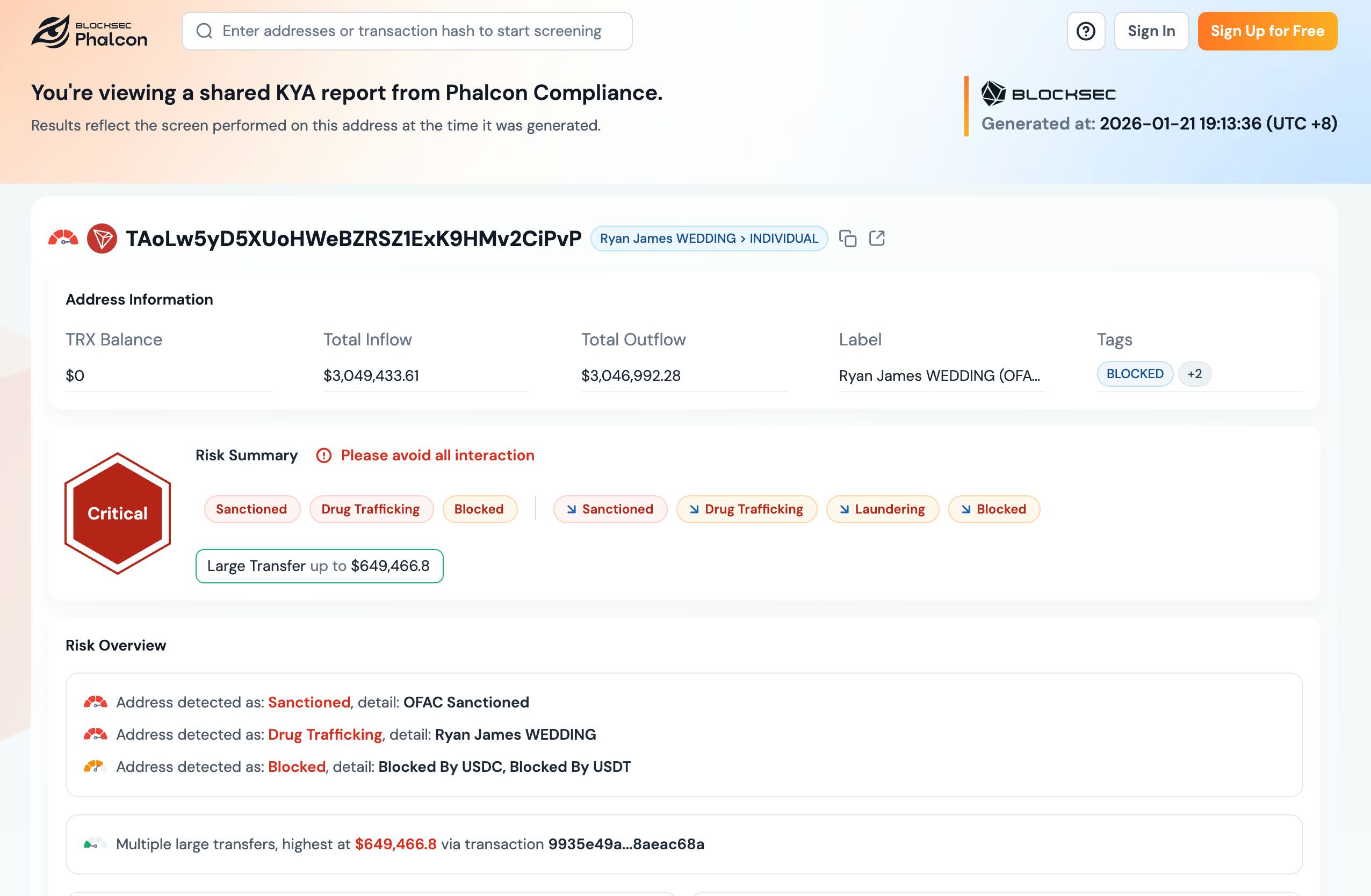
Standard Know Your Customer (KYC) procedures fall short when processing pseudonymous on-chain transfers. Know Your Address (KYA) serves as a necessary technical layer by executing risk profiling on specific wallets prior to transaction authorization. Functional platforms utilize deep multi-hop fund tracing, allowing analysts to compile a cross-chain risk profile. Operational KYA protocols must parse data across primary public chains, such as Bitcoin, Ethereum, TRON, Solana, BNB Chain, and the major EVM layer-2 networks. By analyzing the entire transaction path, compliance personnel establish visibility into asset origins and destinations. This feature enables investigators to trace funds through intermediate addresses, mixing protocols, and decentralized exchanges to determine the entities controlling the liquidity.
Real-Time KYT Monitoring for Instant Threat Detection
While KYA assesses static address history, Know Your Transaction (KYT) monitors active asset transfers. Effective KYT infrastructure must process data with millisecond latency to accommodate peak transaction volumes without causing bottlenecks in the user experience. Detecting threats functionally requires minimal delay between risk identification and workflow integration. Modern architectures route risk signals through customized channels—frequently supporting up to 7 distinct alert pathways—ensuring risk officers access relevant data exactly when a flagged transfer initiates. Surfacing these transfers as they occur lets compliance teams apply their own controls under their internal policy — holding a withdrawal for review, requesting further documentation, or escalating the case — before illicit capital mixes with internal liquidity pools.
AI-Driven Risk Engines: Identifying High-Risk Activities
Static parameter rules often fail to detect modified obfuscation tactics. To address this, functional platforms deploy risk engines that process behavioral analysis alongside hundreds of distinct on-chain signals. By correlating those signals rather than reading them in isolation, these systems identify complex transfer patterns linked to terrorist financing or structured investment fraud. Enterprise-grade engines utilize multiple overlapping risk control parameters, with dedicated engines covering entity classification, interaction history, high-frequency transfers, large-value movements, and intermediate wallet behavior. These models permit compliance teams to calibrate detection thresholds to align with their specific operational models and local legal constraints.
Streamlining Workflows with Crypto Compliance Tools
Operating a compliance department efficiently requires infrastructure that integrates visual analysis, team workflows, and automated reporting. Consolidating these processes reduces manual data entry, enabling risk officers to allocate resources to complex case resolutions and strategy.
Visualizing On-Chain Investigations and Fund Tracing
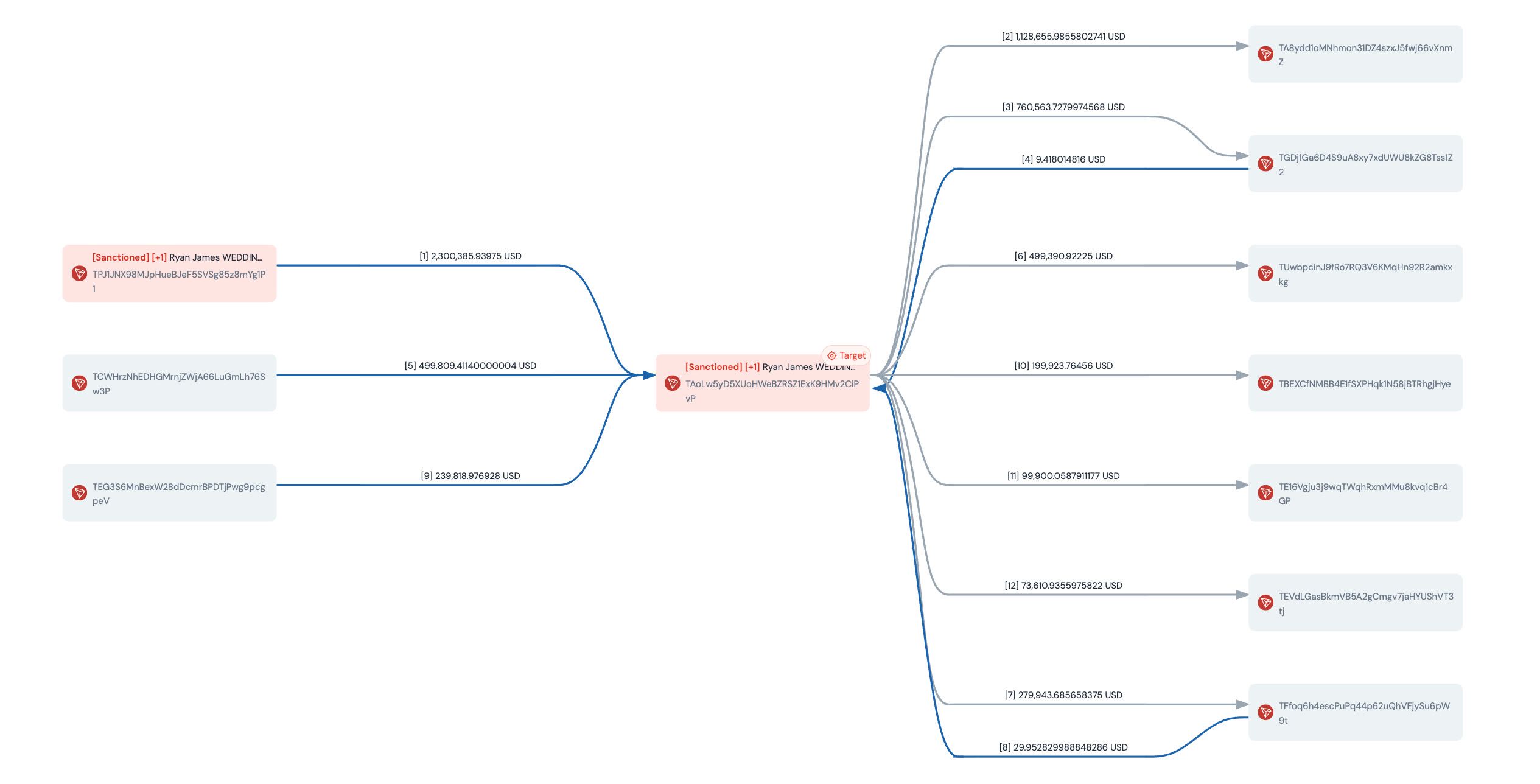
Analyzing blockchain transaction histories through raw block explorer data requires significant manual effort and introduces tracking errors. Enterprise on-chain investigation tools mitigate this by compiling visual relationship graphs automatically. Integrations with specialized investigation tools, such as MetaSleuth, permit analysts to view fund flows graphically, reducing the hours spent on evidence collection. Through node-based visualization, investigators can map multi-layered laundering networks, locate centralized exchange deposit addresses, and track tokens moving across blockchain bridges. This technical capability shifts the compliance department's workflow from raw data compilation to structured analysis and case resolution.
Enhancing Team Collaboration and Alert Management
Enterprise-level compliance management requires structured internal communication. Professional software integrates task assignment workflows, case management modules, and centralized list management systems. These functions enable various personnel, from entry-level analysts to senior compliance directors, to process complex alerts systematically. Upon generating a high-priority alert, the system routes the case to designated personnel based on configured role permissions. This workflow architecture ensures risk alerts are evaluated without administrative bottlenecks. Integrating collaboration modules ensures the compliance team processes data at a speed comparable to the firm's core matching engine or transaction processor.
One-Click STR/SAR Reporting for Global Audits
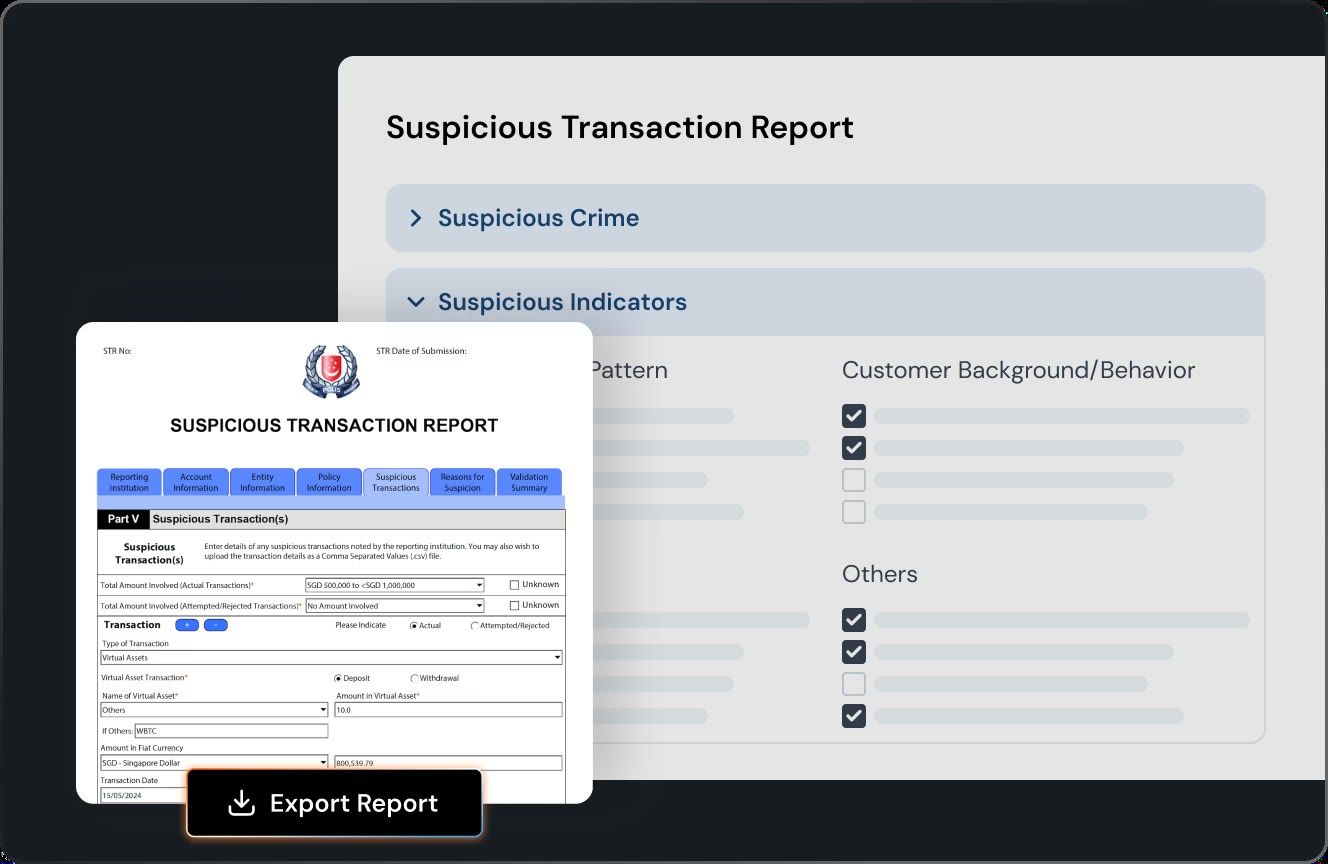
Following the verification of suspicious activity, institutions must file Suspicious Transaction Reports (STR) or Suspicious Activity Reports (SAR) with their respective financial intelligence units. Manually assembling these reports requires aggregating transaction hashes, entity profiles, and investigation logs, which consumes considerable administrative bandwidth. Contemporary compliance platforms incorporate automated report generation, outputting documentation that meets specific regulatory formatting constraints. Additionally, these systems log an immutable audit trail of the investigation steps. Automating the reporting phase allows organizations to shift their compliance staff away from repetitive formatting tasks toward substantive risk assessment and policy refinement.
Evaluating the Best Crypto Compliance Software
Selecting the appropriate infrastructure requires comparing legacy analytics providers against Web3-native platforms that supply customizable and responsive risk modules. Firms must assess technical architecture, network compatibility, and specific functional requirements to find a matching solution.
Legacy Solutions vs. Web3-Native Platforms
The analytics market contains a structural division between older monitoring systems and Web3-native architectures. Legacy solutions frequently utilize delayed batch processing and encounter difficulties when parsing data from newer Layer 2 networks or decentralized finance (DeFi) protocols. Built initially for basic Bitcoin transaction mapping, these systems often generate high false-positive rates when retrofitted for complex smart contract interactions. Web3-native platforms are structured specifically to interpret smart contract logs, liquidity pool interactions, and cross-chain messaging in real time. They supply modular architecture, permitting firms to connect specific APIs to their internal systems. For expanding VASPs, utilizing a Web3-native setup provides operational stability as digital asset technology updates.
Phalcon Compliance: The All-in-One Risk Management Suite
When assessing functional blockchain analytics solutions, Phalcon Compliance provides an integrated suite built for current digital asset environments. The platform covers the six standard modules necessary for institutional risk management. Its KYA functionality executes deep multi-hop cross-chain tracing, and takes a depth-over-breadth approach to coverage: the full stack runs on every supported chain (Bitcoin, Ethereum, TRON, Solana, BNB Chain, Polygon, Base, Optimism, Avalanche C-Chain, and Arbitrum) rather than shallow list-matching on the long tail, establishing clear visibility into multi-entity transaction profiles. Phalcon Compliance supports real-time operations, providing millisecond-level KYT response times and routing alerts through 7 custom channels so risk officers can act the moment a transfer is flagged. The risk engine evaluates over 200 behavioral signals across 25 default risk engines (13 address-side and 12 transaction-side) to flag obfuscated transfer patterns. Connected with MetaSleuth for visual case investigations, and supporting automated STR/SAR output, Phalcon Compliance offers a structured system for scaling business operations alongside verifiable risk management.
How It Compares to Industry Alternatives
The vendor landscape includes several analytics providers; however, many lack the unified, low-latency execution necessary for high-frequency processing platforms. Certain alternatives maintain large historical databases but experience measurable latency during active transaction screening or require substantial configuration fees for custom rule deployment. Phalcon Compliance establishes its operational baseline by combining millisecond KYT evaluation with integrated workflow management features. Rather than procuring separate applications for screening, investigation, and reporting, institutions using Phalcon Compliance deploy a consolidated system. This architecture lowers total infrastructure costs while maintaining the technical accuracy required for standard AML monitoring processes.
Frequently Asked Questions (FAQ)
This section reviews common technical inquiries regarding blockchain risk management, differentiating between core monitoring functions, and outlining the mechanics of illicit fund tracking. Clarifying these concepts assists organizations in scoping the technical requirements of digital asset compliance.
What is the difference between KYA and KYT?
Know Your Address (KYA) evaluates the static historical risk profile of a blockchain wallet prior to a transfer. It reviews past on-chain associations to determine if the address correlates with sanctioned entities, known exploits, or illicit marketplaces. Know Your Transaction (KYT) monitors the real-time execution of fund transfers. It evaluates the transaction payload to identify anomalies, such as structured large-volume movements or interactions with flagged smart contracts, precisely as the block is validated.
How do compliance tools detect money laundering?
Compliance software identifies potential laundering activities by applying behavioral analysis and pattern matching to on-chain data. Systems query blockchain ledgers for specific typologies, including direct deposits from flagged sources, structured transfers meant to bypass reporting thresholds, and interactions with mixing protocols. By computing a wide range of risk signals and tracing capital across multiple hops, these tools isolate activities that match standard money laundering operational profiles.
Can blockchain analytics trace funds across different networks?
Current blockchain analytics architecture supports cross-network fund tracing. Because obfuscation tactics heavily rely on cross-chain bridges and decentralized exchanges to sever transaction histories, modern engines specifically parse these swap events. By matching transaction timestamps, equivalent token volumes, and wallet behavior across networks like Ethereum, Binance Smart Chain, and TRON, compliance infrastructure maintains a continuous audit trail for the investigated capital.