Choosing the best crypto compliance software is a compliance decision more than a technology decision, it determines whether you can screen every deposit before it lands, whether you can defend your program to a regulator, and whether your bank keeps your account. This guide compares six leading options for crypto compliance: BlockSec Phalcon Compliance, Chainalysis, Elliptic, TRM Labs, AMLBot, and Merkle Science.
The stakes are high: an industry estimate cited in the FATF 2025 Virtual Assets Targeted Update put 2024 fraud and scam on-chain activity alone at roughly $51 billion, while the BlockSec 2025 Crypto Crime Report tracked sanctions-linked transaction volume rising by nearly $100 billion year-over-year. One contact with "dirty money" can cost you your bank account or a regulator's fine.
At a Glance: Six Blockchain and Crypto Compliance Platforms
| Platform/Vendor | Core Focus | Best For | Coverage Approach | Key Differentiator | Pricing |
|---|---|---|---|---|---|
| Phalcon Compliance | Screening, monitoring and alert triage | Payment companies, exchanges, wallets and OTC desks running production volume | Focused: deep coverage of the core production chains that carry the vast majority of real business flow (BTC, ETH, TRON, Solana and major EVM chains) | The only self-serve option here: published tiers, no sales call; sub-100ms screening | Free tier, then from $39/month; API plans from $699/month |
| Chainalysis | Blockchain analytics and investigations | Teams that prioritize entity-attribution depth for backward-looking investigations and long procurement cycles | Broad but inconsistent: 400+ networks on KYT page, 75+ on Hexagate, 29 on blockchain intelligence page | Extensive entity attribution database, Reactor graph investigations | Premium; reported at roughly EUR 120K–250K+ per year |
| Elliptic | Cross-chain compliance | Teams that need holistic cross-chain screening across the whole wallet ecosystem | Broad: 65+ chains platform-wide; publisher itself argues headline counts are often inflated | Holistic Screening across the whole wallet ecosystem | Mid-premium; reported at roughly 30–40% below Chainalysis |
| TRM Labs | Cross-chain risk intelligence | Teams running frequent multi-chain forensic investigations at scale | Two-tier: 184+ for risk screening, 65+ for deep indexing and tracing | Glass-box attribution: every label traceable to its source | Mid-premium; reported at roughly EUR 60K–150K per year |
| AMLBot KYT | Lightweight wallet screening (Telegram-first) | Users who want quick one-off wallet checks inside the Telegram ecosystem | Undisclosed; fast-screening mode on select chains only | Telegram bot access, pay-as-you-go; fixed-tier bundles with no configurable rule engine | Quoted on request; free check on signup |
| Merkle Science | Behavior-based risk detection | Teams that want behavior-based analytics with a modest compliance headcount | Undisclosed chain count; publishes 10,000+ assets and 200 bridges instead | Behavioral analytics that go beyond blacklists | Custom, mid-market |
A note on chain coverage, depth matters more than count. Vendor chain counts (verified 2026-08-07) are not directly comparable: coverage depth varies, and the same vendor often publishes different figures on different product pages (Chainalysis alone lists 400+ networks on its KYT page, 75+ for Hexagate, and 29 for blockchain intelligence). Elliptic itself argues that headline chain counts have become inflated. A "400+ chains" or "184+ chains" headline often bundles in long-tail networks with sparse label data and no behavioral signal support, coverage in name only. What matters is depth on the chains you actually use: does the tool return real-time behavioral scoring on your networks, or just a static list check?
What to Look for in Crypto Compliance Software
Four things matter most:
- Speed: a risk verdict in milliseconds, so you can screen every deposit and withdrawal without building a queue.
- Investigation embedded in the workflow: how fast can an analyst move from "this alert fired" to "here is the full fund flow behind it"? Tools that make you export addresses and re-import into a separate investigation product bleed analyst hours per case; tools with investigation embedded turn it into a one-click drill-down.
- Intelligence freshness: how fast does the vendor sync OFAC designations, new attack addresses, and mixer attributions? Batch pipelines leave hours-to-days of exposure between when an address is designated and when the tool flags it; real-time pipelines close that window to minutes.
- Ease of use: how fast from signup to first useful screen? Look for simple onboarding, FATF-aligned default rules that work out of the box, clear dashboards, a real rule engine you can tune, and good API support so your developers can integrate without friction.
Crypto Compliance Solutions Compared: Features, Pricing, and Best Fit
1. Phalcon Compliance: best for crypto businesses running compliance in production
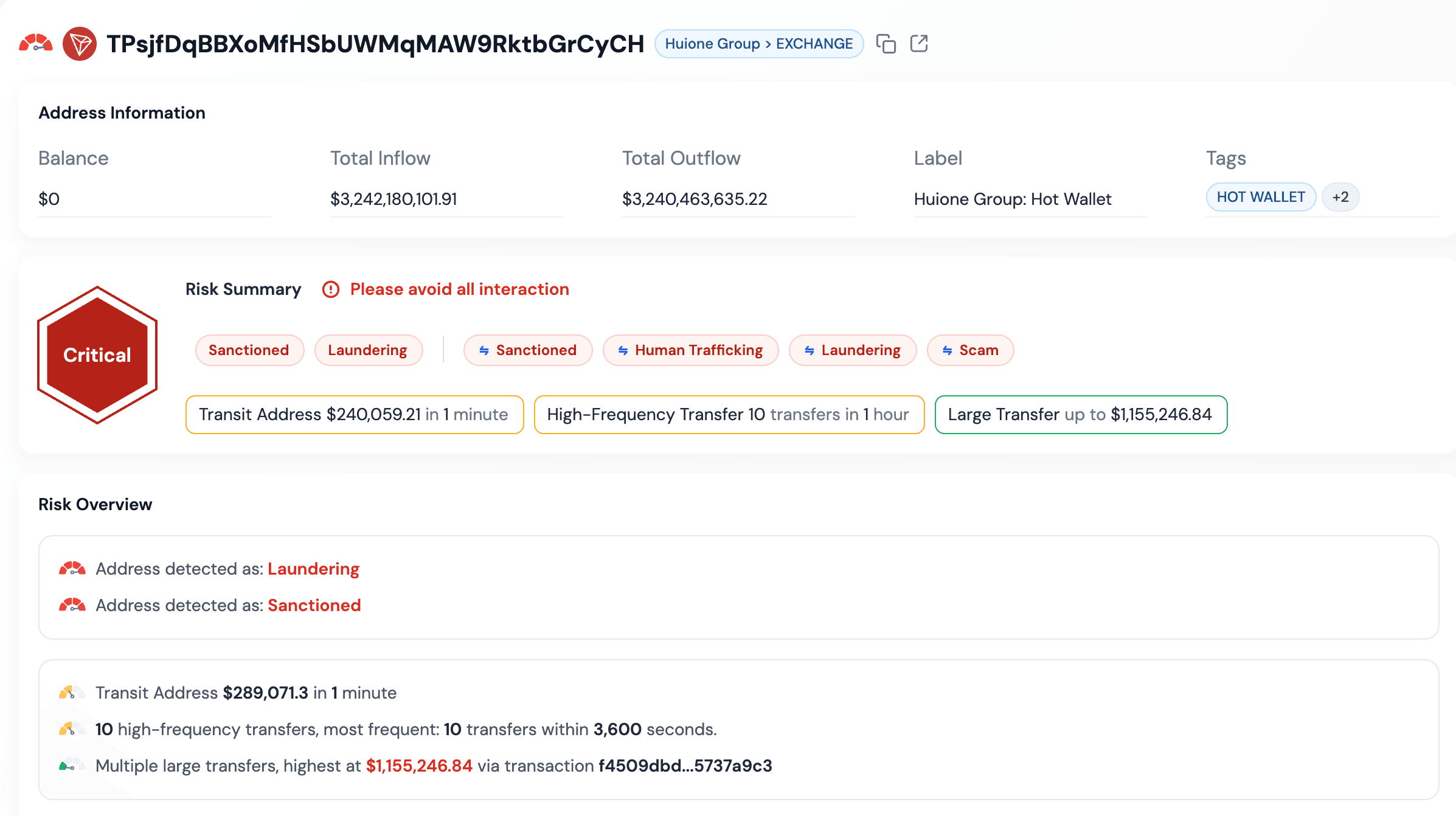
Phalcon Compliance is shaped around how crypto businesses running real production volume actually operate, exchanges, payment platforms, wallets, custody providers, OTC desks, staking services and Web3 fintechs all share the same core problem: high deposit and withdrawal volume, counterparties that need re-checking after onboarding, and a regulator who will eventually ask for the audit trail. Where the other five tools here are enterprise-shaped, list-matching-first, or lightweight-only, Phalcon Compliance is purpose-built for the compliance operator running production volume today.
A boundary worth stating up front, because it is often misread: Phalcon Compliance is the compliance layer. It screens, monitors, scores and surfaces cases, and actions such as holding a risky withdrawal go through your team's review and approval rather than firing autonomously. If what you need is automated on-chain interception of an attack mid-transaction, that is a different product: BlockSec's Phalcon Security covers that side.
Five things make Phalcon Compliance different from the other five tools here:
1. The only self-serve subscription on this list
Every other platform here routes you through a sales conversation before you see a price or run real volume. Phalcon Compliance publishes its tiers openly, offers a free tier that screens on every supported chain plus a 7-day monitoring trial, and lets you upgrade yourself. For a business that needs screening live this month rather than next quarter, that difference is often the deciding one.
2. Research-driven detection with 24×7 intelligence refresh
Phalcon Compliance runs on BlockSec's on-chain security research: 50+ peer-reviewed papers at top-tier venues (IEEE S&P, USENIX Security, NDSS, CCS, ACM SIGMETRICS, ACM IMC), 10,000+ citations, and award-winning work. "Shedding Light on Shadows" won Best Paper Award Runner-Up at ACM SIGMETRICS (5 of 481 submissions), and its MFTracer methodology powers Phalcon Compliance's multi-hop tracing. "Unmasking the Shadow Economy" at ACM IMC 2025 built the drainer-as-a-service dataset that now feeds the platform's live label attributions.
That database refreshes 24×7 through an automated pipeline: 600M+ labeled addresses across 17 risk indicator categories and 25 default risk engines (13 address + 12 transaction), with OFAC SDN designations, new attack addresses, and mixer / darknet / scam attributions updating continuously rather than in overnight batches. Many list-first vendors leave hours-to-days between designation and detection; Phalcon Compliance closes that window to minutes. Signals lean toward on-chain behavioural patterns (mixer proximity, transit-address behaviour, high-frequency transfers, rapid transit), so it often catches new attacker techniques before they hit mainstream sanctions lists. Full research portfolio: blocksec.com/research.
3. Purpose-built for real production workflow
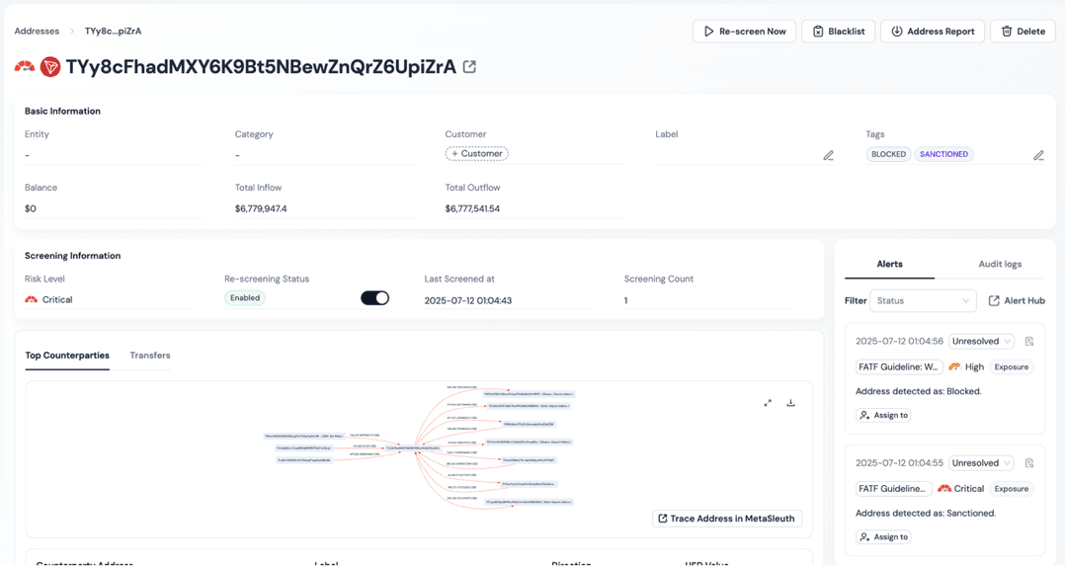
Screening returns a risk score in under 100 milliseconds, fast enough to check every deposit and withdrawal without building a queue. The 5-tier risk model (Critical / High / Medium / Low / No Risk) is configurable per organization, and alert assignment, case management, shared blacklists/whitelists, continuous Monitor for high-value counterparties, custom risk rules, and a REST API (50 calls/min for screening; 10 calls/sec for other endpoints) all come together in one workflow. On chain coverage, Phalcon Compliance takes a depth-over-breadth approach, the full stack runs on every supported chain (Bitcoin, Ethereum, Tron, Solana, BNB Chain, Polygon, Base, Optimism, Avalanche C-Chain, and Arbitrum) rather than shallow list-matching on the long tail.
4. Regulatory reporting in the same platform
One-click STR/SAR reports come out of the platform using region-specific templates aligned with multiple key regulatory jurisdictions. It aligns with FATF guidance and is used by payment platforms, exchanges, wallets and OTC desks. Seven notification channels, Email, Telegram, Slack, Lark, Discord, PagerDuty, Webhook, mean alerts land where your team actually works.
5. Investigation embedded, plus lighter API options
Investigation is not a separate step. MetaSleuth is embedded directly into Phalcon Compliance, click once from any alert to open the full multi-hop cross-chain fund-flow graph, trace across bridges and swaps, and pull the evidence back into your case file. Analysts move from "this alert fired" to "here is the full fund flow behind it" in a single click.
The same intelligence layer also powers two lighter options for teams that don't need the full platform: MetaSleuth Crypto AML API (monthly API: labels from $699/month, labels plus risk scores from $1,199/month) or x402 Compliance API (pay-per-call in USDC, $0.10 to $1.00 per request depending on depth). See FAQ for pricing.
Cons: Multi-user collaboration is Enterprise-only (smaller teams sharing one account get less role separation). For investigations that regularly reach into long-tail networks, pair with a broader analytics platform.
Pricing:
- Free: $0 forever. 3 screenings/month across every supported chain, alert center, 7-day Monitor trial.
- Essential: $39/month or $399/year (saves $69). 25 screenings/month or 300/year, 10 custom engines, STR/SAR reports, blacklists/whitelists, Telegram + Lark alerts, 1 monitored address.
- Scale: from $699/month or $6,999/year (saves $1,389). 750 screenings/month or 9,000/year, API access, Webhook + Slack + Discord + PagerDuty alerts.
- Enterprise: custom. Higher volumes, multi-seat, unlimited custom engines, 24/7 support.
Screenings and Monitor slots top up on demand; annual billing saves up to 30%. Full pricing breakdown.
2. Chainalysis: best for teams that prioritize entity-attribution depth for backward-looking investigations
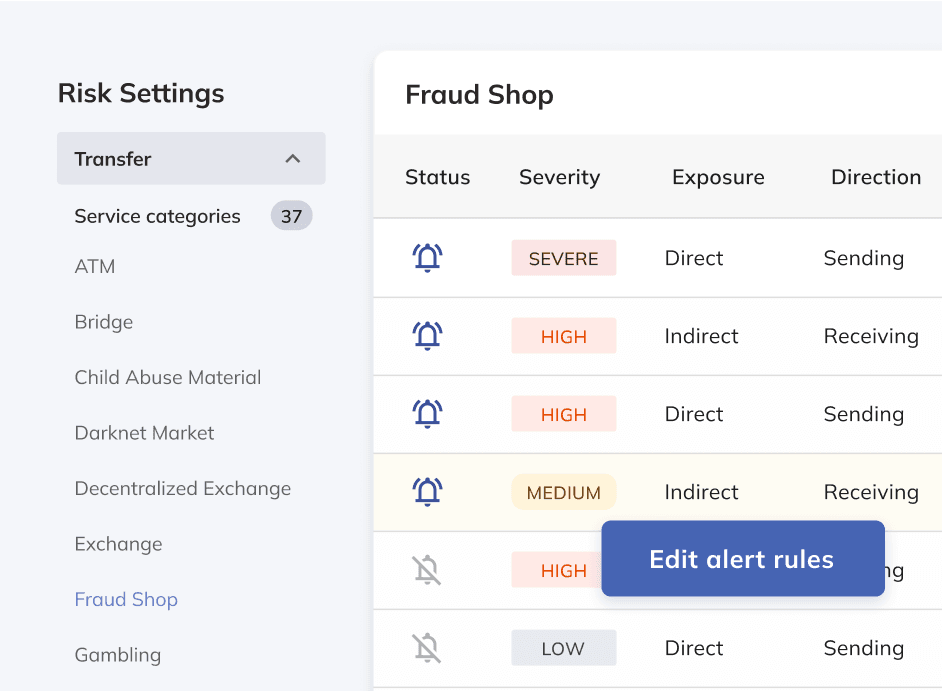
Chainalysis is the biggest name in the category, with a massive attribution database built over years. Their "Reactor" tool visualizes money movement as a graph, funds hopping wallet to wallet, making it a strong fit for backward-looking investigations. Regulatory familiarity is the other reason to pick it: when applying for a licence, the name is recognised and a Chainalysis-backed programme is easier to defend. It works best for teams with dedicated analysts, not quick real-time checks.
Key Features: extensive entity-attribution database; "Reactor" visual investigations; law enforcement tracking; global regulatory support and training.
Pros: largest dataset in the industry, highly trusted by regulators worldwide.
Cons: no published pricing (budgeting requires a sales cycle), slower to integrate for real-time checks, coverage claims hard to pin down (400+ networks on KYT page, 75+ for Hexagate, 29 for blockchain intelligence).
Pricing: no list prices published. Third-party comparisons put full-platform contracts at roughly EUR 120,000–250,000+ per year, scaling with volume and modules. Budget a sales cycle before you see a number.
3. Elliptic: best for teams that need holistic cross-chain screening across the wallet ecosystem
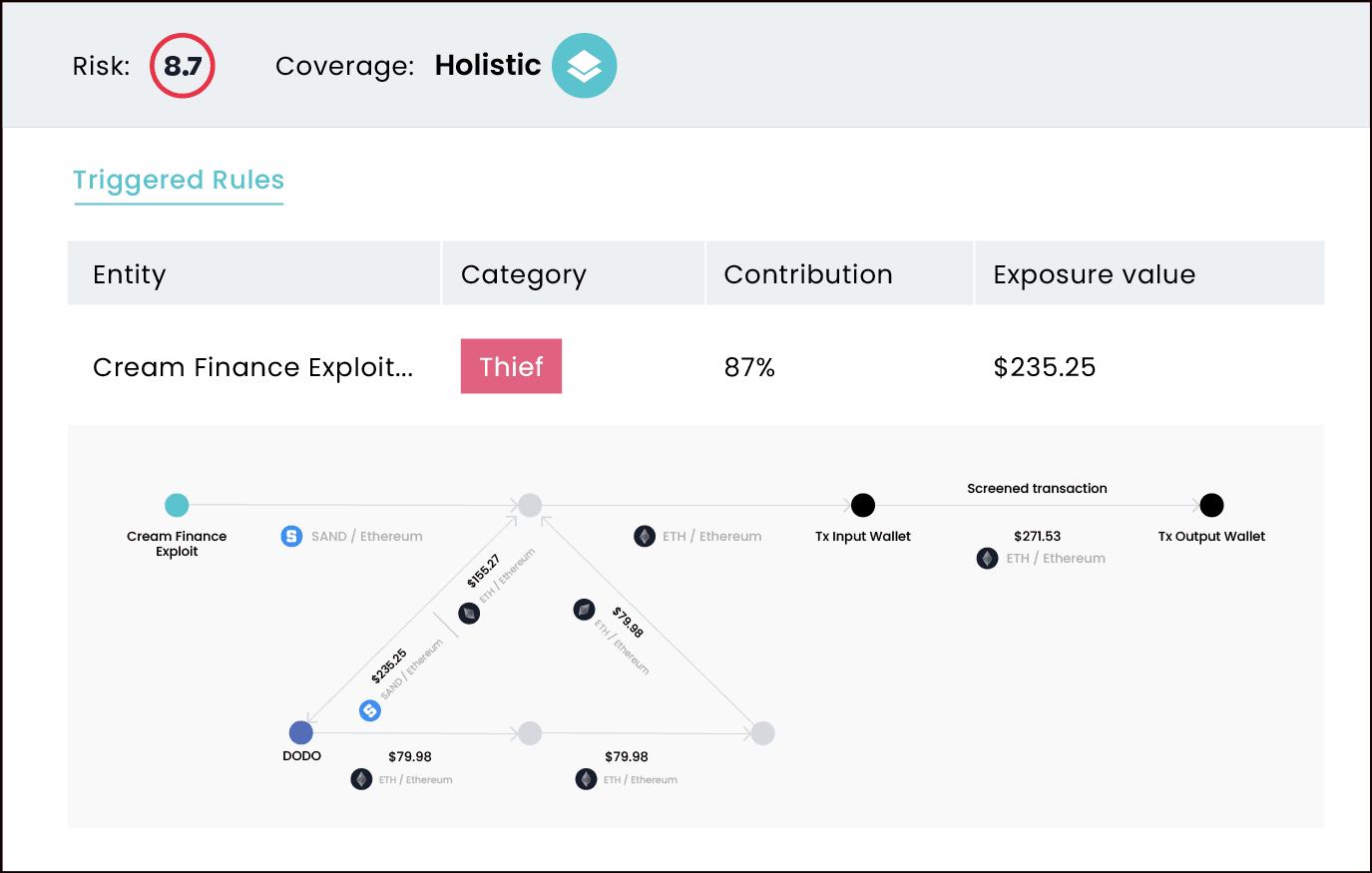
Elliptic is strong at cross-chain tracking through "Holistic Screening", analyzing the whole wallet ecosystem instead of one asset in isolation, so criminals who swap Bitcoin for Ethereum or move through bridges stay in view. It fits teams operating in heavily regulated finance environments where holistic cross-chain coverage is a core requirement. Screening returns risk scores showing fund provenance and sanctioned-mixer exposure, and training resources help newer teams ramp.
Key Features: holistic cross-chain investigations; deep transaction insights; wallet sanctions screening; training resources.
Pros: excellent cross-chain tracking; suited to regulated-finance workflows. To its credit, Elliptic publicly argues headline chain counts are often inflated and publishes guidance on verifying real coverage.
Cons: complex interface; enterprise-focused rather than DeFi-fast; entry pricing in five figures; coverage published platform-wide (65+ chains) rather than per product, confirm which chains each product supports.
Pricing: mid-premium, quoted on request. Annual suites (starter / growth / customized enterprise), no published rates. Third-party comparisons place it roughly 30–40% below Chainalysis, still five figures per year at entry.
4. TRM Labs: best for teams running frequent multi-chain forensic investigations at scale
TRM Labs sits in the same enterprise tier as Chainalysis and Elliptic but leans hardest into cross-chain work, following value as it moves between chains, bridges and swaps without the analyst restarting the trace each time.
Its coverage comes in two layers: risk screening and sanctions coverage extend to 184+ blockchains (among the broadest in the category), while complete indexing and tracing for real investigations cover 65+ chains. Both numbers are accurate but answer different questions, ask which layer applies to the chains you actually care about. TRM has also built a substantial public-sector track record (including work with US federal agencies), giving it Chainalysis-level regulatory familiarity.
Key Features: risk screening across 184+ chains; full indexing on 65+ chains and 1.9B+ assets; 3.1B+ labeled addresses; glass-box attribution traceable to source evidence; enterprise SSO, RBAC, case collaboration.
Pros: among the broadest screening coverage; genuinely strong cross-chain tracing; defensible glass-box attribution; regulator-friendly.
Cons: no published pricing (enterprise-only sales); US hosting raises data-residency questions for EU-focused teams; the 184+ headline overstates deep-investigation coverage (65+ chains).
Pricing: not published. Third-party comparisons place TRM at EUR 60,000–150,000 per year, below Chainalysis, above the mid-market tools here.
5. AMLBot KYT: best for quick one-off wallet checks inside the Telegram ecosystem
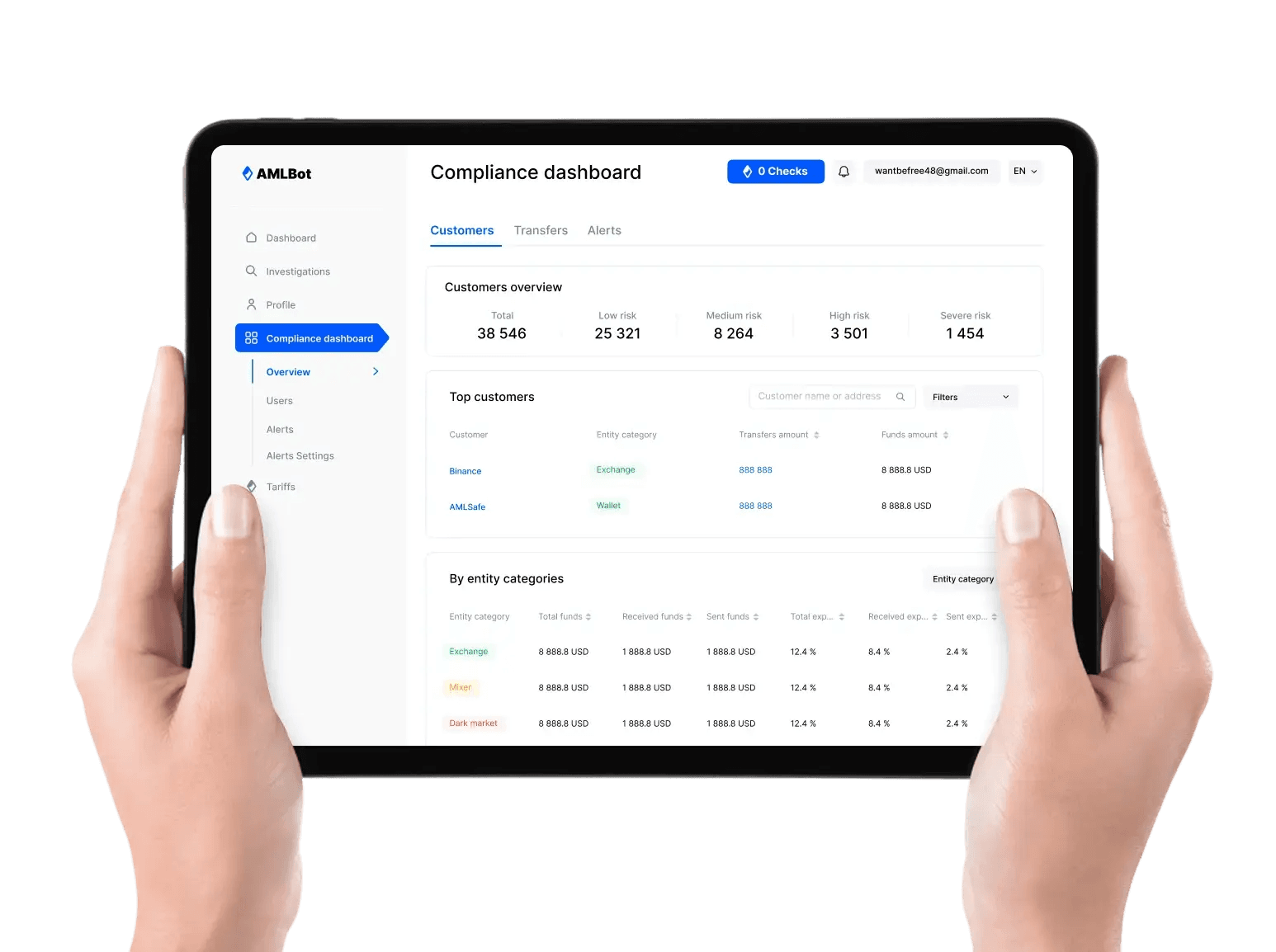
AMLBot's distinguishing feature is where it lives, a Telegram bot and mini app, which makes it a natural fit for P2P traders, TON-adjacent projects, and communities already in that app.
Key Features: Telegram bot + mini app + web access; free check on registration; three fixed tiers (Lite / Pro / Pro+); simple Low / Medium / High output on Lite; precise 0-to-100 scoring, behavioral alerts, and API access on Pro+.
Pros: fastest path to a first check, free on registration and instantly usable inside Telegram, convenient when your business already happens there.
Cons: no supported-chain list published; fast-screening mode only on select chains (BTC, ETH, Solana); fixed-tier bundles with no configurable risk engine; API access, real-time monitoring and precise scoring locked behind Pro+; no plan above the free check publishes rates.
Pricing: 1 free check on registration. Three tiers by monthly volume: Lite (<50/month, Low/Med/High only), Pro (>50/month, adds OFAC matching + PDF reports), Pro+ (>500/month, adds API + 0–100 scoring + real-time monitoring). All quoted on request; no rates published.
For a lightweight check with transparent pricing, BlockSec's MetaSleuth Crypto AML API (monthly) or x402 Compliance API (pay-per-call) are alternatives from the same intelligence stack as Phalcon Compliance. See the FAQ for pricing.
6. Merkle Science: best for teams that want behavior-based analytics with a modest compliance headcount
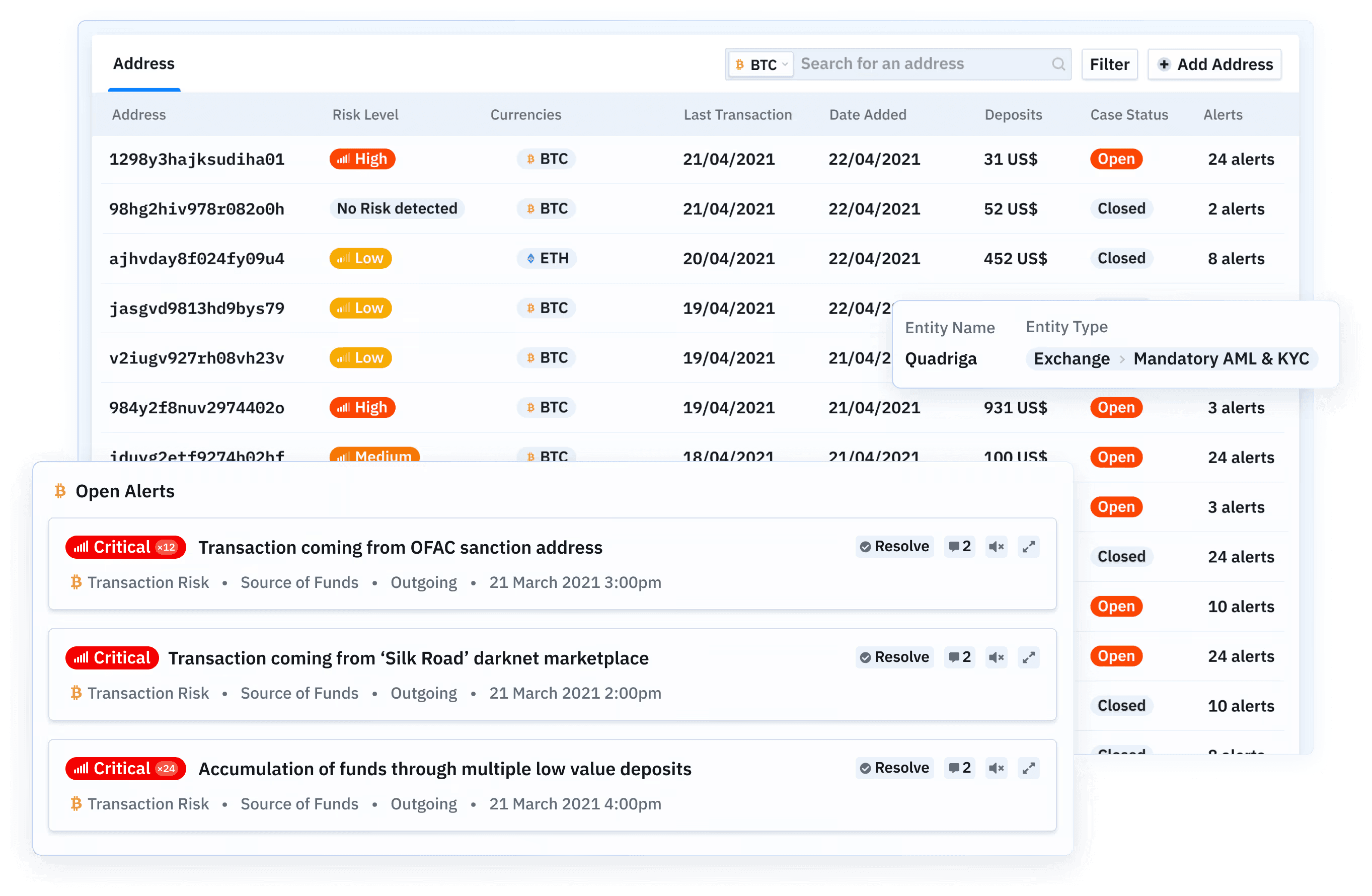
Merkle Science combines blacklists with behavior-based analytics, the system looks at how a wallet acts, not just whether it's on a list, so a hacker using a fresh wallet still gets flagged if the pattern matches. Rules are customizable (e.g. tighter thresholds on high-value deposits), and their "Compass" tool manages rules, automated reporting and risk tracking in one place.
The combination fits compliance teams that want behavioral detection and configurable rules without the analyst headcount that Chainalysis-tier tooling assumes, a match when compliance is a few people, not a department.
Key Features: blacklist + behavior-based analytics; customizable risk rules; predictive analysis for new threats; "Compass" transaction monitoring; 10,000+ assets and 200 bridges.
Pros: catches new criminals before they are listed; rules customizable to your business.
Cons: predictive models can produce false alarms and need tuning; no published chain count or pricing; access starts with a booked demo (slower to evaluate than self-serve options).
Pricing: custom mid-market, quoted after a demo. Packages described by capacity (e.g. 1,000 annual screenings with unlimited rescreening) rather than price. Third-party resellers offer per-screening access as a lower-commitment entry point if you only need low-volume screening.
Case Study: Israel–Iran Conflict Fundraising
Between June 13–30, 2025, amid heightened hostilities between Israel and Iran, Tether froze 151 addresses. BlockSec analyzed administrative seizure orders issued by Israel's National Bureau for Counter Terror Financing (NBCTF), using them as a representative sample to assess terrorist-linked USDT transactions.
- Timing: Only one new seizure order was issued after the June 13 escalation, dated June 26. The prior order was from June 8, indicating a delay in enforcement during geopolitical tensions.
- Targeted Organizations: Since October 7, 2024, NBCTF issued eight orders, four of which explicitly mention Hamas; the latest names Iran for the first time.
- Assets Seized:
- 76 USDT (TRON) addresses
- 16 Bitcoin addresses
- 2 Ethereum addresses
- 641 Binance accounts
- 8 OKX accounts
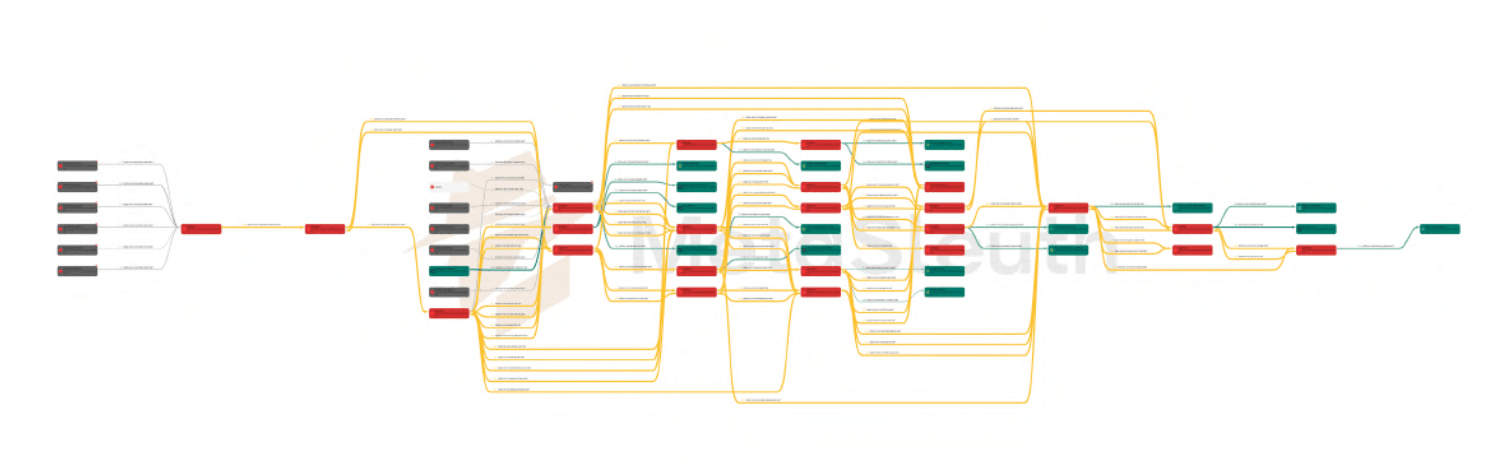
Tracing those flows with MetaSleuth, BlockSec's on-chain investigation platform, showed some exchanges appearing at both ends of the transaction graph, as sources (via hot wallets) and destinations (via deposit addresses), highlighting their central role in the laundering process.
Compliance Alert
Weak AML/CFT execution and delays in asset freezes let illicit transfers move before enforcement takes effect. All addresses in this case had already been flagged by Phalcon Compliance, proactive monitoring and detection are what shrink that gap.
Why Crypto Compliance Matters
Compliance is more than a rules problem, it is a growth lever:
- Avoid enforcement action: with sanctions-linked volume up nearly $100 billion YoY (BlockSec 2025 Crypto Crime Report), the fine risk is real.
- Build trust: users and partners transact more confidently when they see the platform screens for dirty money.
- Open bank relationships: a strong AML program makes traditional banks more willing to work with you, which is what enables fiat rails and cross-border payments in practice.
- Enter new markets faster: being compliant when regulation is messy is what actually lets you launch in a new jurisdiction while less-prepared competitors are still stuck at the door.
Conclusion
The right tool is the one that fits your chains, your volume, and your team.
- For production compliance today (exchanges, payment platforms, wallets, custody, OTC desks, staking, Web3 fintechs): Phalcon Compliance. It's the only self-serve option here, combines research-driven signals with 24×7 label updates, and runs the full stack on every supported chain.
- For deep backward-looking attribution and licensing-heavy procurement: Chainalysis.
- For holistic cross-chain screening across the wallet ecosystem: Elliptic.
- For frequent multi-chain forensic tracing at scale: TRM Labs (broadest screening coverage here).
- For occasional one-off checks in the Telegram ecosystem: AMLBot; if you need lightweight API access with published rates, BlockSec's MetaSleuth Crypto AML API and x402 Compliance API are alternatives (see FAQ).
- For behavior-based analytics with a modest compliance headcount: Merkle Science.
Frequently Asked Questions (FAQ)
Is crypto compliance only for big exchanges, or do startups need it too?
Both, and wallets, payment platforms, custody providers, OTC desks, and DeFi front-ends too. If you touch "dirty money" by mistake, you can lose your bank account or face legal trouble. BlockSec offers three entry points sized to workload: Phalcon Compliance (full compliance workflow with all 17 risk indicators, deep multi-hop analysis, dashboard, cases, monitoring, STR/SAR; free tier), MetaSleuth Crypto AML API (lightweight API you call from your own systems: Basic Edition is labels only at $699/month, Standard Edition adds risk scores at $1,199/month, both capped at 10K addresses/day and 5 qps), and x402 Compliance API (pay-per-call in USDC on Base: $0.10 label query, $0.20 light screening, $1.00 full KYA/KYT report).
Why can't I manually check a wallet address on a block explorer?
You could, but it's impossible to keep up. Hackers move money through thousands of wallets in seconds. Blockchain compliance companies have automated tools that trace these hidden paths instantly. A human eye simply cannot see what their software sees.
Will using compliance software slow down my users' transactions?
No. Modern tools are built for speed, returning a verdict in milliseconds so screening runs in the background without holding up users. What happens next is your call: the tool surfaces the risk, and your team decides whether to hold, reject or escalate.
How often should I re-screen customers after onboarding?
Screening once at onboarding is not enough, a wallet that is clean today can become linked to an OFAC-designated address, a mixer, or an exploit within hours. Continuous re-screening is the modern default.
Look for a Monitor feature that automates re-screening rather than a manual schedule. Phalcon Compliance's Monitor module re-screens tracked addresses 24×7 and fires alerts on four event types (Risk Level Increased / Decreased, Alert Triggered / Expired) across seven notification channels. Ask each vendor whether their re-screening is truly continuous or just a batch job with hours of gap.
Do I need lawyers to run this software?
No. The best tools are designed to be user-friendly, with clear "red light / green light" signals your daily operations team can act on. Lawyers help with big-picture decisions and edge cases; the day-to-day dashboard does not require legal training.
What happens when regulations change, do I need to update the code?
No. Cloud-based providers update their databases and rules automatically as regulations move, so your integration stays the same.
Does compliance software violate user privacy?
No. These tools look at on-chain data, which is already public on the blockchain, and focus on crime patterns rather than personal information.
How do I choose between different blockchain compliance companies?
Ask each vendor for the chain list per product (not the headline number), confirm which layer of support each chain gets (labels, behavioral signals, real-time monitoring, reporting), and check whether API access is included in your tier or gated behind a higher plan.
How much does crypto compliance software cost?
Anywhere from free to six figures a year. Only BlockSec's stack publishes prices and lets you self-serve, and the three options fit different workloads:
- Phalcon Compliance: the full workflow platform. Full 17 risk indicator categories, 25 default risk engines, deep multi-hop cross-chain interaction analysis, dashboard, alert triage, case management, continuous monitoring, STR/SAR reports, embedded investigation, team collaboration. Free tier, then $39/month (Essential), $699/month (Scale), or custom Enterprise. Pick this if you need a real compliance operation.
- MetaSleuth Crypto AML API: lightweight, API-first. Label and risk-score queries delivered to your own systems, no dashboard or workflow layer. Two editions: Basic (labels only) $699/month and Standard (labels + risk scores) $1,199/month, both 10K addresses/day at 5 qps. Pick this if you only need basic risk data on demand and will build the workflow yourself.
- x402 Compliance API: pay-per-call in USDC on Base, no account or subscription. Three depths: $0.10 label query, $0.20 light screening (sanctions and blacklist exposure), $1.00 full KYA/KYT report with multi-hop cross-chain tracing. Designed for AI agents, backends, or one-off checks.
Everything else on this list (Chainalysis, Elliptic, TRM Labs, AMLBot above the free check, Merkle Science) requires a demo and a quote, expect a sales cycle of several weeks and contracts running from five to six figures per year.
How long does it take to deploy crypto compliance software?
It depends entirely on which tool you pick. Enterprise platforms typically take weeks-to-months: sales qualification, custom pricing, procurement approval, integration, and initial rule configuration. Self-serve tools cut that to minutes: sign up, pick a tier, add your API key, start screening. Phalcon Compliance publishes a free tier with no credit card required and FATF-aligned default risk engines that work out of the box, so most teams run their first real screens the same day they sign up.
Is compliance software the same as sanctions screening?
No, sanctions screening is one layer of it. Modern compliance software covers a much broader risk taxonomy: sanctions, mixing, ransomware, dark markets, drainer-as-a-service phishing, FATF grey-list jurisdictions, and more. Phalcon Compliance, for example, evaluates 17 risk indicator categories across 25 default risk engines, not just SDN List matching. A pure sanctions-screening tool will miss risky funds that come from a mixer, a fresh drainer wallet, or a high-risk jurisdiction that is not yet on any sanctions list.
What is the difference between "KYC" and "Transaction Monitoring"?
KYC (Know Your Customer) is checking an ID card to see who someone is. Transaction Monitoring is checking what they are doing. Blockchain compliance companies focus on the second part. They ensure that the funds on your platform aren't tied to darknet markets or sanctions.