Short Answer
Depeg risk is the risk a stablecoin stops trading at its target price, and it comes from three places: reserve trouble, panic selling the mechanism cannot absorb, and broken market structure. It is a different risk from freezing. A freeze makes funds unusable while the price holds; a depeg makes funds worth less exactly when everyone wants out. Both hit treasury and payment operations, and they need different monitoring. This page explains what breaks a peg, what the big historical events actually showed, and which signals an operations team can watch.
What Depeg Means, and How It Differs From Freezing
A depeg is a price failure: the token trades away from its peg, usually below it, and holders cannot exit at the value they expected. Stablecoins hold their peg through reserves, redemption rights, or market mechanisms, and when confidence in any of those breaks, the price moves first. Freezing is the mirror risk: the issuer's blacklist makes an address unable to transact at all, while the token itself keeps its price. An operation that only watches freeze lists can be fully blindsided by a depeg, and one that only watches price misses the other side going dark. The two risks sit side by side, and the freeze side is covered in How Does USDT and USDC Freezing Work?
The Three Ways a Peg Breaks
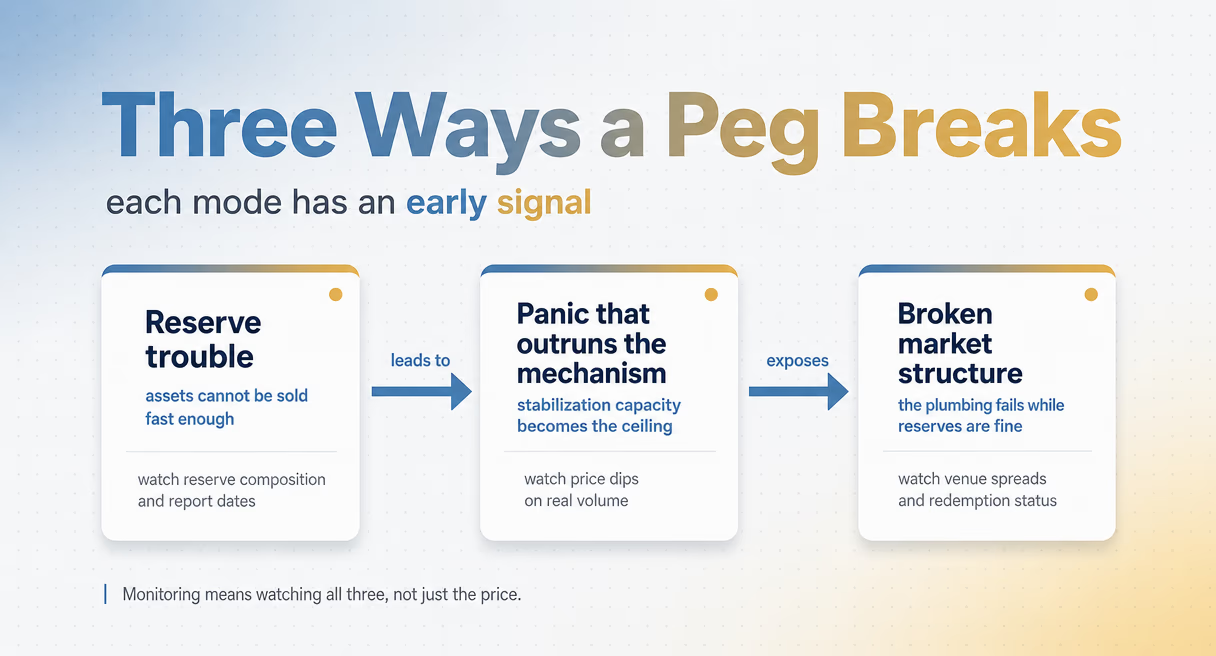
| Failure mode | What breaks | Early signal to watch |
|---|---|---|
| Reserve trouble | Assets cannot be sold fast enough to honor redemptions | Reserve composition and whether reserve reports are current |
| Panic that outruns the mechanism | Stabilization capacity becomes the ceiling | Traded price dipping on real volume, not thin noise |
| Broken market structure | The plumbing around the token fails while reserves are fine | Venue spreads and redemption channel status |
Reserve trouble
For fiat-backed stablecoins, the peg lives or dies with the reserves behind it. The mechanism is simple in principle: every token is backed by assets an issuer can sell to honor redemptions. The risk is what those assets are and who controls them. Reserves held in shaky banks, reserves in instruments that cannot be sold fast during a run, or reserves that turn out not to exist, each of those turns a redemption demand into a price break. This is why regulators keep tightening reserve rules, MiCA in the EU and the GENIUS Act in the US among them, with its rules phasing in through early 2027. The quality of reserves, not just their headline size, is the thing to check.
Panic that outruns the mechanism
A run happens when more people want out than the mechanism can serve at the peg, and once the price dips, selling begets selling. Crypto-backed and algorithmic designs are most exposed here, because their stabilization depends on mechanics, trading loops, locked extra collateral, or mint-and-burn flows, rather than a simple redemption promise. When panic volume floods in, the mechanism's capacity becomes the ceiling, and the price finds out where the real floor is. Algorithmic designs have no reserve at all, which is why their failures have been the most total.
Broken market structure
Even a fully reserved stablecoin can trade off-peg when the plumbing around it fails. Thin liquidity on a given exchange, a paused redemption channel, or a regional banking outage can push the traded price away from par even though nothing is wrong with the reserves themselves. These depegs are usually temporary, but a payment settling during the gap still settles at the wrong price. That is why treasury operations care about the market structure around a token, not only the token itself.
What History Showed: Two Cases With Time Anchors
UST, May 2022: the algorithmic failure
In May 2022, the algorithmic stablecoin UST collapsed from roughly one dollar to cents within days, wiping out its sister token alongside it. UST held its peg through a mint-and-burn trading loop with no reserves, and when large exits stressed the loop, the mechanism that was supposed to restore the peg became the engine of its collapse. Confidence left faster than the loop could absorb, and both tokens went effectively to zero. The lesson that stuck: a peg with no reserve behind it is a design claim, not an asset.
USDC, March 2023: the reserve-channel event
In March 2023, USDC fell well below its peg for several days after the failure of Silicon Valley Bank, where a portion of its cash reserves was held. The reserves existed, but the bank holding them did not, and until regulators guaranteed depositors access, the market priced the uncertainty straight into the token. The peg restored once the reserve channel reopened. The lesson differs from UST: a fully backed stablecoin can still depeg hard when the banking channel behind the reserves breaks, and several days off-peg is long enough to hurt real operations.
xUSD, November 2025: the yield-bearing failure
The newest failure mode belongs to synthetic and yield-bearing stablecoins, and it showed up again in 2025: nearly half a dozen decentralized stablecoins lost their pegs that year. The clearest case was xUSD, a yield-bearing stablecoin from Stream Finance. On November 3, 2025 the platform disclosed that an external fund manager had lost about $93 million of the assets backing xUSD; within 24 hours xUSD fell from $1.00 to $0.26 and withdrawals froze. The mechanism differs from both UST and USDC: the peg was backed by yield assets under third-party management, so the failure point was neither an algorithm nor a bank, but the custody and management of the backing itself. Synthetic and yield-bearing designs carry this specific exposure, and it does not show up in reserve attestations that only count assets.
Monitoring Signals for an Operations Team
Watch three groups of signals: the reserve picture, the traded price against the peg, and redemption health. The reserve picture means who holds the reserves, in what assets, and whether the reserve reports are current. The price picture means actual traded prices across venues, not the official peg, because the market breaks the news first. Depth matters too: a small dip on thin volume is noise, while a widening dip on real volume is the event starting. Redemption health means whether the issuer's redemption channel is working, which is what turned the USDC event from a scare into a multi-day depeg. For a treasury or payments operation, the practical layer is exposure: which stablecoins you hold, in what concentration, and what your fallback is if the one you lean on trades off-peg for a week. Monitoring that other side is covered in How to Monitor Stablecoin Counterparty Risk
What to Do Next
Map your stablecoin exposure against the three failure modes, and put price and redemption signals on the same dashboard as your freeze monitoring. For the freeze side of asset availability, Phalcon Compliance screens the other side and monitors addresses across a label library of more than 600 million addresses, updated around the clock. Explore Phalcon Compliance for the monitoring path, and for the full stablecoin risk picture, start from the Stablecoin Compliance hub.