
The Short Answer: Issuers Maintain a Central Blacklist On-Chain
USDT and USDC are centralized stablecoins: a single issuer controls each token contract and can restrict an address's ability to move funds even when the holder still controls the private keys. A stablecoin freeze is the issuer using a built-in control function to stop an address from moving funds. It is not a hack and not a third-party seizure.
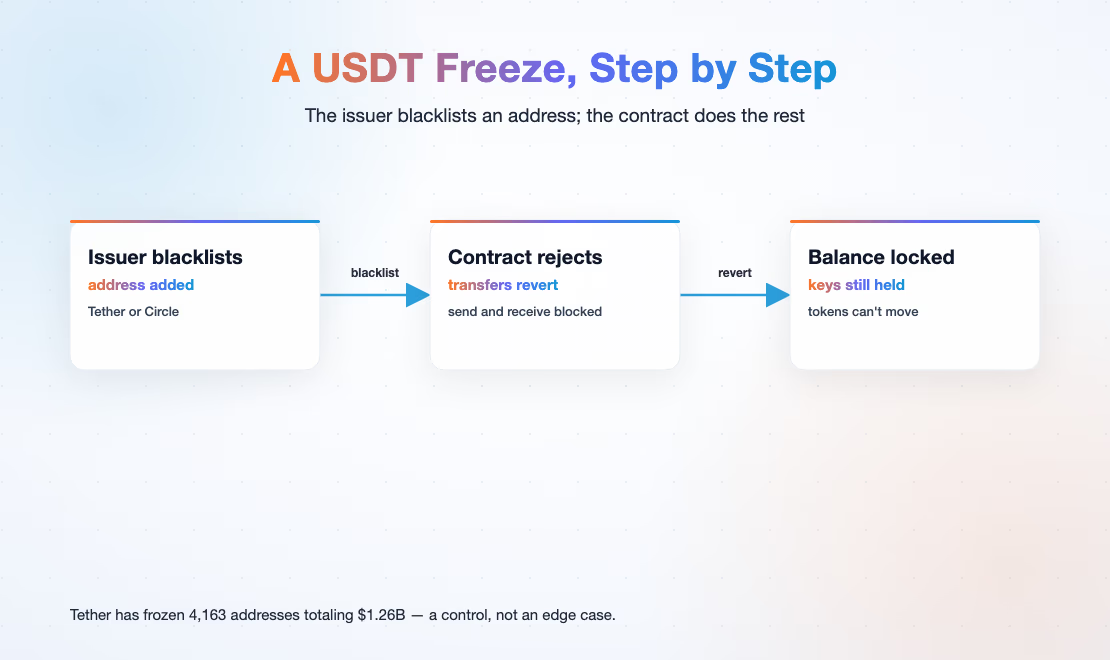
The mental model that makes freezing intuitive is a centralized control point: the issuer keeps an on-chain switch it can flip on any address to stop funds from moving. When Tether blacklists a USDT address or Circle blacklists a USDC address, the token contract rejects further transfers to and from that address. The balance stays on-chain, but the holder can no longer move it.
That is the short answer. The longer answer matters for any business that holds or settles these tokens, because a freeze changes what it means for funds to sit in your wallet. The wallet may still hold the balance, but the balance may no longer be usable. For a treasury, a payment processor, or an exchange, the distinction between holding an asset and being able to use it is the entire risk.
This question is worth answering carefully because the two largest stablecoins, USDT and USDC, both carry this central control by design. It is the architecture, not a bug that appears occasionally.
How Freezing Works On-Chain
Both USDT and USDC ship with an administrative blacklist baked into the token contract. When the issuer adds an address to that blacklist, the token's transfer logic refuses to process transfers involving that address. The result is a freeze: the balance is locked in place, and neither sending nor receiving is possible.
Issuers can go further than blocking. A blacklisted balance can also be permanently destroyed, or burned, removing the frozen funds from the circulating supply. The exact contract functions differ between the two tokens, but the model is identical: each issuer holds a central control point, can block an address from transferring, and can in some cases destroy blacklisted funds.
In practice, the freeze shows up as a failed transaction. The holder tries to send USDT or USDC, and the transfer reverts. The funds do not move, and they do not leave the address. This is different from a seized wallet, where an attacker or a court takes control of the keys. In a freeze, the holder still has the keys, but the token itself refuses to move.
The trigger is usually a sanctions list, a law enforcement request, or an internal risk rule. Tether and Circle publish little detail about individual decisions, which is why compliance teams often learn about a freeze from the on-chain data rather than from the issuer. An address can be blacklisted with no notice to its holder, and the holder's first sign is often a transaction that will not settle.
Three events that stop funds from moving, and how they differ:
| Event | What happens to the balance | Who controls the keys | How it usually surfaces |
|---|---|---|---|
| Blacklist freeze | Transfers to and from the address are refused; the balance stays on-chain | The holder keeps the keys | A transaction that will not settle, often with no notice |
| Burn of blacklisted funds | The frozen balance is permanently destroyed and leaves the circulating supply | The holder keeps the keys, but the tokens are gone | The balance disappears from the address |
| Key seizure or theft | The attacker or a court takes control of the keys | Control of the keys changes hands | Funds move without the holder's action |
How Often Freezing Happens
This is not a rare edge case. As of September 2026, Tether's blacklist holds 10,156 addresses with about $5.91 billion in frozen value, per the live data on BlockSec's USDT Freeze Checker. The pace shows in shorter windows too: in the 30 days to April 8, 2026, Tether froze 962 addresses worth about $228 million (835 on Tron, 127 on Ethereum) and unfroze 69 addresses worth about $29 million. The scale builds year over year: 2025 alone added 4,163 addresses worth $1.26 billion, part of $3.29 billion frozen across 7,268 addresses since tracking began.
The scale is visible at the level of a single address too. In March 2026, Tether froze a single address holding about 6.76 million USDT, and on-chain analysis linked it to an Iran-related fund network involving the IRGC, the Houthis, and a shadow banking system. One address, one freeze, and an entire risk network behind it.
These figures describe Tether's USDT activity, which is the most heavily documented on-chain. They come from on-chain analysis of public blacklist events rather than from issuer announcements, and they are reported here as public chain data, not as a product measurement. USDC operates under the same central-control model, but its freeze decisions are published less frequently in a form that is easy to count.
For a compliance team, the Tether data is the clearest public signal of how often stablecoin freezing actually happens. The lesson is that freezing is an ongoing, active process across the largest stablecoin, and an address on the other side that was usable yesterday can be frozen tomorrow. The risk is not unique to USDT.
How Phalcon Compliance Monitors Freezing Activity
A freeze is a public on-chain event, and that is the compliance opportunity. Because blacklist changes and frozen balances are visible on-chain, a compliance platform can watch them and connect them to the wider risk picture. You do not have to wait for an issuer to tell you.
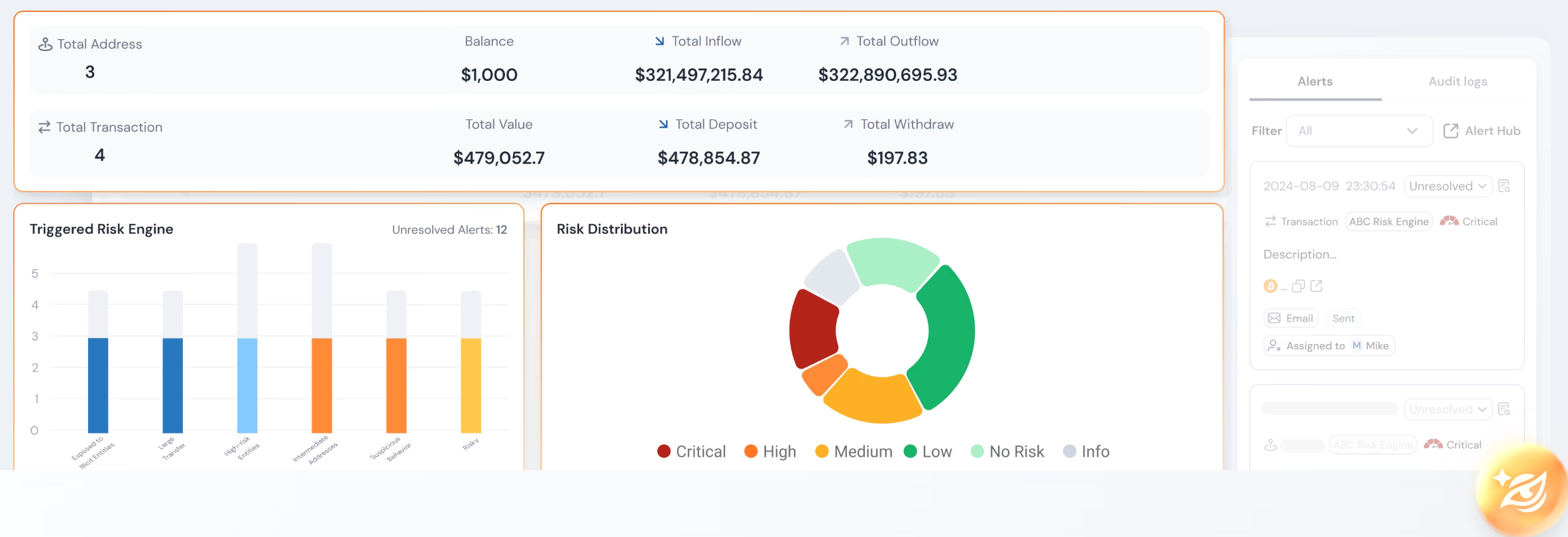
Phalcon Compliance combines a large-scale address label library with fund path analysis and behavioral recognition to score on-chain addresses and surface the risk networks a frozen or high-risk address is connected to. This is what Phalcon Compliance does. It draws on a label library of more than 600 million blockchain addresses. Its risk engine reads across 17 Risk Indicator categories, from Sanctioned, Scam, and Mixing to FATF High Risk Jurisdiction and FATF Grey List Jurisdiction.
When a frozen address or a related one appears in your transaction flow, the platform flags the connection and shows the path that links your exposure to the freeze. That turns a blacklist event you did not initiate into a risk signal you can act on before funds move. It also lets you see the second-order exposure: a wallet that received funds from a blacklisted address carries a link to the freeze even if it was never frozen itself.
This matters most at three moments: before you receive funds, before you pool them into a treasury, and before you send them out. In each case, the question is the same. Has this address, or anyone it has touched, been frozen or linked to a frozen network? Phalcon Compliance answers that question from on-chain evidence instead of waiting for an issuer notice.
What to Do Next
If your business holds, accepts, or settles stablecoins, freeze risk is a standing exposure, not a one-off. Add freeze and blacklist monitoring to your compliance workflow so a frozen address or the wallets linked to it surface before settlement.
Start with the addresses that matter most: the wallets you receive from, the pools you hold in, and the parties you settle with. Then monitor them the way the issuers themselves do, with on-chain visibility into blacklist changes and the networks behind them.
Manage stablecoin freeze risk with Phalcon Compliance, and Download the stablecoin freeze risk whitepaper for the full data set and the treasury-management framework behind it.
Two pieces complete the freeze picture: what happens when a stablecoin wallet is frozen walks through the three-stage response, and how issuers manage freeze and blacklist risk explains the policy layer behind each freeze.
To check a specific address, see how to check a USDT address for freeze status, fund sources, and risk labels.
For the full picture of stablecoin rules, freezing risk, and payment AML, start from the Stablecoin Compliance guide.