
The Short Answer: Freeze Risk Is a Distinct Asset-Availability Risk
Stablecoin issuers face two different safety questions, and the difference between them is easy to miss. The first is whether an attacker can steal the private keys that control the treasury. The second is whether the issuer of a stablecoin, or a compliance action behind it, can freeze or blacklist the assets those keys protect. Issuers manage that risk across four dimensions, four control points, and continuous monitoring. The private keys can stay in the issuer's control while the tokens themselves become unavailable, because the token contract, the redemption path, or the issuing entity can restrict circulation. That capability is becoming a legal expectation rather than a design choice: under the GENIUS Act, signed on July 18, 2025, US payment stablecoin issuers must be able to seize, freeze, and burn tokens and to prevent their transfer, with the requirements phasing in through early 2027. An issuer that cannot restrict circulation is out of step with where US regulation has landed.
That distinction is the point of this article. A custodian that keeps keys safe is still exposed if a freeze action on the token makes those tokens unusable. A treasury team that thinks in terms of private-key security will build the wrong controls. BlockSec structures stablecoin freeze risk across four dimensions: address risk, link risk, behavior risk, and fund pool risk. This framework is a BlockSec whitepaper model, not a regulatory standard. The rest of this article walks through those four dimensions, the four control points that turn them into decisions, and the screening that keeps the picture current.
For a stablecoin issuer this is not a hypothetical concern. Sanctions lists and blacklists are updated continuously, and a single deposit from the wrong address can pull a whole treasury into the freeze decision of the stablecoin issuer or a regulator. Managing the risk well means never accepting the assets that would trigger a freeze, not reacting to one after it lands.
The Four Dimensions of Freeze Risk
The four dimensions break freeze risk into questions an issuer can actually answer.
Address risk asks whether the address itself already carries public high-risk marks, sanctions listings, or unusual labels. Public lists such as the OFAC digital currency address mechanism are the most basic external reference for this layer. An address that already appears on one of those lists should never reach the treasury at all, because accepting it imports the label along with the funds.
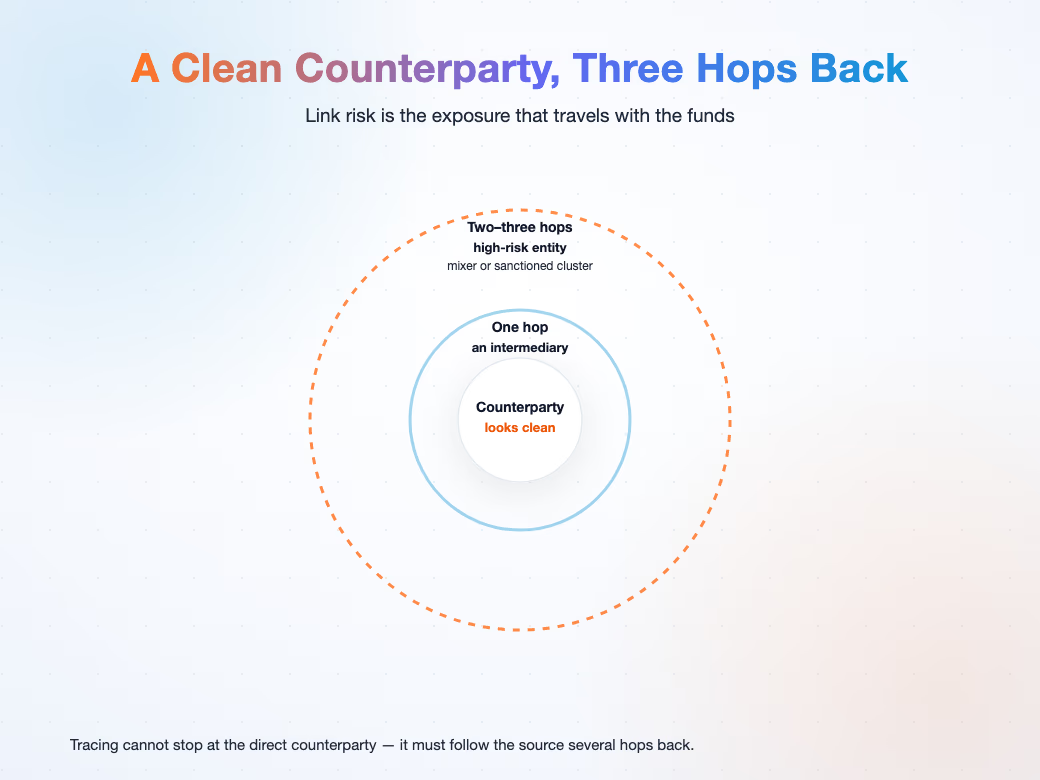
Link risk traces who the address has interacted with before and after it entered the treasury, which is why tracing cannot stop at the direct address. It has to follow the source of its funds through multiple hops, because a clean-looking address can carry risk from further upstream. A deposit that looks routine at one hop can be exposed several hops back.
Behavior risk looks past a single address to related address clusters, historical anomalies, and unusual transaction behavior such as fund splitting. A single address can look routine while the cluster around it is not. Splitting funds into many small transfers is a classic sign that the transaction is trying to hide a pattern.
Fund pool risk asks whether risky assets have already entered the main pool, mixed with clean assets, or are positioned to spread further through consolidation and payouts. This is the dimension that turns a single bad deposit into a treasury-wide problem, because once risky assets mix with clean ones the whole pool inherits the exposure.
| Dimension | What it asks about the other side | The exposure if it is missed |
|---|---|---|
| Address risk | Does the address already carry public high-risk marks or sanctions labels | Importing a listed label straight into the treasury |
| Link risk | Who has the address interacted with, across hops | Routine-looking deposits exposed several hops back |
| Behavior risk | Does the cluster around it act unusually | Fund splitting hiding a single large exposure |
| Fund pool risk | Where will the funds sit | A flagged batch contaminating the main pool |
The Four Control Points for Managing Freeze Risk
Because freeze risk keeps moving, control cannot be a one-time check. The four control points are before receiving, before consolidation, before payout, and periodic re-review of existing assets. Before receiving decides whether to accept an incoming transfer from a given address. Before consolidation decides whether to merge a batch of assets into the main pool. Before payout decides whether to send funds to a high-risk address. Periodic re-review checks whether the risk exposure of assets already on the balance sheet has changed.
These four points mirror the logic behind continuously updated sanctions data. Risk control is not a one-time acceptance; it is ongoing monitoring. A control that runs only at onboarding leaves every later deposit, merge, and payout outside the decision, and a treasury that skips re-review will keep carrying assets whose exposure has silently grown.
The order of the control points also matters. Each earlier point stops risk before it reaches the next one. Screening before receiving keeps a bad deposit out. Screening before consolidation stops it from spreading. Screening before payout stops the issuer from pushing risk outward. Re-review catches the exposure that slipped through an earlier stage.
How Phalcon Compliance Makes Freeze Risk Visible
Phalcon Compliance turns the four dimensions and the four control points into a live screening view. Phalcon Compliance KYA supports deep multi-hop fund tracing to build a cross-chain, cross-entity risk profile. This is what Phalcon Compliance KYA does. Phalcon Compliance KYT runs real-time transaction monitoring so a risk change is surfaced as it happens. Together the two features cover the static question of what an address is and the moving question of what a transaction is doing.
Phalcon Compliance draws on 600M+ labeled addresses across sanctions, fraud, hacks, and mixers. Phalcon Compliance reads risk across 17 Risk Indicator categories rather than from a single label. The result is that each control point can make a decision with the full four dimensions in view, not with a single static label. A team can screen the same address before receiving, before consolidation, and before payout, and re-review it on a schedule, so the decision is always made against the current risk picture.
What to Do Next
If your treasury still treats freeze risk as a private-key problem, the next step is to make the four dimensions visible at each of the four control points. Start with the addresses that matter most, and screen them before every deposit, merge, and payout rather than once at onboarding.
Manage stablecoin freeze risk with Phalcon Compliance, or Download the stablecoin freeze risk whitepaper to see the full framework and the deployment plan behind it.
For the mechanics and the incident side, see how USDT and USDC freezing works and what happens when a stablecoin wallet is frozen.
For the full picture of stablecoin rules, freezing risk, and payment AML, start from the Stablecoin Compliance guide.