A Tether pode queimar meu USDT depois de congelá-lo? Sim. Depois que a Tether chama
addBlackListpara congelar um endereço, seu proprietário pode chamardestroyBlackFundsnaquele endereço para reduzir permanentemente o fornecimento de tokens — esta é a função que torna o USDT congelado irrecuperável na carteira de origem, não apenas bloqueado. A função está definida no contrato inteligente USDT no Ethereum (0xdAC17…1ec7) e espelhada na Tron. Se o seu USDT foi destruído como parte de um caso federal dos EUA, o processo de Recuperação de Tokens da Tether historicamente combina a queima com uma nova emissão de USDT equivalente para a agência confiscante ou uma carteira designada pelo tribunal — os tokens no seu endereço desaparecem, mas o valor pode chegar às vítimas identificadas por meio do tribunal, não diretamente de volta a você.
O contrato inteligente USDT expõe uma função chamada destroyBlackFunds que permite à Tether queimar permanentemente o saldo de USDT em um endereço previamente incluído na lista negra, decrementando o fornecimento total de tokens naquela rede. Ao contrário de um simples congelamento, que apenas bloqueia um endereço de movimentar seu USDT, uma destruição é irreversível naquele endereço. Os tokens específicos desaparecem e nenhum caminho on-chain pode recuperá-los. Mas "destruído" nem sempre significa "perdido para a vítima." No fluxo de recuperação, a política de Recuperação de Tokens da Tether geralmente combina a queima com uma nova emissão de USDT equivalente para um endereço designado pelo tribunal ou da vítima, de modo que os tokens desaparecem, mas o valor não.
A análise de lista negra de 2025 da BlockSec colocou o volume que essa função movimentou em 2025 em aproximadamente $698 milhões, dos cerca de $1,26 bilhão que a Tether incluiu na lista negra no Ethereum e na Tron. A destruição não é um caso extremo raro. Ela representa aproximadamente metade do que um congelamento eventualmente resolve.
Este guia é o passo a passo em nível de código desse mecanismo: a função exata no contrato USDT, quem pode chamá-la, quando a Tether usa a destruição versus um simples congelamento, o padrão de recuperação de vítimas por queima e reemissão, os notáveis eventos de destruição de 2026, e como pesquisadores e jornalistas devem enquadrar o volume de destruição ao reportar sobre ele.
A função de queima em si: destroyBlackFunds
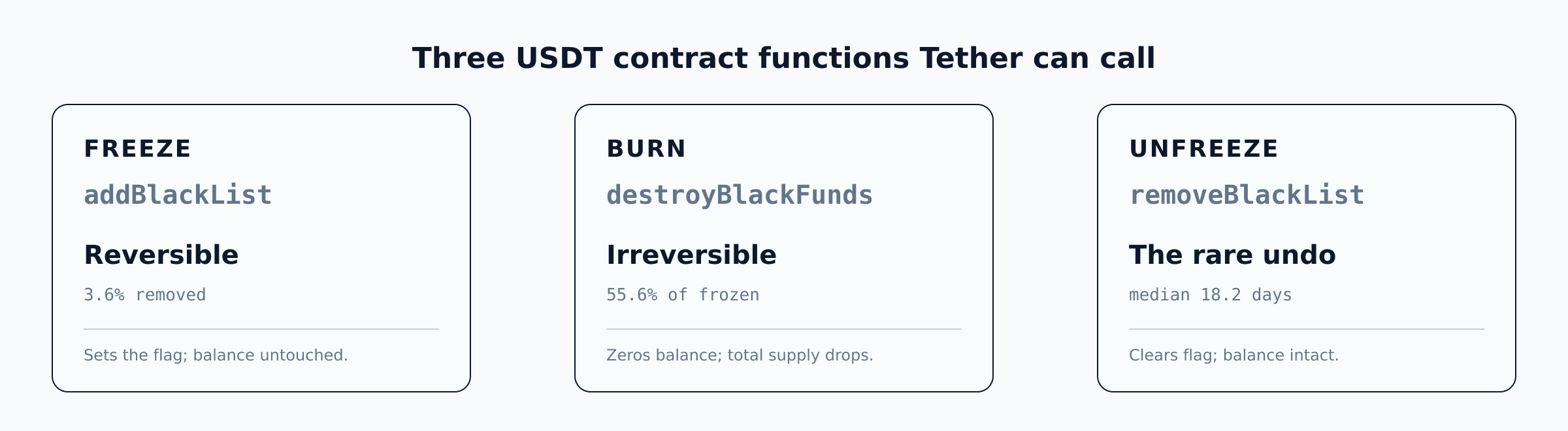
A função destroyBlackFunds(address) é a terceira do conjunto de três funções de aplicação do contrato USDT, sendo as outras duas addBlackList (o congelamento) e removeBlackList (o descongelamento). É a única das três que altera o saldo de USDT do alvo e o fornecimento total de tokens on-chain.
O código real do contrato USDT implantado
Aqui está o trecho relevante do contrato USDT implantado no Ethereum em 0xdAC17F958D2ee523a2206206994597C13D831ec7 (pragma solidity ^0.4.17, portanto a emissão de eventos usa a sintaxe anterior à versão 0.4.21: apenas o nome da função, sem a palavra-chave emit):
function addBlackList (address _evilUser) public onlyOwner {
    isBlackListed[_evilUser] = true;
    AddedBlackList(_evilUser);
}

function removeBlackList (address _clearedUser) public onlyOwner {
    isBlackListed[_clearedUser] = false;
    RemovedBlackList(_clearedUser);
}

function destroyBlackFunds (address _blackListedUser) public onlyOwner {
    require(isBlackListed[_blackListedUser]);
    uint dirtyFunds = balanceOf(_blackListedUser);
    balances[_blackListedUser] = 0;
    _totalSupply -= dirtyFunds;
    DestroyedBlackFunds(_blackListedUser, dirtyFunds);
}
Cinco linhas de Solidity codificam todo o mecanismo de destruição: verificar se o endereço está na lista negra, ler seu saldo em uma variável local chamada dirtyFunds, zerar o saldo, decrementar _totalSupply e emitir um evento.
O require: a destruição só pode seguir um congelamento
A verificação require(isBlackListed[_blackListedUser]) é a proteção no contrato implantado. Se o endereço alvo não estiver já na lista negra, a transação é revertida. A destruição sempre segue um congelamento — cada evento de destruição on-chain tem um evento de congelamento precedente, ambos publicamente indexáveis em ordem.
O evento e os dois efeitos não reversíveis
Cada chamada de destruição bem-sucedida emite DestroyedBlackFunds(_blackListedUser, dirtyFunds), indexado no Etherscan, Tronscan e no rastreador da BlockSec. Dois efeitos on-chain são não reversíveis: o mapeamento balances do endereço alvo é zerado (nenhuma função undoDestroy existe), e _totalSupply é permanentemente decrementado pelo valor queimado. A Tether pode compensar o valor por meio de uma nova emissão em outro lugar, mas os tokens originais e o slot de fornecimento desaparecem.
Apenas a chamada de destruição muta o estado real. O congelamento apenas inverte um sinalizador e bloqueia transferências; o descongelamento limpa esse sinalizador. Somente a destruição zera o saldo e decrementa o fornecimento total.
Quem pode chamar destroyBlackFunds
A destruição é uma chamada onlyOwner tanto no contrato USDT do Ethereum quanto no contrato USDT TRC-20. O proprietário não é uma única chave ativa. É um endereço multisig controlado pela Tether Ltd., com um período de atraso entre a proposta de transação e a execução.
Nenhum ator externo pode acionar uma destruição na camada do contrato. Nenhum tribunal, regulador, corretora, DAO ou outro emissor pode acioná-la. Quando uma ordem judicial de confisco civil chega, a sequência é: ordem judicial → a conformidade da Tether recebe e valida internamente → o multisig da Tether propõe e executa a destruição → o evento on-chain ocorre. A Tether é o ator registrado on-chain mesmo quando uma agência governamental é a autoridade subjacente.
O atraso do multisig é informação pública. Qualquer pessoa monitorando a atividade do multisig do proprietário da Tether pode ver uma destruição proposta antes de sua execução. O problema da janela de atraso que permite que um subconjunto de alvos de congelamento mova seu USDT antes que um congelamento seja efetivado é uma preocupação do lado do congelamento, não do lado da destruição: quando uma destruição é proposta, o sinalizador isBlackListed do alvo já é true, portanto os tokens já estão imobilizados.
O mesmo conjunto de três funções existe no contrato TRC-20 com controles equivalentes somente do proprietário. O Arquivo de Relatórios de Congelamento USDT da BlockSec mostra que a Tron domina o volume de destruição de USDT em 2026, tipicamente 85-97% da atividade tanto por contagem quanto por valor em uma determinada semana, mas o mecanismo é idêntico: mesma proteção, mesma estrutura de eventos, mesmo decremento de _totalSupply.
Quando a Tether usa a destruição em vez de apenas congelar
A Tether usa apenas o congelamento (sem destruição) quando a situação está sob investigação ativa. A Tether chama a destruição somente quando o caso foi resolvido em uma disposição formal: uma ordem judicial de confisco civil, uma designação da OFAC com um caminho de disposição implícito, ou uma petição verificada pela Tether de vítima para recuperação via reemissão.
O padrão se divide em uma estrutura de autorização de dois níveis.
O primeiro nível é somente congelamento. Um congelamento é executado a critério da Tether, sem necessidade de ordem judicial, de minutos a horas desde uma solicitação de informações das autoridades policiais até o bloco executado. O USDT é imobilizado on-chain, com o saldo intacto.
O segundo nível é destruição mais reemissão. Uma destruição, especialmente quando combinada com uma nova emissão, requer um fundamento legal mais robusto: uma ordem judicial de confisco civil (prazo típico de meses do congelamento à destruição para casos civis; mais rápido com processos criminais), ou uma petição de vítima verificada pela Tether com evidências de rastreamento que atendam ao padrão interno de conformidade da Tether. A Tether realiza internamente uma nova auditoria do rastreamento antes de acionar, porque destruir tokens pertencentes a um terceiro inocente exporia a Tether a risco de conversão e violação de dever fiduciário.
A divisão categórica do que acaba sendo destruído: destruições relacionadas a sanções (OFAC, programas de financiamento ao terrorismo), que avançam mais rapidamente uma vez que a determinação subjacente é final (veja a análise on-chain da BlockSec); casos de recuperação de fraude onde a vítima foi identificada, quase sempre combinados com uma reemissão; e apreensões por autoridades policiais (confisco civil ou criminal) onde a reemissão vai para uma carteira custodiante controlada pelo governo.
O volume de destruições em 2025 ficou em aproximadamente $698 milhões contra aproximadamente $1,26 bilhão de valor congelado no mesmo ano, cerca de 55,6%. Esse número descreve a taxa de transferência do pipeline ao longo do ano, em vez do destino de qualquer dólar específico incluído na lista negra em 2025, porque algumas destruições de 2025 resolvem congelamentos de 2023-2024. O que importa para um operador de conformidade é a direção: uma grande parcela do USDT incluído na lista negra acaba sendo queimada, e essa queima muitas vezes é combinada com uma reemissão em algum lugar on-chain, como a próxima seção aborda.
"Destruído" não significa "perdido": o mecanismo de queima e reemissão
Quando a Tether chama a destruição, os tokens naquele endereço são permanentemente queimados. Mas a Tether frequentemente combina a queima com uma nova emissão de USDT equivalente para um endereço designado pelo tribunal ou da vítima, de modo que os tokens desaparecem; o valor, não. Este é o aspecto mais mal compreendido do mecanismo de destruição no conteúdo SERP da era 2022, e muda como a proporção destruição-congelamento do mesmo período deve ser interpretada.
Como queima + reemissão funciona: os 2 passos
O padrão tem duas etapas on-chain distintas:
- Destruição no endereço ruim.
destroyBlackFunds(endereço_ruim). O saldo vai a zero,DestroyedBlackFundsé acionado, o fornecimento total é decrementado. - Emissão no endereço bom. A Tether chama a função de emissão padrão (também
onlyOwner) para emitir uma quantidade equivalente de USDT para um endereço designado pelo tribunal ou da vítima. O fornecimento total incrementa de volta pelo mesmo valor.
Efeito líquido no fornecimento total de USDT: zero. Efeito líquido nos tokens específicos que estavam no endereço ruim: desapareceram. Efeito líquido no valor: ele agora está em um endereço diferente, controlado pelo proprietário legítimo ou por um custodiante governamental.
Por que os dois passos em vez de "reatribuir saldo"? Porque o contrato USDT não tem tal função. transfer e transferFrom, as primitivas de movimentação ERC-20 padrão, exigem a chave privada do endereço de envio, e por definição a vítima de boa-fé não possui essa chave. A queima e reemissão é o mecanismo que permite que o valor chegue à vítima sem precisar da chave privada do atacante ou reverter o endereço de origem.
A política oficial de recuperação da Tether
A Tether publica uma política formal de Recuperação de Tokens que detalha o processo para vítimas:
- Solicitações de recuperação aceitas para valores superiores a $1.000.
- Taxa: até 10% do valor de recuperação, ou mínimo de $1.000, o que for maior.
- A avaliação da Tether é a "critério exclusivo e absoluto" e é final.
- Canal formal: a equipe de Solicitações de Informações da Tether.
A taxa de 10% não é trivial para recuperações de grande valor, e "critério exclusivo" significa que não há direito formal à recuperação. Mas o caminho existe e é utilizado em escala real.
A auditoria secundária interna da Tether
Antes de executar uma destruição e reemissão, a equipe de conformidade da Tether realiza uma auditoria interna secundária das evidências de rastreamento: reexecutando o agrupamento de endereços, verificando a reivindicação de propriedade e verificando se nenhuma carteira de terceiro inocente está entrelaçada com o alvo de destruição. A motivação é exposição legal: destruir USDT que pertencia a uma contraparte inocente (um depósito custodiante recente, uma carteira ativa de corretora, uma parte OTC downstream) expõe a Tether a risco de conversão e violação de dever fiduciário. É por isso que o prazo do congelamento à destruição normalmente leva muitos meses para casos de confisco civil, e por que o volume de destruição em qualquer mês tende a ser de casos de congelamento de meses anteriores.
O que "destruído" realmente significa para o valor
A proporção destruição-congelamento de ~55,6% no mesmo período é frequentemente reportada como "$698 milhões perdidos." Para o endereço que foi incluído na lista negra, sim: o USDT desapareceu. Mas para o valor que esses tokens representavam, a destruição frequentemente é combinada com uma nova emissão para o proprietário legítimo ou um custodiante governamental. Esse novo USDT então vai para as autoridades policiais, para a vítima, ou para um processo de disposição controlado pelo tribunal.
O enquadramento correto é que a destruição é uma primitiva de recuperação, não uma punição. Jornalistas escrevendo sobre um evento específico de destruição devem sempre perguntar se a destruição foi combinada com uma reemissão em algum lugar on-chain, e onde os tokens reemitidos foram parar. Essa é a história do que realmente aconteceu com o valor.
Eventos notáveis de destruição
Casos relevantes de destruição na pauta de 2024-2026, do mais recente ao mais antigo.
- Congelamento de $131M do IRGC iraniano (14 de julho de 2026): o Secretário do Tesouro Scott Bessent anunciou designações da OFAC contra quatro carteiras Tron vinculadas ao IRGC e ao Banco Central do Irã sob a Ordem Executiva 13902, parte da Operação Fúria Econômica. A Tether executou o congelamento em todas as quatro em poucas horas. Combinado com a ação de abril, os congelamentos de USDT vinculados ao Irã divulgados publicamente em 2026 totalizam pelo menos $475M ($344M mais $131M), um piso conservador já que congelamentos adicionais vinculados ao Irã nem sempre são anunciados individualmente. Todos são candidatos a destruição e reemissão conforme os processos de confisco amadurecem.
- Congelamento de $344M do Irã (23 de abril de 2026), o maior congelamento único da Tether já registrado: dois endereços Tron (
TNiq9...QZH81em $213M eTTiDL...pjSr9em $131M), executado em coordenação com as autoridades dos EUA. A OFAC designou ambos os endereços como propriedade do Bank Markazi do Irã (Banco Central do Irã) com vínculos com a Força Qods do IRGC e o Hizballah; o comportamento de ambos os endereços se encaixava em armazenamento de reservas soberanas em vez de lavagem ativa. O CEO da Tether, Paolo Ardoino, confirmou a coordenação no anúncio oficial. O USDT congelado deve progredir por meio de confisco civil para custódia governamental pelo caminho de queima e reemissão. - Drift Protocol (abril de 2026): uma exploração em uma DEX de perps na Solana que dreneu ~$285M inicialmente, revisado para ~$295M em perdas de usuários depois que a Mandiant atribuiu a operação a atores vinculados à RPDC que passaram meses infiltrando a equipe. A Tether então liderou um pacote de resgate de até $147,5M ($127,5M da Tether mais $20M de parceiros) com USDT substituindo USDC como camada de liquidação da Drift no relançamento. A escala de nove dígitos em um único evento de recuperação de vítima mostra que o padrão de queima e reemissão opera muito além de casos individuais de cinco dígitos.
- $182M em janeiro de 2026 distribuídos em 5 carteiras Tron: uma tranche anterior da Operação Fúria Econômica, em grande parte não divulgada quanto à atribuição específica, mas parte do ~$1 bilhão em criptomoedas iranianas que o Secretário do Tesouro Bessent disse que os EUA apreenderam desde o início da campanha.
- IRGC iraniano $6,76M (2024): a Tether coordenou com autoridades dos EUA e de Israel para congelar USDT vinculado ao Corpo de Guardiões da Revolução Islâmica do Irã e às forças Houthi (estudo de caso da BlockSec). O rastreamento on-chain da BlockSec mostra que partes progrediram para destruição.
- Padrões de financiamento ao terrorismo do Hamas (2023-2025): múltiplos congelamentos visando fluxos de USDT para carteiras afiliadas ao Hamas. Destruições se seguiram para o subconjunto vinculado a designações formais.
Para o volume agregado de destruições, o Arquivo de Relatórios de Congelamento USDT da BlockSec publica contagens diárias, semanais e mensais em ambas as redes. Amostras recentes: mensal de junho de 2026, 65 queimas, $37,58M destruídos (Tron $29,08M / Ethereum $8,50M); Semana 29 (13-19 de julho de 2026), 12 queimas. A atividade de destruição é menor do que a atividade de congelamento em qualquer semana. Os congelamentos são a porta da frente e as destruições são a porta dos fundos do mesmo pipeline, com latência de processamento de caso de 6 a 18 meses entre os dois.
Transformar esse pipeline em uma visão operacional do seu próprio portfólio é onde a triagem de carteiras e o monitoramento de eventos entram em cena.
O que "destruição" significa para conformidade e destinatários
Para o destinatário cujo endereço é destruído, a recuperação no nível do contrato é nula — sem undoDestroy, sem caminho administrativo para restaurar o saldo queimado. O único caminho é a política de recuperação da Tether, perseguida como uma petição com evidências de rastreamento. O resultado realista depende de demonstrar propriedade inocente à satisfação da Tether; se o endereço foi sinalizado por causa legítima (correspondência de sanções, solicitação das autoridades), as chances de uma reemissão são efetivamente zero.
Para o operador de conformidade monitorando seu portfólio, um evento de destruição em um endereço ao qual você tinha exposição é um gatilho de gestão de caso mesmo depois que o fluxo de trabalho inicial de congelamento foi encerrado. As obrigações de relatório regulatório continuam ao longo do ciclo de vida da destruição e reemissão. O artefato de trilha de auditoria deve registrar todos os três eventos naquele endereço: AddedBlackList, DestroyedBlackFunds e (se visível) a reemissão combinada no endereço de destino.
Para o quadro fiscal e contábil, o tratamento varia por jurisdição. Em algumas jurisdições, a destruição é tratada como uma perda e a reemissão como uma nova aquisição (potencialmente acionando um evento tributável mesmo que economicamente a vítima volte ao ponto de partida); em outras, as transações combinadas são tratadas como uma única participação contínua. O IRS não emitiu orientação específica sobre pares de destruição e reemissão até meados de 2026, e o framework EU MiCA é silencioso no lado fiscal. Documente ambas as etapas on-chain com números de bloco e carimbos de tempo, e consulte um especialista tributário em sua jurisdição. Para mesas OTC e comerciantes, o risco de destruição é downstream do risco de congelamento. Quando a destruição ocorre, a exposição OTC geralmente já está resolvida pelo caso de congelamento; o manual é o mesmo — triagem pré-transação mais monitoramento de eventos pós-transação.
Contexto acadêmico e setorial
A conexão acadêmico-setorial aqui é nosso trabalho mais amplo sobre fluxos de fundos ilícitos on-chain, incluindo o artigo SIGMETRICS 2026 Shedding Light on Shadows, que apresenta o framework MFTracer para rastrear fluxos de dinheiro por caminhos on-chain complexos. Essa linhagem analítica é o que informa a instrumentação do Rastreador de Congelamento USDT da BlockSec do fluxo de eventos de lista negra / destruição / reemissão. O lado do rastreamento (seguir o dinheiro) é complementar ao lado da discrição (o que a Tether faz com o que encontra). Tratar o volume de destruição em qualquer período como um sinal de conformidade independente lê incorretamente os dados, porque a destruição é uma função defasada do volume de congelamento de meses anteriores.
A implicação regulatória é que a capacidade de destruição está se tornando um pré-requisito de licenciamento de fato para emissores de stablecoins de pagamento. Sob a Lei GENIUS dos EUA (2025), os emissores de stablecoins de pagamento permitidos são tratados como instituições financeiras regulamentadas sob a Lei de Sigilo Bancário, com obrigações de Manutenção de Registros / Regra de Viagem para transferências de $3.000 ou mais e triagem obrigatória de listas de sanções sob a regra de implementação proposta pelo Tesouro. O congelamento (e a destruição downstream sob uma disposição legal formal) não é mais um diferencial; é uma pré-condição de licenciamento. A Portaria de Stablecoins de Hong Kong (em vigor a partir de 1º de agosto de 2025) implica a mesma capacidade por meio de seus requisitos de AML/CFT e cooperação em sanções, e o regime MiCA da UE empurra os emissores na mesma direção. Espere que todos os emissores de stablecoins de pagamento (USDC, PYUSD, RLUSD, FDUSD e futuros tokens referenciados em HKD) construam capacidades equivalentes de destruição e reemissão conforme os regimes de licenciamento amadurecem.
Perguntas frequentes
O USDT destruído pode ser recuperado? Não no endereço contra o qual foi destruído. A destruição zera o saldo e decrementa o fornecimento total, sem reversão no nível do contrato. Mas quando a Tether combina a destruição com uma nova emissão para uma vítima ou endereço designado pelo tribunal (o padrão de queima e reemissão), o valor é recuperado como USDT recém-emitido. As vítimas devem buscar isso pelo processo oficial de Recuperação de Tokens da Tether.
Qual é a diferença entre destroyBlackFunds e uma queima normal de tokens?
Uma queima normal requer a chave privada do titular do token. O titular chama a função de queima em seu próprio saldo, em linha com o modelo de movimentação ERC-20. A destruição da Tether é onlyOwner, funciona no saldo de outra pessoa e é protegida por uma verificação require de que o endereço alvo já está na lista negra. É um mecanismo de aplicação/recuperação controlado pelo emissor, não uma queima voltada ao usuário.
Quem pode chamar destroyBlackFunds?
Apenas o multisig do proprietário da Tether, tanto no contrato USDT do Ethereum em 0xdAC17F958D2ee523a2206206994597C13D831ec7 quanto no contrato USDT TRC-20 em TR7NHqjeKQxGTCi8q8ZY4pL8otSzgjLj6t. Nenhum tribunal, regulador ou corretora pode acionar a destruição na camada do contrato.
destroyBlackFunds funciona no USDT da Tron?
Sim. O mesmo conjunto de três funções existe em ambas as redes com controles equivalentes somente do proprietário. Em 2026, o Arquivo de Relatórios de Congelamento USDT da BlockSec mostra a Tron dominando a atividade de destruição, tipicamente 85-97% do total de uma determinada semana.
Quanto USDT foi destruído até hoje?
O relatório de 2025 da BlockSec registrou aproximadamente $698 milhões destruídos contra aproximadamente $1,26 bilhão incluídos na lista negra no mesmo ano, uma proporção de fluxo no mesmo período de cerca de 55,6% (não uma taxa de sobrevivência de coorte, já que algumas destruições correspondem a congelamentos de anos anteriores). Os volumes mensais de destruição em 2026 têm sido na casa das dezenas de milhões (por exemplo, $37,58M em junho de 2026). O volume acumulado total pode ser reconstruído a partir do fluxo de eventos DestroyedBlackFunds em ambas as redes via Etherscan e Tronscan.
Se meu USDT foi destruído, ainda posso ser compensado? Se você é uma vítima legítima de terceiros (não o titular do endereço sinalizado), sim: envie uma solicitação de recuperação pelo processo oficial da Tether. Solicitações acima de $1.000 são aceitas; taxa de até 10% ou mínimo de $1.000. Se você era o titular do endereço sinalizado e o congelamento foi por causa legítima, as chances práticas são efetivamente zero.
Leituras relacionadas
- Congelamento de USDT: O Guia Completo de 2026
- Como Descongelar um Endereço USDT
- Como Verificar se um Endereço USDT Está Congelado
- A Lista Negra do USDT, Explicada (2026)
- O Manual de Congelamento de USDT para Mesas OTC
Sobre o autor

Andy é cofundador da BlockSec. A BlockSec desenvolve o MetaSleuth, o Trace AI e o Phalcon Compliance. Ele também é Professor Associado na Universidade Chinesa de Hong Kong, onde sua pesquisa se concentra em segurança de sistemas e blockchain. Página pessoal: yajin.org.
Siga: X / Twitter · LinkedIn