
The Short Answer
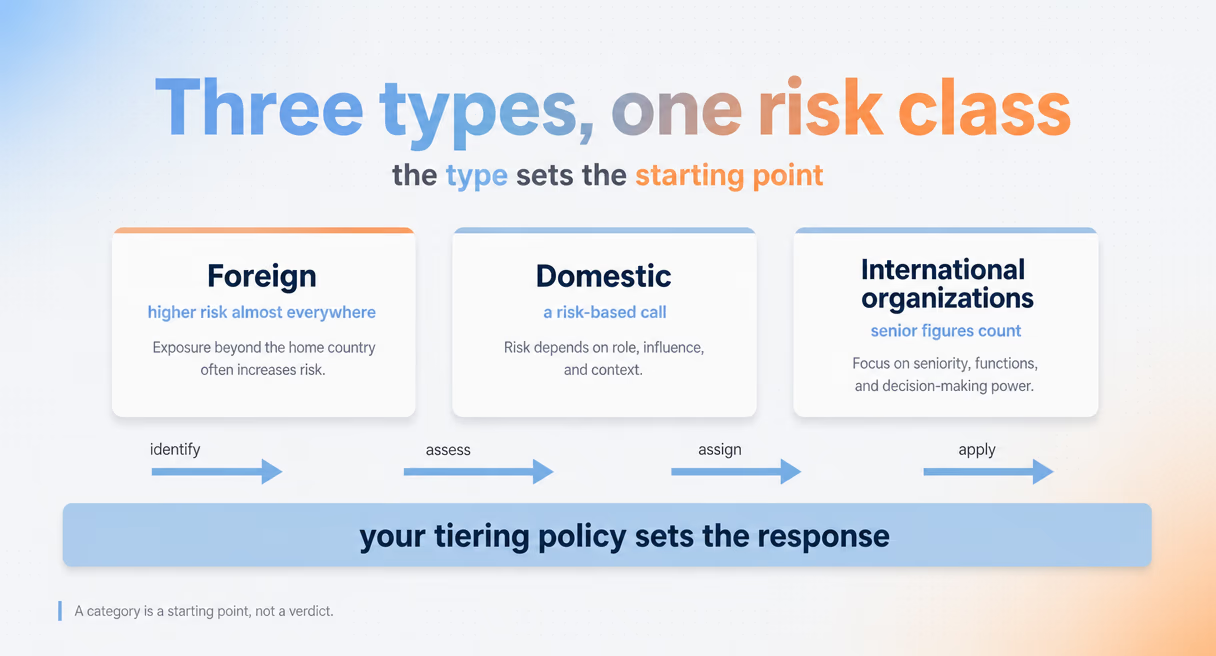
FATF sorts politically exposed persons into three types: foreign, domestic, and figures in international organizations. The type decides your starting point. Under FATF-aligned rules, foreign PEPs are treated as higher risk by default, while domestic PEPs trigger a risk-based judgment by the institution. Applicable law and PEP type set the minimum measures; your tiering policy determines any additional scrutiny, not an exemption from that legal floor. The PEP compliance hub collects the related guides.
The Types of PEPs, in Plain Terms
Three buckets cover the field. A foreign PEP holds public office abroad, a domestic PEP holds it at home, and the third type covers directors and senior officers of international organizations. The buckets are entry points: what each one obliges you to do is decided in the sections below.
A foreign PEP is a person entrusted with a prominent public function by another country: a foreign minister, parliament member, senior judge, or ambassador. A domestic PEP holds the equivalent functions inside your own jurisdiction. The third type covers people entrusted with prominent functions by an international organization, such as directors and deputy directors. FATF guidance on PEPs (Recommendations 12 and 22) set the categories, and the definition excludes middle-ranking and junior officials, so the label attaches to senior functions rather than to every public employee.
The definitions series on our blog walks through what the three types are in introductory terms; this guide goes one layer down, into what each type obliges your program to do.
Domestic vs Foreign: Why the Distinction Matters
The distinction affects the starting point under the applicable framework. FATF calls for additional measures for foreign PEP relationships, while domestic and international-organization PEP relationships require a risk-based assessment and additional measures when higher risk. Local law may set a stricter floor, including for domestic PEPs in the EU; internal tiers cannot waive that floor.
For foreign PEPs, the default is strict. FATF Recommendation 12 treats foreign PEP relationships as higher risk and attaches a specific measure set, walked in full in the requirements guide. Most jurisdictions that follow the FATF text apply those measures to every foreign PEP relationship, not only the ones that look suspicious.
Domestic PEPs sit in a different lane. The same FATF text asks institutions to determine whether a customer is a domestic PEP, or a family member or close associate of one. Enhanced measures apply when the relationship carries higher risk. The judgment belongs to the institution, informed by local corruption exposure and the nature of the relationship. The European Union removed most of that discretion: its anti-money laundering directive applies the enhanced due diligence duties to domestic PEPs as well, treating the category as law rather than guidance.
The duties that follow from either lane have their own guide on PEP screening requirements.
The rest of the family, from data sources to monitoring, hangs off the PEP compliance hub.
PEP Risk Tiers and What Each Tier Requires
Type and applicable law establish minimum measures; tiers are an internal policy tool above that floor. One common model has higher-risk, medium, and normal-exposure tiers, weighing role influence, jurisdiction, funds complexity, and the relationship. The tier adjusts the intensity of scrutiny only where the framework permits discretion; it does not cancel mandatory PEP measures.
Under FATF-aligned requirements, foreign PEP relationships receive senior management approval, source-of-wealth and source-of-funds checks, and enhanced ongoing monitoring. A higher-risk tier may require deeper evidence and more frequent review. The medium and normal-exposure examples below apply only where local law permits risk-based discretion for the relationship; any mandatory PEP measures remain in place at every tier.
| Tier | Who typically lands here | Measures that come with it |
|---|---|---|
| Higher risk | Foreign PEPs under FATF-aligned requirements and other relationships assessed as higher risk | Applicable mandatory PEP measures, with enhanced due diligence and monitoring proportionate to the risk |
| Medium | Domestic or international-organization relationships with moderate exposure, where local law permits discretion | Applicable mandatory measures plus review proportionate to the assessed risk |
| Normal exposure | Confirmed lower-risk cases, only where local law permits this treatment | Applicable mandatory measures plus routine risk-based due diligence and monitoring |
Two properties make a tier model survive an audit. First, the assignment factors are written down: role influence, jurisdiction risk, source of funds complexity, and relationship nature, applied the same way to every file. Second, every assignment is the institution's own documented judgment. A risk rating is a policy output your team defends in writing, not a fact a tool hands you. The full duty side of tiering, including what each tier's measures require, is covered in PEP screening requirements and EDD.
Examples That Show How Classification Works
Three composite cases show the logic. A foreign official opening an account lands in the automatic tier. A family member of a legislator inherits scope and gets their own risk call. A former official two years out of office still draws a risk window before anything relaxes. All three are category combinations, not real people.
First case: a national-level minister from another country opens an account with your firm. Foreign PEP, automatic higher-risk tier. Before the relationship proceeds you need senior management approval, an established source of wealth and funds, and enhanced monitoring from day one.
Second case: a spouse of a member of your own parliament opens a personal account. Family members fall within the relevant PEP scope even if they hold no office. Identify the domestic PEP measures required by local law first, then assess the relationship and document the tier. A lower tier permits lighter additional scrutiny only where the law allows it; in a framework requiring enhanced measures for domestic PEPs, the spouse's low internal rating does not waive those measures.
Third case: a former senior official, out of office for two years, starts transacting. Leaving office does not clear the file: jurisdictions commonly keep a risk window after departure, and the timing rules, including the EU floor, are covered in the guide on PEP monitoring. When the window and the risk argument both close, the file can be re-rated rather than simply forgotten.
The family scope itself is part of the classification question, and its full extent is the single-check guide's ground, covered there with the confirmation fields. Wherever a family or close-associate tie exists, the question travels with it.
Classification only pays off when the reasoning survives, and that reasoning is yours: tier calls live in your own files. On the address side, Phalcon Compliance screens wallets, a separate evidence line that does not record PEP tiers.
The full family of guides is mapped on the PEP compliance hub.