A PEP definition covers anyone entrusted with a prominent public function, spanning foreign officials, domestic officials, and international organization figures. Look up the term and most sources stop at a single sentence. But the three types carry materially different regulatory weight. Misclassifying a match into the wrong tier is how programs end up either over-scraping routine relationships or under-screening dangerous ones. This guide breaks down each type, the risk logic behind it, and what the classification obligates a crypto compliance team to do.
The Working PEP Definition
In working terms, the classification reaches anyone who holds a prominent public function, and it splits that population into foreign officials, domestic officials, and senior figures in international organizations. The definition's purpose is risk classification, not accusation: it marks people whose office creates elevated money-laundering exposure, and it applies from the moment the office is held. FATF Recommendations 12 and 22 are the international source of the framework.
Foreign PEPs carry mandatory enhanced due diligence, domestic PEPs follow jurisdiction-specific rules, and international organization PEPs depend on seniority thresholds.
Type 1: Foreign PEPs
Foreign PEPs are individuals holding prominent public functions in a country other than the one screening them, and they sit at the top of every framework's risk hierarchy. Heads of state, heads of government, ministers, senior government officials, senior political party figures, and senior executives of state-owned enterprises fill this tier. FATF Recommendation 12 makes enhanced due diligence mandatory for foreign PEP relationships, the one tier where no institution has discretion.
The logic is corruption economics. Public office confers control over budgets, procurement, licensing, and enforcement; foreign office-holders exercise that control at a distance from the screening institution's home supervision. The proceeds of that control, from bribes to misappropriated state assets to kickbacks, need placement, and the individuals controlling them are precisely the people with the resources to structure that placement well.
The category is about office, not conduct. A foreign minister under no investigation whatsoever is a foreign PEP; the classification tracks the position's risk profile, not any individual's behavior. That distinction matters for how screening results are treated: a foreign-PEP match is grounds for enhanced due diligence, senior approval, and documented reasoning, not refusal by default.
Type 2: Domestic PEPs
Domestic PEPs are the same functional category applied to a country's own officials, and they are where the world's frameworks genuinely disagree. PEP type determines the due diligence floor, so classify every match into one of the three types before deciding on scrutiny depth. The core definition is identical: prominent public function, elevated risk by virtue of office. The divergence is in the required response. Some jurisdictions apply the same mandatory enhanced due diligence as for foreign PEPs, while others, following FATF's baseline, allow a risk-based approach that scales scrutiny to the actual risk of the relationship.
The disagreements are predictable. The EU has required enhanced due diligence for domestic PEPs since the Fourth Anti-Money Laundering Directive took effect in 2015 — Article 20 of Directive (EU) 2015/849 — and the 2024 AML Package carries that strict posture forward; what institutions calibrate is the depth of the diligence, not whether to apply it. The United States treats PEP status as one risk factor within its broader customer due diligence architecture rather than a standalone trigger, with two qualifications: enhanced scrutiny of private banking accounts held by senior foreign political figures is a statutory duty under 31 CFR 1010.620(c), and per the 2020 interagency statement U.S. institutions do not treat their own domestic officials as PEPs. Other jurisdictions land at points between, and multinational platforms inherit the practical consequence: the same domestic official can warrant different scrutiny depending on where the relationship sits. How the three frameworks line up on this split is unpacked in PEP Definitions Compared: FATF, FinCEN, and EU AMLD.
The tier's judgment calls are real. Is a municipal council member a domestic PEP? Frameworks generally answer with a seniority threshold rather than a yes/no: "prominent" function implies position at or near the top of a branch or institution. The practical guidance most programs follow: when seniority is ambiguous, treat the match as in-scope and let the risk assessment, not the classification, determine the response depth.
Type 3: International Organization PEPs
International organization PEPs are senior officials of entities like the United Nations, the World Bank, and the International Monetary Fund, people whose authority derives from an organization rather than a state. The category exists because the corruption risk logic transfers intact: senior positions in international organizations control procurement, program funds, and personnel decisions, and those controls create the same enrichment pathway as national office. FATF's framework applies a risk-based approach to this tier, with seniority thresholds determining who counts.
This is the tier screening programs most often miss, for a structural reason: name-screening systems built around national sanctions lists and domestic watchlists do not naturally surface international organization rosters. A director-general of a UN agency does not appear on the lists a compliance team checks most often. The gap is known and the frameworks account for it, but a program that has never mapped its screening sources against this tier will not catch what it does not look for.
The seniority threshold does real work here. International organizations employ hundreds of thousands of people; the PEP category covers the senior tier, those who direct the organization's resources, not the career staff below it. Where the line sits is defined by each organization's structure, and the conservative practice is to screen matches against the organization's senior leadership listings rather than a fixed rank.
The three types side by side make the regulatory gradient visible:
| Tier | Who it covers | EDD requirement | Risk weight |
|---|---|---|---|
| Foreign PEPs | Heads of state, ministers, senior officials, party leadership, state-owned enterprise executives | Mandatory under FATF R12 | Highest |
| Domestic PEPs | Same functional roles within the screening jurisdiction | Risk-based (FATF baseline) to mandatory (EU, AMLD4 since 2015) | Variable by jurisdiction |
| International organization PEPs | Senior management of UN, World Bank, IMF-class entities | Risk-based with seniority threshold | Often overlooked |
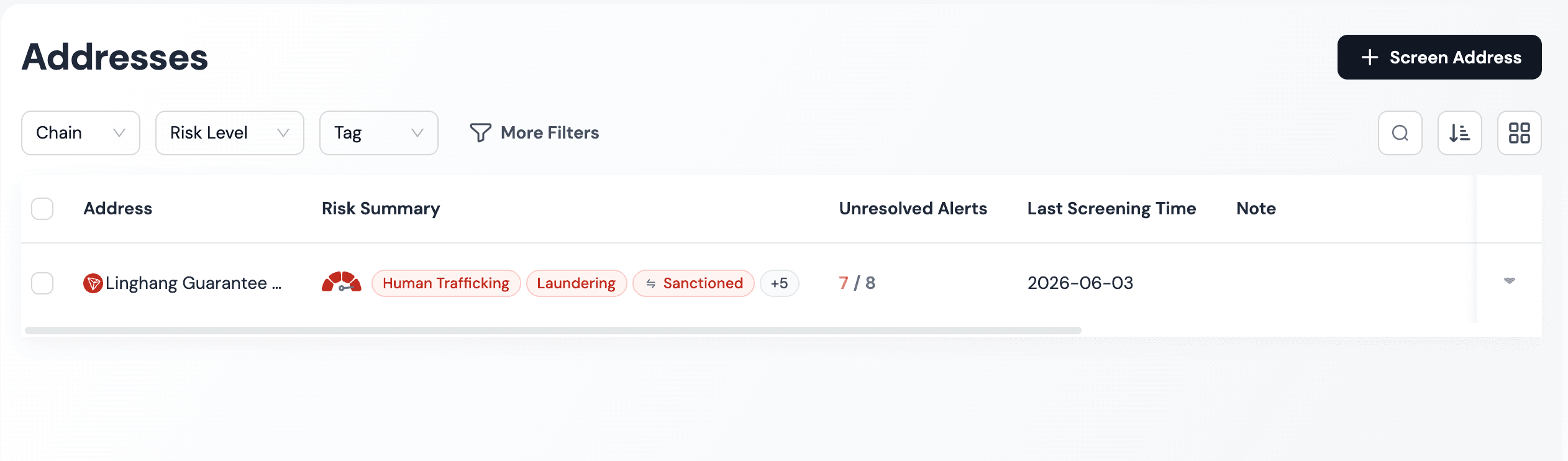
On the tooling side, the two disciplines split cleanly: PEP classification runs on identity data, while Phalcon Compliance carries the address half, screening wallet history against labeled intelligence.
Screen the Address Side
Classifying a match into the right PEP type is identity-side work; checking what the wallet behind a relationship has touched is address-side. Open Phalcon Compliance and run a first screen free: over 600 million labeled addresses, sanctioned entities among the categories, free tier for first checks, credit packages for light volume, subscription tiers as the program scales.
FAQ: PEP Definition Basics
Is a PEP always a government official? No, the definition extends past government office in two directions. Senior executives of state-owned enterprises are PEPs because they control state resources, and senior officials of international organizations are PEPs because organizational authority creates the same enrichment pathway. Private-sector executives with no state or organizational mandate are not PEPs, whatever their wealth.
Are PEPs criminals? No, and treating the classification as an accusation is the most common conceptual error. PEP status marks elevated risk by virtue of office, a probability statement, not a finding. Most PEPs never face an allegation. The classification obligates scrutiny appropriate to risk; it does not presume wrongdoing, and declining every PEP relationship outright is as much a program failure as ignoring the status.
How is a PEP different from a sanctioned person? A sanctioned person appears on an official designation list, such as OFAC's SDN list or an EU or UN sanctions regime, and dealing with them is legally prohibited. A PEP is classified by risk category, not listed by enforcement action, and the relationship is permitted subject to enhanced due diligence. The two overlap when a designated person also held public office, but the mechanisms are separate. Sanctions screening answers "is this prohibited." PEP classification answers "does this warrant elevated scrutiny." Address-side tools like Phalcon Compliance carry the sanctions-screening half at wallet granularity; the 2020 U.S. interagency PEP statement covers how the two obligations interlock in a U.S. program.
Where is the official PEP definition published? The international baseline is FATF Recommendation 12 and its companion guidance. National implementations layer on top: FinCEN's customer due diligence materials in the United States, the EU's AMLD texts, and equivalent national regulator publications. The official texts are short enough to read directly, and citing the correct one matters when a regulator asks a program to defend its classification decisions. For how the status starts, extends to family members, and fades after office, see Politically Exposed Person Status: Role, Not Registry.