Politically exposed person meaning centers on function: the status applies the moment someone takes a significant public role. That single framing resolves most of the confusion around the term. A PEP is not enrolled on a registry, does not carry an accusation, and does not lose the status the day the news cycle moves on. The meaning attaches to the office and radiates outward to the people around the officeholder. This piece unpacks that mechanism: what function creates exposure, who inherits it, and when it finally fades.
The Meaning: Function Creates Exposure
In practice the meaning turns on one question: does this person hold a public function significant enough to create elevated risk? When the answer is yes, the status applies regardless of any list, registry, or wrongdoing. The classification tracks the office, not the individual's conduct, which is why it can attach to a person under no suspicion whatsoever. Per FATF Recommendations 12 and 22, the functional test is "prominent public function," and the exposure it creates is what the classification names.
The distinction matters operationally. A registry-based check, sanctions lists for instance, answers one question: does this person appear on an official list. A function-based classification answers another: does the position create risk warranting elevated scrutiny. The first is a lookup; the second is a judgment about role.
| Dimension | Registry-based check | Function-based PEP classification |
|---|---|---|
| Question answered | Does this person appear on an official list | Does this position create risk warranting elevated scrutiny |
| Trigger | Enforcement or designation action | Taking a prominent public function |
| Timing | Updates when a list changes | Applies from the moment of appointment |
| Result type | Lookup result | Risk judgment about role |
A newly appointed minister becomes a PEP before any list updates; a private citizen with no public mandate never becomes one regardless of wealth.
Family Members and Close Associates
The meaning radiates to family members and close associates, who can hold or move funds on behalf of the official. The risk pathway runs through them as channels: an official who cannot receive a payment directly can route it through a spouse, a child, a sibling, or a business partner, and the classification follows the channel rather than stopping at the officeholder. FATF's framework treats family members and close associates as within the PEP definition's reach.
The family circle is defined concretely: spouse or equivalent partner, children and their spouses, parents, and in most frameworks siblings. Close associates extend beyond blood: the business partners, beneficial owners, and anyone with close relations enabling movement of the official's assets. The logic is not that these people are suspect; it is that they are proximate to the risk pathway. How the three PEP tiers themselves differ is covered in PEP Definition: The Three Types of Politically Exposed Persons Explained.
Screening practice follows the definition. A wallet transacting with a platform may belong to a family member with no public profile of their own. The PEP exposure arrives through the relationship, invisible to any check that looks only at the account holder's own conduct. This is one of the places where address-level screening and relationship-based risk genuinely interlock: the address's counterparties reveal the association that a name check would miss.
When Someone Stops Being a PEP
Leaving office does not clear the risk: what a term of public function created persists long after the handover ceremony. FATF's risk-based guidance recognizes the residue: institutions may apply enhanced due diligence to former PEPs for a period after they leave office, scaled to the continuing risk. There is no global bright line; "once a PEP" persists as a risk factor even after the mandatory tier steps down. PEP status is a living attribute: it starts at appointment, extends to associates, and decays gradually after office ends.
The decay logic is exposure economics. Corruption proceeds accumulated during office do not expire with the term; they persist as assets requiring management. A former official whose accounts warrant scrutiny at reduced intensity is still a different risk case than someone who never held office. Programs that treat status as binary, full EDD or nothing, miss the middle ground the frameworks explicitly provide.
Practical programs handle the transition with time windows and re-assessment. Full PEP treatment continues for a defined period after office ends; after that, the relationship drops to standard monitoring unless a reassessment finds continuing risk factors. The window's length varies by framework and by the office's risk weight: a former head of state's decay curve is longer than a former mid-level official's. What no framework permits is the opposite error: treating the status as permanent at full intensity forever, which exhausts scrutiny capacity on residual risk while current-office risk goes unwatched.
Why Role-Based Risk Matters for Screening
Role-based risk and list-based screening answer different questions, and a compliance program needs both running. List-based screening catches designated entities: sanctioned persons, flagged addresses, enforcement actions already taken. Role-based risk catches the exposure that function creates before any designation exists, whether the officeholder whose position invites corruption, the family member channeling funds, or the associate holding assets. The two signal types are complementary, not redundant. Phalcon Compliance covers the list-based half on-chain; identity-side tooling covers the role-based half.
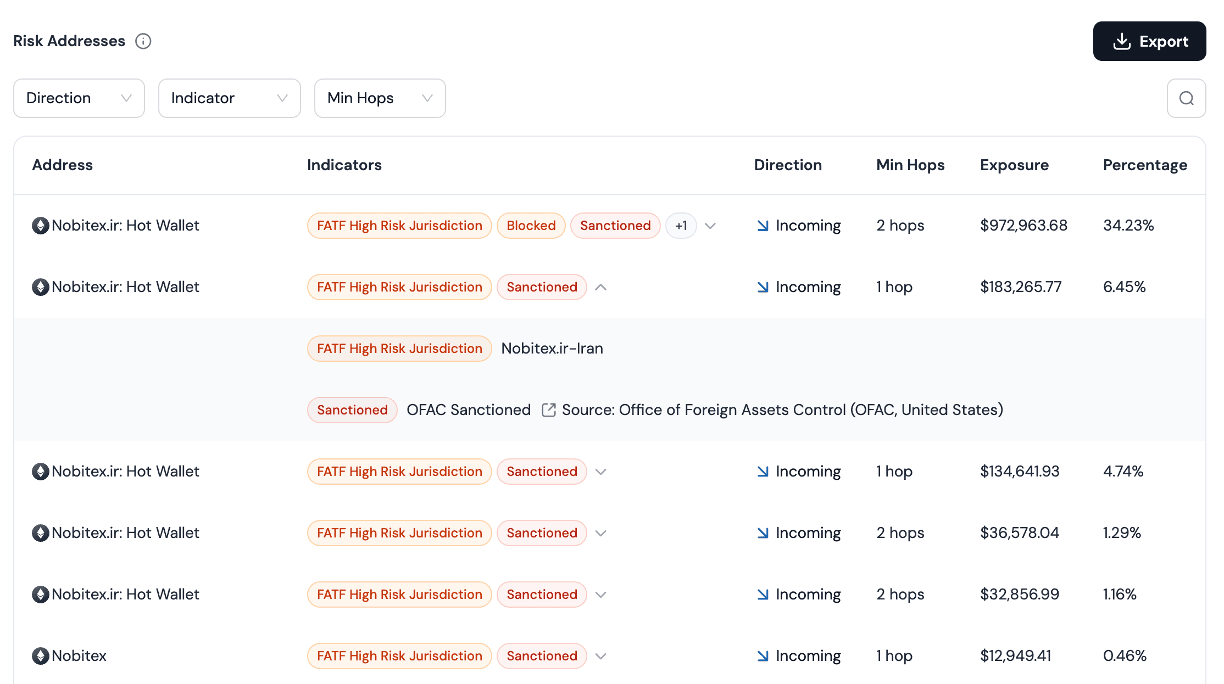
On-chain screening makes the complementarity concrete. An address entering a platform carries no name, but it carries behavior: the counterparties it has transacted with, the funds it has received, the labels attached to its history. Sanctions-entity screening checks that history against designated and high-risk categories. Phalcon Compliance screens against over 600 million labeled addresses covering sanctioned entities among other illicit categories, updated around the clock. That is the list-based layer at address granularity.

Role-based risk adds the dimension lists cannot see: change. An officeholder is appointed; a family relationship becomes a channel; an associate structure forms. None of these appear on a designation list, and all of them alter a relationship's risk profile. Programs that treat screening as a one-time gate miss every one of these transitions. The mechanism is covered in depth by Explainable Crypto AML Risk Scoring, where scoring that explains its signals lets compliance teams see not just that risk exists but why.
Screen Both Halves
Neither half substitutes for the other; a working program runs both. Run the address half now: open Phalcon Compliance and screen a first wallet free, against over 600 million labeled addresses, from the free tier through credit packages to subscription tiers as volume grows.
FAQ: Understanding PEP Status
Is PEP a permanent status? No, but it is also not a same-day expiry. The status attaches at appointment, holds at full weight through the term of office, and decays after it ends on a risk-based timeline. FATF's guidance leaves the decay window to institutions, scaled to the continuing exposure: former senior officials carry residual risk for longer than former junior ones.
Does marriage make you a PEP? Not independently: the status derives from the officeholder, and family members carry PEP-related scrutiny through the relationship. A spouse of a PEP is treated as within the definition's reach for screening purposes; a person with no connection to any officeholder does not become a PEP by any personal status of their own. The relationship is the channel, which is why family-member scope is defined per framework.
Are journalists PEPs? No. Media prominence is not a public function in the regulatory sense; the classification turns on office and its powers, not on public visibility. A journalist with extensive influence holds no procurement budget, signs no state documents, and controls no public licensing. The confusion arises because both categories are "public figures," but the frameworks draw the line at function, and journalism has none of the powers the definition targets.
What's the difference between PEP and sanctions status? PEP is a risk classification; sanctions is a legal prohibition. A PEP relationship is permitted subject to enhanced due diligence; a sanctioned person cannot be transacted with at all. Sanctions screening answers whether an address or entity appears on a designation list; PEP classification answers whether function-based risk warrants elevated scrutiny. The two run side by side, each catching what the other structurally cannot; the 2020 U.S. interagency PEP statement shows how the obligations interlock in practice. The framework-by-framework split is covered in PEP Definitions Compared: FATF, FinCEN, and EU AMLD.