Back to Blog

#7: ParaSpace Incident: A Race Against Time to Thwart the Industry's Most Critical Attack Yet

Code Auditing
February 17, 2024
5 min read
Key Insights

Background

On March 17, 2023, Paraspace (now Parallel Finance), an NFT lending platform, suffered a critical attack due to a vulnerability in its price oracle. Paraspace allows users to deposit NFTs and ERC-20 tokens as collateral to borrow ERC-20 tokens, enabling returns on NFTs without selling them.
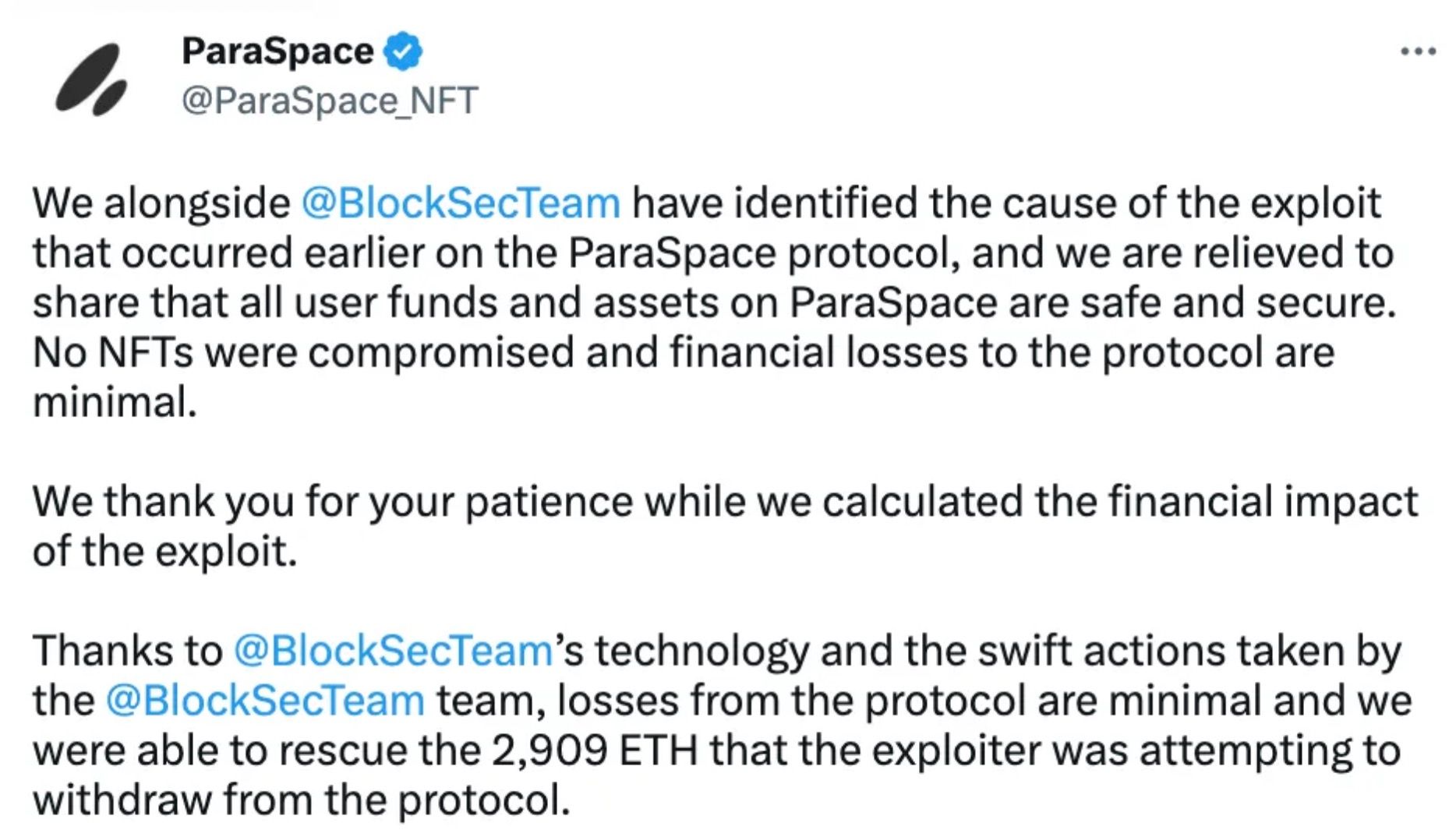
Click here to read the tweet

A key feature of ParaSpace is ApeStaking, which auto-compounds APE rewards. Users staking APE receive cAPE tokens, a cToken representation of APE, which can be used as collateral to borrow assets like USDC and WETH. Depositing cAPE tokens grants pcAPE shares, whose collateral value is calculated by multiplying the pcAPE amount by its rebasingIndex.

The rebasingIndex is derived from the total pooled APE balance and total shares, as shown in the following code snippets:

function _scaledBalanceOf(address user, uint256 rebasingIndex)
    internal
    view
    returns (uint256)
{
    return super.scaledBalanceOf(user).rayMul(rebasingIndex);
}

function lastRebasingIndex() internal view override returns (uint256) {
  return ICApe(_underlyingAsset).getPooledApeByShares(WadRayMath.RAY);
}

function getPooledApeByShares(uint256 sharesAmount)
    public
    view
    returns (uint256)
{
    uint256 totalShares = _getTotalShares();
    if (totalShares == 0) {
        return 0;
    } else {
        return
            sharesAmount.mul(_getTotalPooledApeBalance()).div(totalShares);
    }
}

function _getTotalPooledApeBalance()
    internal
    view
    override
    returns (uint256)
{
    (uint256 stakedAmount, ) = apeStaking.addressPosition(address(this));
    uint256 rewardAmount = apeStaking.pendingRewards(
        APE_COIN_POOL_ID,
        address(this),
        0
    );
    return stakedAmount + rewardAmount + bufferBalance;
}
```the `_getTotalPooledApeBalance()` function sums the staked APE tokens, pending rewards, and a buffer balance from the ApeCoinStaking contract.

## Vulnerability Analysis

The vulnerability lies in the manipulation of the `rebasingIndex`, which artificially inflates the collateral value of cAPE tokens. Specifically, the `depositApeCoin()` function in the ApeCoinStaking contract increases the `stakedAmount` for a position. An attacker can exploit this by depositing APE tokens into the cAPE position, inflating the output of `_getTotalPooledApeBalance()` and thus the `rebasingIndex`.

```solidity
function depositApeCoin(uint256 _amount, address _recipient) public {
    if (_amount < MIN_DEPOSIT) revert DepositMoreThanOneAPE();
    updatePool(APECOIN_POOL_ID);

    Position storage position = addressPosition[_recipient];
    _deposit(APECOIN_POOL_ID, position, _amount);

    apeCoin.transferFrom(msg.sender, address(this), _amount);

    emit Deposit(msg.sender, _amount, _recipient);
}

function _deposit(uint256 _poolId, Position storage _position, uint256 _amount) private {
  Pool storage pool = pools[_poolId];
  _position.stakedAmount += _amount;
  pool.stakedAmount += _amount.toUint96();
  _position.rewardsDebt += (_amount * pool.accumulatedRewardsPerShare).toInt256();
}
```this design flaw allows the attacker to inflate the collateral value by depositing APE tokens through `depositApeCoin()` with cAPE as the recipient.

## Attack Analysis

The attacker exploited this vulnerability using a flash loan attack in five key steps:

1. Obtained a flash loan of approximately 47,352 wstETH and supplied about 46,018 wstETH to borrow cAPE via multiple contracts.
2. Deposited roughly 12,880,000 cAPE tokens as collateral.
3. Traded approximately 1,205 wstETH for about 492,124 APE tokens and withdrew 1,839,999 cAPE to APE tokens.
4. Deposited 2,332,214 APE tokens into the cAPE position by calling `ApeCoinStaking.depositApeCoin()`, increasing the protocol’s stakedAmount from 851,662 to 3,183,876 (a 373% increase).
5. Leveraged the inflated collateral to borrow large amounts of assets such as USDC and WETH for profit.

This manipulation of the pcAPE price via flash loans exploited the use of spot prices in the oracle calculation.

<div class="blog-promo-card blog-promo-card-security">
  <div class="blog-promo-card-content">
    <p class="blog-promo-card-title">Get Started with Phalcon Security</p>
    <p class="blog-promo-card-description">Detect every threat, alert what matters, and block attacks.</p>
    <a href="https://www.blocksec.com/phalcon/security" target="_blank" rel="noreferrer" class="blog-promo-card-button-wrapper blog-promo-card-button-security">
      <span class="blog-promo-card-button-inner">
        <span>Try now for free</span>
        <svg xmlns="http://www.w3.org/2000/svg" width="14" height="14" viewBox="0 0 14 14" fill="none">
          <path d="M2.9165 6.99999H11.0832M11.0832 6.99999L6.99984 2.91666M11.0832 6.99999L6.99984 11.0833" stroke="white" stroke-width="1.5" stroke-linecap="round" stroke-linejoin="round"></path>
        </svg>
      </span>
    </a>
  </div>
</div>

## Summary

The ParaSpace incident underscores the risks of oracle manipulation and flash loan attacks in DeFi protocols. It highlights the critical need for robust, manipulation-resistant price oracles and continuous security monitoring beyond pre-launch audits.

BlockSec’s Phalcon Security system demonstrated the value of active threat detection and prevention by automatically blocking the attack and protecting user assets. This incident serves as a reminder for DeFi protocols to implement comprehensive security measures, including smart contract audits, infrastructure audits, and real-time monitoring.

For more insights on DeFi security incidents and best practices, explore our [Security Incident Library](https://blocksec.com/security-incident-library) and consider our [Smart Contract Audit](https://blocksec.com/smart-contract-audit) and [Infrastructure Audit](https://blocksec.com/infrastructure-audit) services.

<div class="blog-promo-card blog-promo-card-metasleuth">
  <div class="blog-promo-card-content">
    <p class="blog-promo-card-title">Explore MetaSleuth Investigation</p>
    <p class="blog-promo-card-description">Trace flows and build evidence for investigations</p>
    <a href="https://metasleuth.io/" target="_blank" rel="noreferrer" class="blog-promo-card-button">
      <span>Try now for free</span>
      <svg xmlns="http://www.w3.org/2000/svg" width="14" height="14" viewBox="0 0 14 14" fill="none">
        <path d="M2.9165 6.99999H11.0832M11.0832 6.99999L6.99984 2.91666M11.0832 6.99999L6.99984 11.0833" stroke="white" stroke-width="1.5" stroke-linecap="round" stroke-linejoin="round"></path>
      </svg>
    </a>
  </div>
</div>

---

## Read other articles in this series:

- [Lead-In: Top Ten "Awesome" Security Incidents in 2023](https://blocksec.com/blog/top-ten-awesome-security-incidents-2023)  
- [#1: Harvesting MEV Bots by Exploiting Vulnerabilities in Flashbots Relay](https://blocksec.com/blog/harvesting-mev-bots)  
- [#2: Euler Finance Incident: The Largest Hack of 2023](https://blocksec.com/blog/euler-finance-incident)  
- [#3: KyberSwap Incident: Masterful Exploitation of Rounding Errors](https://blocksec.com/blog/kyberswap-incident)  
- [#4: Curve Incident: Compiler Error Produces Faulty Bytecode](https://blocksec.com/blog/curve-incident)  
- [#5: Platypus Finance: Surviving Three Attacks](https://blocksec.com/blog/platypus-finance-incident)  
- [#6: Hundred Finance Incident: Precision-Related Exploits](https://blocksec.com/blog/hundred-finance-incident)  
- [#8: SushiSwap Incident: A Clumsy Rescue Attempt](https://blocksec.com/blog/sushiswap-incident)  
- [#9: MEV Bot 0xd61492: From Predator to Prey](https://blocksec.com/blog/mev-bot-0xd61492)  
- [#10: ThirdWeb Incident: Incompatibility Between Trusted Modules](https://blocksec.com/blog/thirdweb-incident)


<div class="blog-promo-card blog-promo-card-audit"><div class="blog-promo-card-content"><p class="blog-promo-card-title">Best Security Auditor for Web3</p><p class="blog-promo-card-description">Validate design, code, and business logic before launch</p><div class="blog-promo-card-buttons"><a href="https://blocksec.com/audit-report" target="_blank" rel="noreferrer" class="blog-promo-card-button-ghost">Read Audit Reports</a><a href="https://blocksec.com/expert-contact" target="_blank" rel="noreferrer" class="blog-promo-card-button">Request an Audit</a></div></div></div>
Sign up for the latest updates
Tracing $1.6B in TRON USDT: Inside the VerilyHK Ponzi Infrastructure
Case Studies

Tracing $1.6B in TRON USDT: Inside the VerilyHK Ponzi Infrastructure

An on-chain investigation into VerilyHK, a fraudulent platform that moved $1.6B in TRON USDT through a multi-layered fund-routing infrastructure of rotating wallets, paired payout channels, and exchange exit funnels, with traced connections to the FinCEN-sanctioned Huione Group.

Weekly Web3 Security Incident Roundup | Mar 30 – Apr 5, 2026
Security Insights

Weekly Web3 Security Incident Roundup | Mar 30 – Apr 5, 2026

This BlockSec weekly security report covers nine DeFi attack incidents detected between March 30 and April 5, 2026, across Solana, BNB Chain, Arbitrum, and Polygon, with total estimated losses of approximately $287M. The week was dominated by the $285.3M Drift Protocol exploit on Solana, where attackers combined multisig signer social engineering with Solana's durable nonce mechanism to bypass a zero-timelock 2-of-5 Security Council, alongside notable incidents including a $950K flash loan TWAP manipulation against the LML staking protocol, a $359K Silo Finance vault inflation via an external `wstUSR` market donation exploiting a depegged-asset oracle and `totalAssets()` accounting flaw, and an EIP-7702 delegated-code access control failure. The report provides detailed vulnerability analysis and attack transaction breakdowns for each incident, covering flawed business logic, access control, price manipulation, phishing, and misconfiguration attack types.

Drift Protocol Incident: Multisig Governance Compromise via Durable Nonce Exploitation
Security Insights

Drift Protocol Incident: Multisig Governance Compromise via Durable Nonce Exploitation

On April 1, 2026 (UTC), Drift Protocol on Solana suffered a $285.3M loss after an attacker exploited Solana's durable nonce mechanism to delay the execution of phished multisig approvals, ultimately transferring administrative control of the protocol's 2-of-5 Squads governance with zero timelock. With full admin privileges, the attacker created a malicious collateral market (CVT), inflated its oracle price, relaxed withdrawal protections, and drained USDC, JLP, SOL, cbBTC, and other assets through 31 rapid withdrawals in approximately 12 minutes. This incident highlights how durable nonce-based delayed execution can decouple signer intent from on-chain execution, bypassing the temporal assumptions that multisig security implicitly relies on.

Best Security Auditor for Web3

Validate design, code, and business logic before launch. Aligned with the highest industry security standards.

BlockSec Audit