
The Short Answer: AML Is Both a Regulatory Duty and a Business Necessity
A crypto payment business is, in most jurisdictions, a regulated financial service, because it moves value in and out of the financial system. AML carries two distinct weights: a regulatory duty and a business necessity. The duty comes from outside, from frameworks such as the FATF standards that most countries have adopted. The necessity comes from inside, from the costs that land on a business that misses the duty.
Two pressures push in the same direction, and they are usually described separately even though they belong together. Regulators expect a payment business to know the other side of its payments, screen the funds it moves, and report suspicious activity. Business reality expects the same thing, because the cost of getting it wrong is a frozen wallet, a fine, or a revoked license. The rest of this article walks through each pressure in turn.
For a payment business, AML is shorthand for a specific set of controls. It means knowing the address behind an incoming payment, screening the transaction against risk data, and filing a suspicious transaction report when a flag is justified. Each control maps to one of the two pressures, which is why the duty and the necessity belong together.
The same three controls serve both pressures:
| Control | Regulatory duty it meets | Business loss it prevents |
|---|---|---|
| Know the address behind an incoming payment | The expectation to know the other side | Settling to a blacklisted address |
| Screen the transaction against risk data | Screening duties at the on and off ramp | A frozen wallet mid-operation |
| File a report when a flag is justified | Suspicious activity reporting duties | Fines and license action after the fact |
The Regulatory Driver: FATF Standards and On and Off Ramp Screening
Most countries build their AML rules on the FATF standards, and those standards treat crypto payment businesses as virtual asset service providers that must manage money laundering risk. A payment business that moves stablecoins into and out of fiat sits directly on the on and off ramp, which is the point regulators watch most closely. Screening duties attach to that point: who is sending, where the funds came from, and whether the transaction matches the business that is behind it.
The FATF approach is risk-based, which means the duties scale with the risk a business actually faces. A payment business that handles high-volume, cross-border stablecoin flows faces more risk than one that moves small local amounts, and its AML controls are expected to match. The standard is a demand that the controls be proportionate to the exposure, not a one-size rule.
The gap between expectation and reality is wide. Across the 138 jurisdictions the FATF has assessed, only 1 is fully compliant with the recommendations, just 29% are largely compliant, and 59% have not yet implemented the required measures (FATF targeted updates). Enforcement is tightening rather than loosening, which means the pressure on payment businesses is rising, not falling.
The direction of enforcement is clear too. Stablecoins have become the preferred tool for most on-chain illicit activity. That puts the businesses that move stablecoins under direct regulatory attention, because the on and off ramp is exactly where regulators look for the screening and monitoring controls that should already be running. For a payment business, this is a standing duty to run address and transaction screening on the funds that pass through its rails, not an abstract one.
The Business Risk Driver: Frozen Funds, Fines, and Lost Licenses
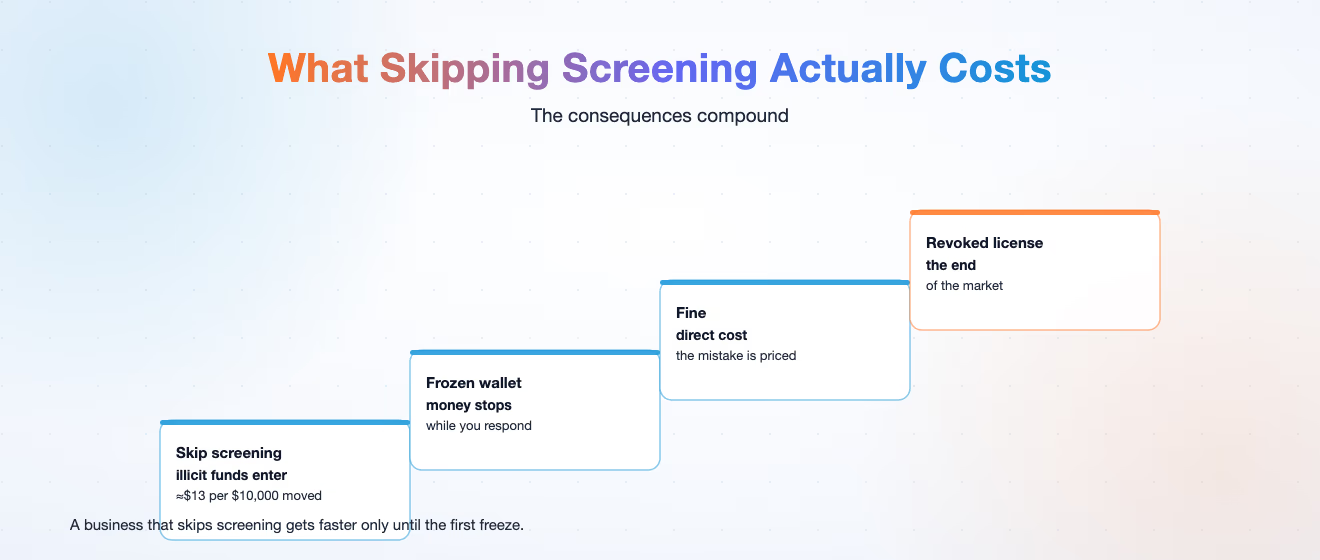
The same controls that regulators demand also protect the business itself. Stablecoin volume is large enough that illicit funds are embedded inside ordinary flows. In 2025, stablecoins passed a $250 billion total market cap and an estimated $36.3 trillion in annual transaction volume, and for every $10,000 in stablecoin value moved, roughly $13 is linked to illicit funds.
That figure matters because a payment business processing real volume will touch those funds eventually. The question is not whether the touch happens. The question is whether the business detects it before a regulator or the other side does. A business that does not screen its flow carries risk from the other side into its own rails and its own balance sheet.
The consequences are concrete and compounding. A frozen wallet stops the business from moving money while it responds. A fine converts the mistake into a direct cost. A revoked license ends the business in that market entirely. None of these outcomes is theoretical for a payment business that settles value at scale, and all of them are cheaper to prevent than to survive.
The choice is usually framed as a trade-off between speed and safety, but that framing hides what actually happens. A payment business that skips screening does not get faster forever. It gets faster until the first freeze, and then it stops moving money while it works through an investigation it could have avoided.
How Phalcon Compliance Helps Payment Businesses
This is where the two pressures meet a tool built for the job. Phalcon Compliance is an AML/CFT platform from BlockSec that serves crypto payment businesses alongside exchanges, e-commerce platforms, advertising platforms, and gaming and social apps. It gives a payment business two controls: KYA to profile an address and KYT to monitor a transaction in real time, plus one-click suspicious transaction report generation for the follow-up filing.
The platform reads risk against more than 600 million labeled blockchain addresses, which span sanctions, scams, hacks, and mixers. Risk is assessed across 17 Risk Indicators rather than a single label, so a payment business sees the reason behind a flag instead of a binary answer. Screening runs at millisecond speed, which means it can sit inside the payment flow without slowing the checkout. The point of the tool is to make the screening part of the payment itself, so the decision to approve or hold happens before funds move, not to add paperwork after a payment settles.
This is what Phalcon Compliance does for crypto payment businesses: it turns the AML duty from a manual, after-the-fact chore into a real-time screening step that runs at the point of payment.
What to Do Next
If your payment business moves stablecoins or fiat on and off chain, the AML duty is already here. Start by making address and transaction screening part of the payment flow itself, so that every deposit and withdrawal is checked before it settles. The alternative is to keep the screening out of the flow and run it as a manual review after the fact. That approach works until it does not, and the cost of the first miss is higher than the cost of the control.
Meet payment AML with Phalcon Compliance, or download the stablecoin freeze risk whitepaper to see how freeze events and treasury risk play out in practice.
Two pieces pair with this one: crypto payment gateway AML compliance requirements turns the duties into controls, and stablecoin cross-border payments shows those controls working on a real corridor.
For the full picture of stablecoin rules, freezing risk, and payment AML, start from the Stablecoin Compliance guide.