Short Answer
Stablecoin cross-border payments move value across two regulatory zones at once, so the compliance work doubles. Screen the other side before funds move, monitor the route while it operates, and keep sanctions coverage aligned on both ends. The token itself does not care about borders, but the rules on each side absolutely do, and a route that is legal at the sending end can fail at the receiving end. This page covers what makes cross-border harder, the screening workflow for both ends, and how teams typically run these routes.
Why Cross-Border Stablecoin Payments Are Harder to Run Clean
Three things multiply when a payment crosses a border: jurisdictions, sanctions exposure, and the transparency burden. On jurisdictions, both ends of the route regulate the same movement, and their rules differ in licensing, screening expectations, and reporting. A payment business often answers to the rules where it is licensed and, practically, to the rules where the other side sits. On sanctions exposure, cross-border routes are exactly where sanctioned actors look for openings, because the split across venues and chains hides them from single-list checks. On transparency, the good news is that public chains expose the full path, so the evidence is there. The operational question is whether your screening actually reads it. The general case for why payment businesses carry these duties at all is in Why Crypto Payment Businesses Need AML
The Two-End Screening Workflow
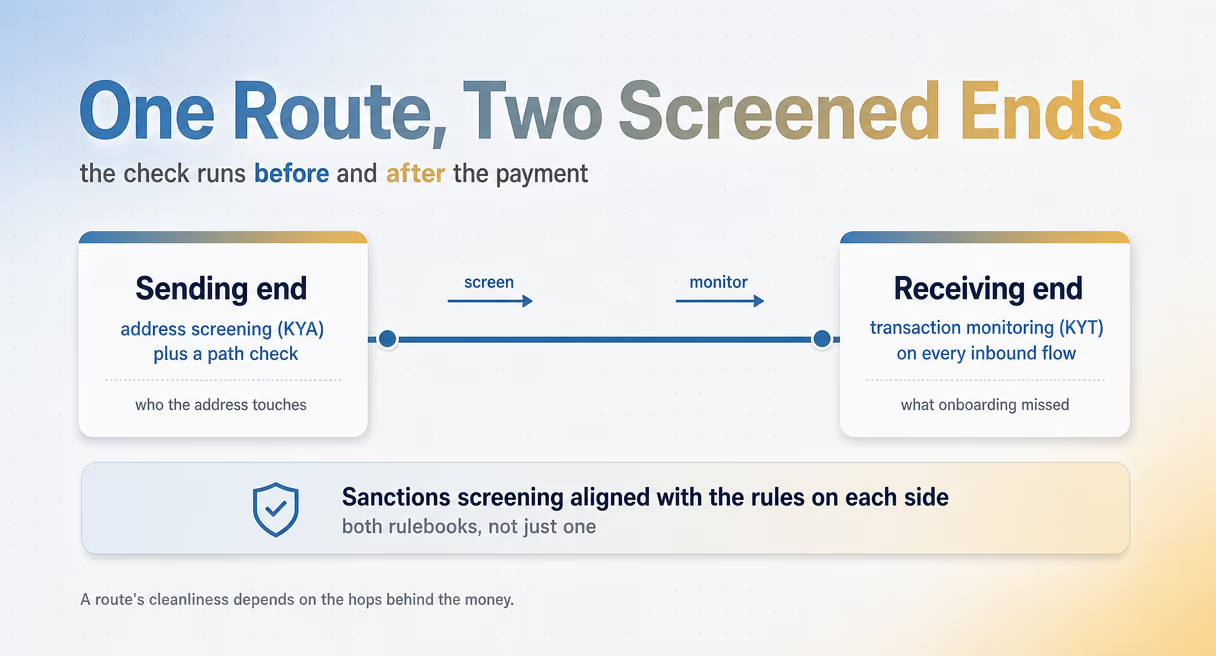
| Route stage | The check that runs | What it catches |
|---|---|---|
| Sending end | Address screening (KYA) on the other side plus a path check | Who the address touches and whether freeze exposure sits behind the funds |
| Receiving end | Transaction monitoring (KYT) on every inbound flow | What onboarding missed, including risk picked up mid-route |
| Both ends | Sanctions screening aligned with the rules on each side | Exposure hidden by the split across venues and chains |
Sending end: know who you are paying from and to
Before funds move, profile every party in the route with address screening (KYA) and check the funds' path. KYA answers who an address is: its labels, its sanctions exposure, the network it touches, and whether it has freeze or blacklist associations. The path check looks at where the funds have been, because a route's cleanliness depends on the hops behind the money, not just the two addresses at the ends. Parties cleared at onboarding need re-checking, since blacklist events can land on a previously clean address mid-route. The screening fundamentals are the same as any payment flow, and the step-by-step is in How to Screen Crypto Payments for Sanctions
Receiving end: monitor what actually lands
While the route operates, monitor every inbound flow in real time and alert on risk changes. Transaction monitoring (KYT) screens each payment as it lands: the sending address's current state, the path the funds took, and the labels attached anywhere along it. This is the layer that catches what onboarding missed, including a route partner whose wallet picked up tainted funds from somewhere else in the meantime. Alerts need a decision path: hold, return, or escalate, with the evidence recorded. Routes that settle at high volume run this as an automated pipeline with webhooks pushing alerts, because a human reading every transaction does not survive volume.
Sanctions coverage across both ends
Run sanctions screening against the lists that matter on both sides of the route, and map high-risk jurisdictions explicitly. The practical standard is alignment with the major sanctions lists, OFAC's SDN list included, plus screening for the risk categories a regulator will ask about: sanctions first, then fraud, mixing, and scam exposure. Phalcon Compliance syncs sanctions list updates in real time and reads from a label library of more than 600 million addresses. That is the coverage shape cross-border routes need, because exposure hides in the network, not at the address in front of you.
The Travel Rule, in One Paragraph
Cross-border payments also sit inside the Travel Rule framework, FATF Recommendation 16, which requires originator and beneficiary information to travel with the transfer. The rule applies to licensed intermediaries, and it layers on top of on-chain screening, not instead of it. The on-chain path and the Travel Rule data describe the same payment from two directions, and operations typically handle the rule through their licensing arrangements. For this page, the operative layer is the on-chain one: who the addresses are, and where the funds have been.
What Cross-Border Routes Look Like in Practice
Two patterns cover most stablecoin cross-border operations, and both stand on the same screening workflow. The first is B2B settlement: a company pays a supplier or partner in another country through stablecoins, route by route, on a recurring schedule. The screening load is concentrated at onboarding and on ongoing monitoring of a stable set of payment partners. The second is remittance-style flow: many smaller senders, one aggregated route, receiving partners who convert to local currency. The screening load shifts to per-transaction monitoring, because the sender population changes constantly and the route's exposure is the average of everyone who uses it. In both patterns, the failure mode is the same: a clean start that goes stale, a payment partner or sender population that changes faster than the checks.
What to Do Next
Build the route checklist before the first payment: KYA on both parties, path check on the funds, sanctions alignment for both jurisdictions, and monitoring that stays on after onboarding. Phalcon Compliance runs the screening side, from the no-registration landing-page scan to API-driven monitoring at transaction speed. Explore Phalcon Compliance for the integration path. For the requirements behind this workflow, read Crypto Payment Gateway AML Compliance Requirements. For the investigation view of the same routes, see Chain Analysis for Cross-Border Payments, and for the full family picture, start from the Stablecoin Compliance hub.