
The Short Answer: Sanctions Screening Goes Beyond the Direct Address
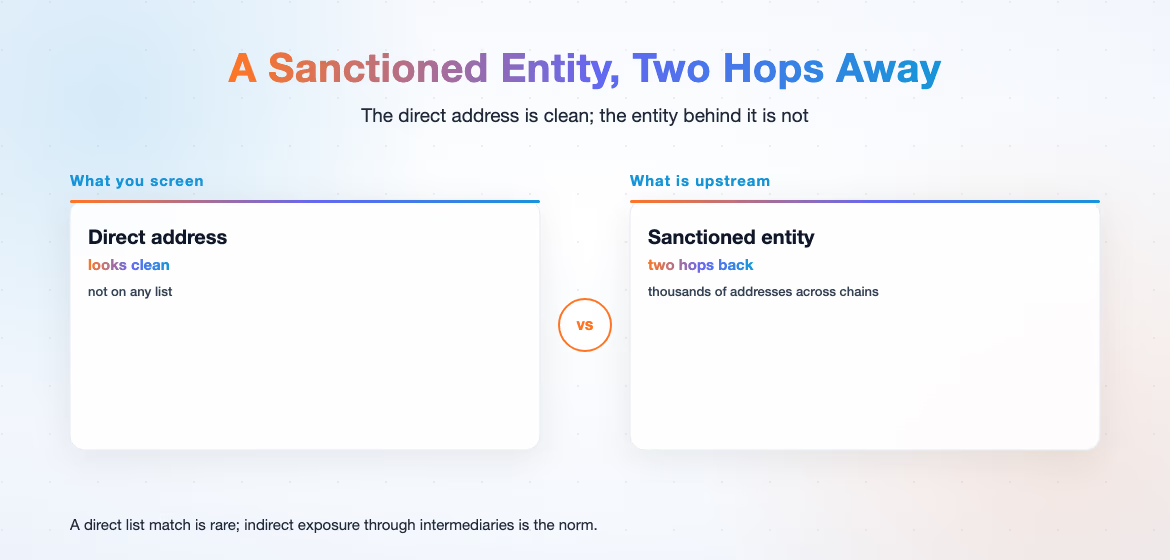
Sanctions screening for crypto payments cannot stop at the direct address. The other side of a payment can look clean on the surface and still sit a few hops away from a sanctioned entity. The workflow has to trace the funds, not just check the address. This is the core principle that separates a sanctions program that actually works from one that only checks a list.
The reason is that a sanctions listing is a property of an entity, not of a single address, and an entity can hold thousands of addresses spread across chains, wallets, and intermediaries. When you screen only the address in front of you, you see the first node. You do not see the entity behind it, the funds that moved through it, or the relationship that connects it to a sanctioned party.
A payment platform that treats address screening as the whole job therefore has a structural blind spot. It can approve a deposit that a few minutes of tracing would have flagged. This article explains how to screen crypto payments for sanctions: why the direct address is not enough, what a screening workflow looks like, and how a KYA and KYT platform makes the workflow hold up.
Why Sanctions Screening for Payments Is Hard
Sanctions screening for payments is hard for three reasons, and they all compound.
First, the data never stops moving. Sanctions lists are updated constantly as authorities add, remove, and modify listings. An address that clears screening today can be matched to a new listing tomorrow, so a one-time check goes stale almost immediately. Payment flows do not pause to wait for a compliance team to re-run its list. In the United States, the screening obligation sits inside the AML program requirements set out in FinCEN's statutes and regulations.
Second, the exposure travels. OFAC states that its published digital currency addresses are not exhaustive. That is why effective screening cannot stop at a direct list match: risk has to be traced through associated addresses, the relationships behind each payment, and multiple hops. A payment that is clean at the first hop can be contaminated at the second or third, because funds move along chains of addresses and the risk travels with the funds.
Third, the other side is rarely a single address. A real party on the other side, whether a customer, a partner, or a liquidity provider, operates across many addresses and many chains. Screening one address gives a partial picture. Screening the whole graph is what reveals the connection to a sanctioned entity.
The result is that a payment platform faces a moving, connected, and distributed risk surface, not a static list of bad addresses. Screening has to keep pace with all three of those properties at once.
Why one-time address checks miss the risk:
| Screening reality | What it means for the workflow |
|---|---|
| The data never stops moving | An address that clears today can match a new listing tomorrow |
| The exposure travels | A payment clean at the first hop can be contaminated at the second or third |
| The other side is many addresses | Screening one address sees a node; screening the graph sees the entity |
The Sanctions Screening Workflow
A workable sanctions screening workflow has three stages: screen before the payment, trace the relationship, and act on the result.
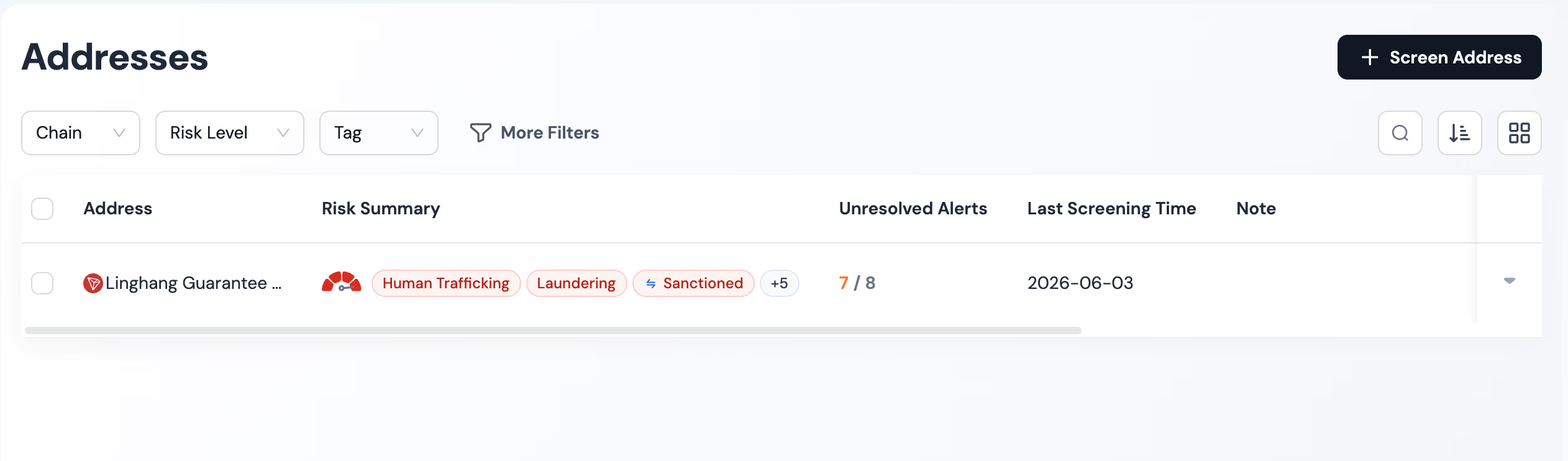
The first stage is pre-transaction screening. Before a deposit lands or a withdrawal leaves, the platform checks the address on the other side against a sanctions and risk label database. This is the KYA (Know Your Address) step: it answers whether the address itself carries a sanctioned or high-risk label. KYA supports deep multi-hop fund tracing, building a risk profile that reaches the people and entities behind an address. That means the check does not stop at the surface address; it walks the connection.
The second stage is transaction monitoring. Screening cannot be a one-time event, because payments continue after the first check. KYT (Know Your Transaction) monitors transactions with millisecond response and pushes risk alerts through seven channels. The monitoring layer catches a payment that looks clean at the moment of screening but connects to a sanctioned party as the transaction settles and funds move.
The third stage is the decision. When tracing surfaces a connection to a sanctioned entity, the payment is blocked, not rejected: a rejection hands the funds back to a sanctioned party, while a blocked payment holds them where they sit and starts the reporting clock. US rules give the follow-up duties exact shapes. A blocked transaction must be reported to OFAC within 10 business days, blocked property is reported again in an annual report due September 30, and rejected transactions follow the same annual September 30 schedule (31 CFR 501.603-604). Ownership matters as much as the list itself: under OFAC's 50 Percent Rule, an entity owned 50 percent or more by blocked persons, individually or in aggregate, is itself blocked even if it appears on no list. And the SDN list is not the only exposure: CAPTA, SSI, and NS-CMIC based sanctions programs carry their own directives on dealings. Every decision needs to be documented, because the audit trail is what proves the platform did not simply screen once and walk away. A one-click report keeps the evidence chain intact without turning every alert into a manual write-up.
The three stages together turn sanctions screening from a point-in-time lookup into a continuous control that runs before, during, and after the payment.
How Phalcon Compliance Keeps Screening Strong
Phalcon Compliance is built to run this workflow as a single, continuous platform. This is what Phalcon Compliance does. It combines the two layers that a payment platform needs: labeled address data for the pre-transaction check and transaction monitoring for the ongoing check.
On the address data side, Phalcon Compliance holds more than 600 million labeled addresses that cover sanctions, scams, hacks, and mixers, refreshed around the clock. That depth matters because a sanctions connection rarely points at the sanctioned entity directly. It points at the intermediaries, the bridges, and the mixing layers in between, and those are exactly the addresses a broad label set catches.
On the transaction monitoring side, the risk engine combines AI behavioral analysis with more than 200 risk signals to surface sanctions financing and money laundering. This is what turns a static list into an active detector: the engine is looking for the behavior that surrounds a sanctions transaction, not just for a name on a list.
The platform also reads risk the way a compliance team thinks about it. Phalcon Compliance reads risk across the full set of 17 Risk Indicator categories rather than a single label. A payment can be flagged for sanctions exposure, a mixer connection, or a link to a high-risk jurisdiction, and the verdict reflects the combination, not one signal in isolation. Phalcon Compliance aligns with FATF standards across multiple key jurisdictions and generates a suspicious transaction report in one click. The escalation and the audit trail come out of the same workflow as the screening itself.
What to Do Next
If your platform still screens payments by checking a single address against a static list, the next step is to add the tracing and monitoring layers that sanctions screening actually requires. Start with the payments that carry the most exposure: deposits and withdrawals into stablecoins, large transfers, and addresses on the other side that touch high-risk jurisdictions. Put those flows through address screening and transaction monitoring, and make sure every flagged payment lands in a documented decision.
Manage stablecoin freeze risk with Phalcon Compliance, and download the stablecoin freeze risk whitepaper to see the full risk model behind sanctions screening for payments.
If you run payments for customers rather than your own treasury, the gateway AML compliance requirements piece maps these checks onto the VASP duties. For the business case behind these checks, why crypto payment businesses need AML lays out the exposure.
For the full picture of stablecoin rules, freezing risk, and payment AML, start from the Stablecoin Compliance guide.