
Chain analysis works for cross-border payments on one condition: it must run on both ends of the rail, inside the payment flow. Chain analysis here means following on-chain value to assess the risk on the other side; blockchain analysis in the broader sense covers the same work, and cross-border payment screening is one of its hardest applications. Cross-border work fails single-sided screening by design, the sending wallet and the receiving wallet often live on different chains under different rules, so analysis that covers one end sees half the exposure. Done two-sided and in-flow, chain analysis becomes the control that makes cross-border crypto payments workable at all.
Why Cross-Border Payments Are a Two-Sided Screening Problem
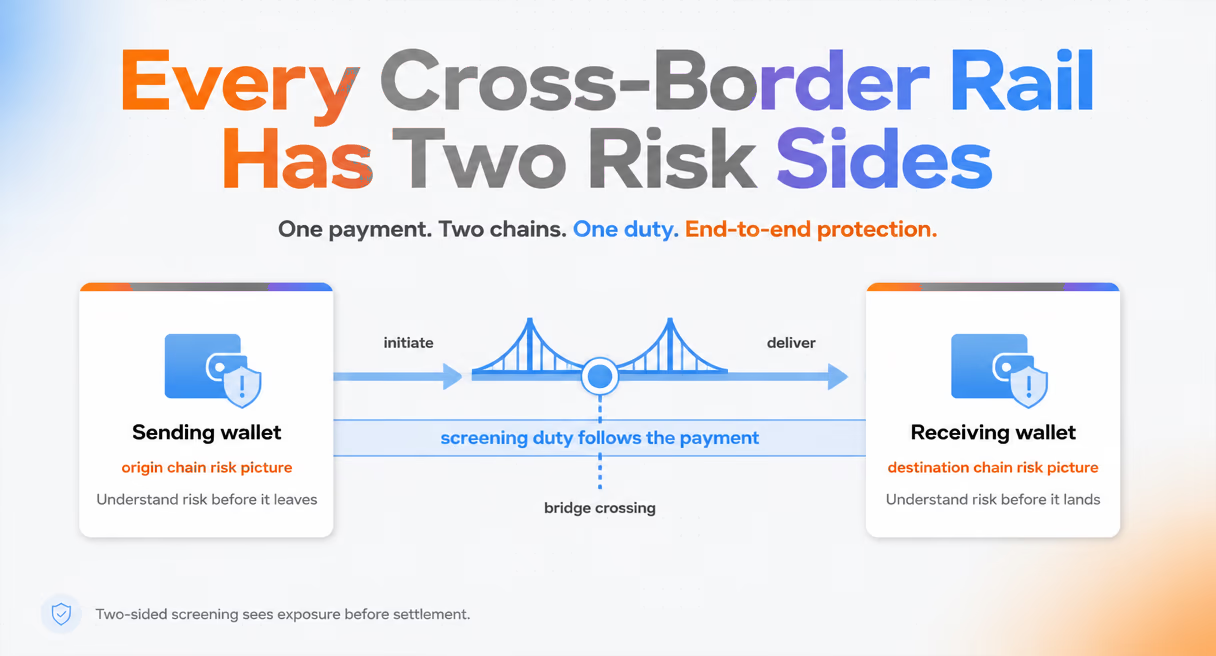
A cross-border payment is a transfer between parties who chose different chains, different custodians, and different regulatory homes. The common baseline those homes implement is the FATF standards. That is the product's whole point, but it breaks the screening setup most systems were built on. Checking the sender's side only verifies the origin; the destination address's risk, its labels, its history, its sanctions status under the receiving jurisdiction, sits on the other chain, invisible to origin-side analysis. The mirror holds for the receiver. Every rail has two ends, and a cross-border rail has two risk sides that do not overlap.
Traditional institutions entering this market describe the bind from the other side: regulators are still defining how to oversee cross-border crypto flows while the duties, sanctions avoidance above all, apply from day one. In the US, that duty set is set out in FinCEN's statutes and regulations. The practical translation is that the screening duty follows the payment across the border, and a compliance stack that cannot follow it leaves each institution holding half a verdict.
What Chain Analysis Covers on Each Side
On each end, chain analysis, the applied branch of blockchain analysis, does the same job it does everywhere, but the cross-border setting raises the bar on two capabilities. Two-sided address screening evaluates both ends against labeled data: the sending wallet against the origin chain's risk picture, the receiving wallet against the destination's, so exposure is visible before settlement rather than after. Chain analysis built for this work carries labeled address data in the hundreds of millions updated around the clock, per BlockSec technical specifications, which is the depth two-sided screening depends on at volume.
Cross-chain reach is the second raised bar. Cross-border value moves through bridges by default, and an analysis layer that stops at the bridge loses the payment exactly where it crosses jurisdictions, which is the one place a cross-border program cannot afford blindness. Tracing coverage across the major bridging routes keeps the trail continuous from origin to destination. For the address-layer screening concept underneath both ends, see What Is KYA: Know Your Address in Crypto.
Speed, Volume, and the False-Positive Budget
Cross-border payment flows impose engineering constraints that decide whether analysis helps or hurts. Speed is the first: screening that answers in milliseconds can sit inside the payment flow, evaluating both ends before settlement, which is the only position where a finding can still hold the transfer. Screening that answers in seconds or minutes pushes the check beside the flow, and a cross-border payment screened after settlement is not risk management; it is a record of what went wrong.
The false-positive budget is the second. Payment routes run at volume, and rule sets misaligned with actual route behavior generate alert noise that a payments team cannot staff against, a failure mode monitoring teams know well from misconfigured transaction-monitoring programs. Alert quality, tiered signals with visible evidence, is what keeps the review queue proportionate to the operation. Teams running cross-border routes on per-call economics get both constraints priced into the model, which is why usage-based screening fits route volumes that swing with market cycles.
The cross-border requirements and what each one demands:
| Cross-border requirement | What it demands from analysis | What failure looks like |
|---|---|---|
| Two-sided screening | Both ends assessed, each against its own chain's risk picture | Half a verdict, one institution holding each end |
| Cross-chain reach | Tracing that follows value through the major bridging routes | Blindness exactly at the jurisdiction crossing |
| In-flow speed | Answers in milliseconds, inside the payment flow | A record of what went wrong, not risk management |
| Alert quality | Tiered signals with visible evidence, at route volume | A review queue no payments team can staff |
The verdict for cross-border payments: chain analysis is not just good, it is the enabling control, provided it runs two-sided, in-flow, and across chains, with alert quality the operations team can live inside.
This piece is part of the MetaSleuth investigations and forensics guide, where the tracing method, evidence handling, and tooling tiers are covered end to end.