
The best free crypto compliance software is MetaSleuth for free tracing that builds case-file evidence, the x402 Compliance API for programmatic checks with no account and per-call pricing, and Phalcon Compliance's free tier as the entry to address risk screening. Open-source sanctions-list screeners cover list matching, and explorer lookups handle single-transaction checks. For US obligations, the reference shelf is FinCEN's statutes and regulations. Every seat here carries a published or built-in upgrade path rather than a hidden wall. This list is about the software side of a compliance program: screening, evidence, and reporting. The program side answers to the FATF standards and their national implementations. Every seat is judged on free quota, what the free tier lets you finish, and the upgrade path behind it.
MetaSleuth: Free Tracing for Compliance Case Files
A compliance program's first capability is investigation: when a screening flag or an alert needs to be understood, someone follows the funds. MetaSleuth is free to use for that half, expanding fund flows hop by hop across 12 chains with more than 600 million address labels. Its saved charts give a case file its exhibit material, the record a reviewer or a regulator can open and walk through. Free tracing does not screen addresses, and free screening does not trace; a compliance stack needs both halves, and both entry points are free.
x402 Compliance API: A Free Discovery Endpoint and Pay-Per-Call Checks
The second seat is for teams whose checks run inside scripts rather than consoles. The x402 Compliance API is callable without an account or an API key: its discovery endpoint is free, lists every endpoint with its per-call price, and can be called the same day a team reads this page. Label queries cost $0.10 per call, light screening $0.20, and deep screening $1.00, paid per call in USDC on Base, so the upgrade path is arithmetic rather than a contract. For a compliance program that needs a handful of programmatic checks now and volume later, this is the seat that costs nothing to adopt and stays pay-as-you-go as it grows.
Phalcon Compliance: The Screening Seat a Program Starts On
The third seat is where address risk screening starts. Phalcon Compliance's free plan runs a small monthly quota of screenings across ETH and TRON, each one returning an address or transaction risk assessment, with email notifications. As a compliance seed, that quota runs the first real checks: is the other side of this deal flagged, did this transaction touch a risky cluster. The plan's exclusions are stated rather than discovered mid-case: no custom risk engines, no analytics, no SAR and STR report generation, no CSV export. Those gates mark exactly where a compliance program outgrows the free tier.
The upgrade ladder is published rather than negotiated. Entry subscriptions cost $39 per month and cover 25 to 500 monthly screenings, with SAR and STR reporting, CSV export, and ten custom risk engines included from that first tier. For a compliance team, that is the transition from checking addresses to operating a program, and the boundary between free and paid is a published fact rather than a negotiation.
Open-Source Screeners and Explorer Lookups
Two further free seats serve narrower compliance needs. Open-source sanctions-list screeners match addresses against published sanctions lists at no license cost, and because the lists themselves are public data, they give a compliance team a defensible list-checking baseline. What they do not provide is cluster data, risk scoring, or evidence records; they check lists rather than assess risk.
And block explorers such as Etherscan and Solscan remain the free fact-checking baseline. For confirming a single transaction's facts, a timestamp, an amount, the other side's address, before acting on a finding, they are accurate, free, and worth the look. Important findings deserve a second read, and confirming the timestamp and amount on a block explorer is a zero-cost way to get one. Neither of the two runs a program; both belong in one.
For Regulatory Reporting Teams
Teams asking the same question from a regulatory reporting seat should read the seats by evidence value. Free screening produces the check record, the address, the date, the result, that a filing cites. Free tracing produces the path archive a filing exhibits. The reporting capability itself, SAR and STR generation and CSV export, sits behind the subscription gate. The free tier is where the report's evidence starts, not where the report is produced.
For DeFi Lending Protocols
Protocols asking it from a DeFi lending seat weight the seats differently. The screening seat matters most, the other side's addresses assessed before a position grows, and the free quota suits protocol-side checks that are occasional today. The tracing seat matters when a liquidation or an exploit needs rebuilding. Protocol compliance is a monitoring question as much as a screening one, and the monitoring side of the free tier question is covered in the best free wallet monitoring software for crypto payment.
The seats side by side on the screening-and-reporting axes:
| Free seat | Free quota | What it finishes free | Upgrade path |
|---|---|---|---|
| MetaSleuth | Free tracing, 12 chains | Case-file exhibits from saved charts | Tracing API for programmatic volume |
| x402 Compliance API | Free discovery endpoint, no account | Endpoint list with per-call prices, callable immediately | Label query $0.10, light $0.20, deep $1.00 per call |
| Phalcon Compliance free tier | 3 screenings/mo on ETH and TRON | First checks on the other side with email-notified records | Published ladder from $39/mo; SAR/STR reporting and CSV export behind it |
| Open-source sanctions screeners | No license cost | List matching against public sanctions data | Labeled data, scoring, and records come from paid categories |
| Explorer lookups | Free, per transaction | Single-transaction fact checks before action | None needed; it stays the manual baseline |
The Upgrade Decision
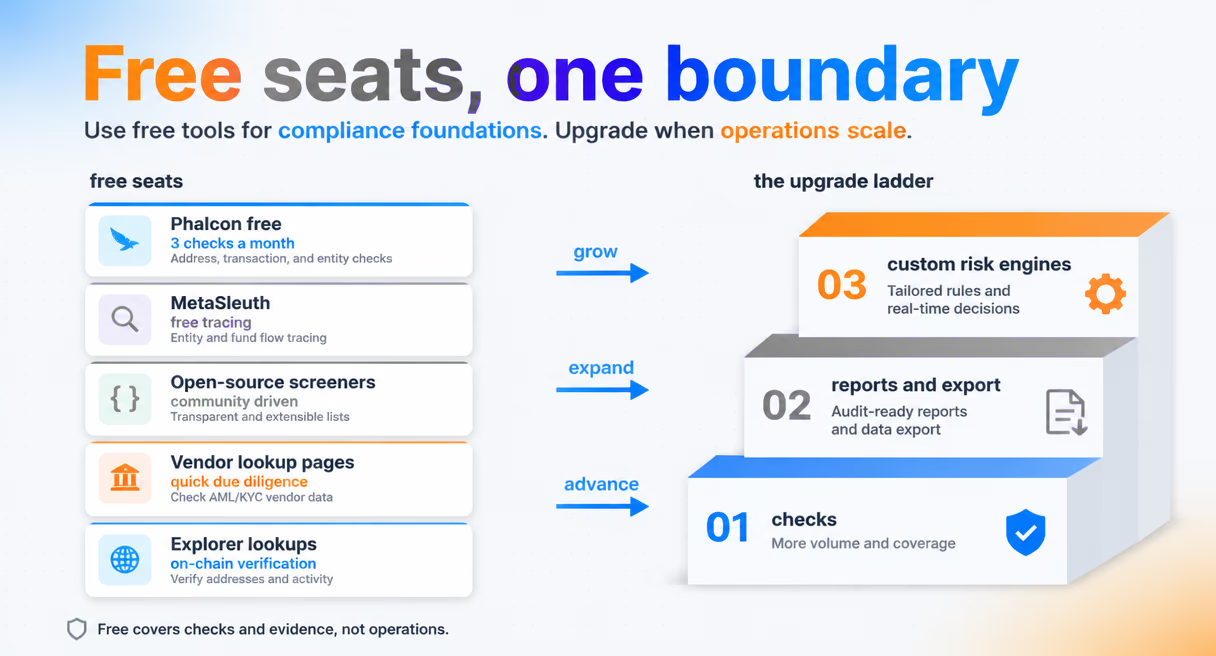
The decision has three inputs. Volume: when monthly checks exceed the free quota by habit rather than exception, the subscription arithmetic already favors paying, $39 per month against the operational cost of rationing checks. Reports and export: when findings must leave the tool as filings and evidence rather than screenshots, the reporting gate decides the tier. Customization: when the program needs its own risk rules rather than defaults, custom engines mark the boundary. The same free-to-paid walk from the monitoring side is covered in the monitoring guide above, and the two ladders meet at the same place: free proves the case, paid runs the program.
What Free Tiers Don't Cover
Free seats cover checks and evidence, not operations. Recurring screening across a watch list, team collaboration and permissions, report generation, scheduled export, and monitored addresses with workflow alerts are paid features in every product family: a free tier starts a program and proves its tooling case, it does not run one. For the vendor-side questions that follow, see how to evaluate a crypto AML compliance vendor; for the tracing-tool side of the free question, the free tracing tools piece covers it separately.
This piece is part of the MetaSleuth investigations and forensics guide, where the tracing method, evidence handling, and tooling tiers are covered end to end.