
The best free wallet monitoring software for crypto payment is Phalcon Compliance's free tier with its Monitor trial for watched-address alerts. In the US, the duties behind that watching start from FinCEN's statutes and regulations. Explorer watchlists, MetaSleuth for tracing what an alert uncovers, and the free alert feeds published by security research teams complete the list. For payment operations, the dimensions that decide value are watch capacity, alert channels, evidence export, and the paid ladder behind the free layer. The same seats answer the broader question of the best free blockchain monitoring tools for crypto payment; this list evaluates every seat on exactly those dimensions.
Phalcon Compliance: Free Screening Plus a Real Monitor Trial
For payment operations, the free entry point is Phalcon Compliance's free plan: a small monthly quota of screenings on ETH and TRON, each one an address or transaction risk assessment delivered with email notifications. It also carries a one-time seven-day Monitor trial on a single watched address. The trial matters more than the screening quota for a payment team. It shows what continuous watching actually looks like: an address under watch, alerts when its status changes, and a notification channel already wired.
The paid ladder behind the free tier is published rather than negotiated. Monitoring is priced by watched-address tier, from 10 concurrent addresses at $60 per month up to 200 at $500 per month, with the first address free on subscription tiers.
Explorer Watchlists: The Free Baseline for Address Watching
Block explorers such as Etherscan and Solscan offer free address watchlists with email notifications. For a payment team's first watched addresses, they are a legitimate start: add an address, get notified on activity, pay nothing. The limits are structural. Watchlists watch single addresses rather than the businesses behind them. They do not assess risk, they do not connect one alert to a wider pattern, and exporting what they show for a dispute or an investigation is a manual screenshot exercise.
Use them to watch; do not mistake them for monitoring. The moment a payment operation needs to know how risky an address is, or to watch enough addresses that notifications become daily work, the free baseline ends.
MetaSleuth: The Trace-After-Alert Seat
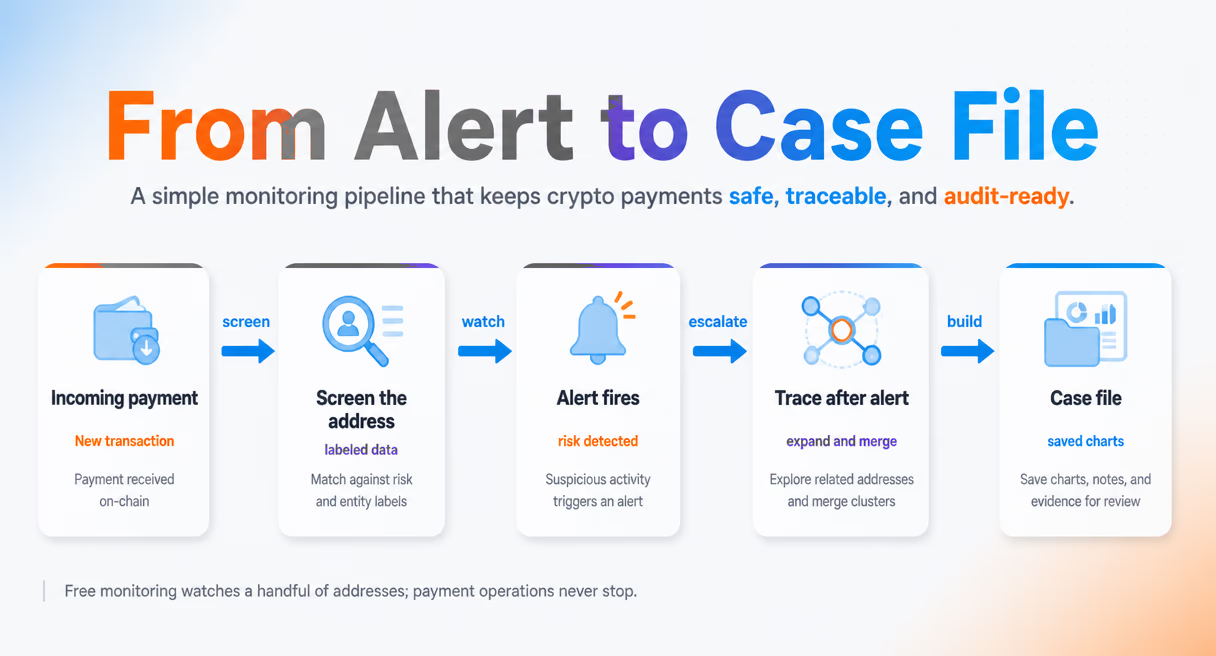
Monitoring tells a payment team that something moved; tracing answers where it went. MetaSleuth is free for that second half: paste the flagged address, expand its fund flow hop by hop across 12 chains, and read the other side's behavior from the graph. For payment fraud response, disputed settlements, and funds that left for a mixer, this is the seat that turns an alert into a case file, and it costs nothing to run alongside a watching layer.
Open-Source Watchers and Research Alert Feeds
Two further free layers suit payment operations with specific shapes. Self-hosted watchers built on open-source indexing frameworks can script custom address monitoring at no license cost, and suit teams with engineering capacity who need watch logic a commercial free tier does not offer. And blockchain security research teams publish free incident and alert feeds that surface exploits, drained wallets, and risky clusters as they happen. For a payment team, these feeds are an early-warning layer that costs nothing but attention.
Both layers belong on the list and off the top of it: the first costs engineering time instead of money, and the second watches the market rather than your own addresses. Free tooling that watches everyone is not the same as monitoring that watches your addresses.
What Free Monitoring Actually Covers in Payment Operations
Across every seat, the free layer covers the same ground: a handful of watched addresses, one-off risk checks, and first-pass visibility into what an alert means. What no free tier in the category covers is the operational load of a payment business. That load means monitoring that never stops across a watch list, alert channels that reach the on-call analyst, and evidence records that survive a dispute, a chargeback response, or a regulator question. The regulator questions trace back to the FATF standards national authorities implement. Payment operations that expect those from free tiers end up unprotected rather than frugal.
The seats side by side on the payment-monitoring axes:
| Free seat | Watch capacity | Alert channel | What it finishes free | Upgrade path |
|---|---|---|---|---|
| Phalcon Compliance free tier | Free screenings; one address, 7-day Monitor trial | First risk checks plus one real watched-address experience | Published ladder; monitoring priced per watched-address tier | |
| Explorer watchlists | A handful of addresses | Activity notifications on first watched addresses | None inside explorers; monitoring tiers replace the layer | |
| MetaSleuth | Follow-up tracing, not a watching layer | None; analysis seat | Turns an alert into a case file with saved charts | Tracing API for programmatic volume |
| Self-hosted open-source watchers | Whatever a team scripts | Custom | Watch logic a commercial free tier does not express | Engineering time instead of money |
| Research alert feeds | Market-wide incidents, not your addresses | Published feed | Early warning on exploits, drained wallets, risky clusters | None; the feeds stay free |
When to Move to Paid
Three triggers mark the line. Watch count: when the watch list outgrows a single watched address or a handful of watchlists, per-address free layers stop mapping to the risk. Alert channels: when a payment team needs alerts inside its own systems, webhooks and integrations rather than an inbox, that is what paid tiers are for. Evidence: when findings must survive review as exported records rather than screenshots, the export gate is where the free tier ends. Teams that hit two of the three triggers are already running on paid capabilities in practice, whether or not the billing has caught up. For payment businesses sizing their first monitoring budget, the walkthrough at picking an affordable crypto AML compliance tool for a small VASP covers the same ladder from the pricing side. The tracing-side counterpart to this ladder is covered in the best free crypto tracing tools.
This piece is part of the MetaSleuth investigations and forensics guide, where the tracing method, evidence handling, and tooling tiers are covered end to end.