
An affordable crypto AML tool decouples cost from contract size and ties it to screening volume. Pay-as-you-go credits and tiered subscriptions do exactly that for a small VASP. Traditional compliance contracts price out two-person teams through rigid annual lock-ins. A credit or tier model lets a team start where its transaction volume sits and move up only when volume justifies it. This guide compares the two pricing shapes, breaks down the Phalcon Compliance plan structure, and marks the points where a team should step up a tier. For the broader workflow, see Phalcon Compliance. This page is part of the AML Compliance Hub.
Why Small VASPs Get Priced Out of Traditional Compliance Tools
Traditional crypto AML tools were built for tier-one exchanges with dedicated compliance desks, and their pricing reflects that buyer. The industry-typical contract is a rigid annual subscription in the six-figure range, often with a multi-year lock-in and a sales-led onboarding that a two-person compliance team cannot justify. Small VASPs, DeFi protocol teams, and emerging exchanges end up locked out not by capability but by entry cost.
Two forces compound the problem. First, the regulatory floor keeps rising. The FATF virtual assets framework extends anti-money-laundering obligations to VASPs of every size. A growing share of jurisdictions have turned Recommendation 15 into national law, so the obligation to screen reaches small operators whether they have the budget or not. In the United States, FinCEN imposes AML program obligations on money services businesses including small VASPs, so the AML program duty applies regardless of contract size. Second, the pricing model has not adapted. Public discussion of compliance tooling cost is thin because much of it moves through private channels and direct messages. A small team trying to benchmark what it should pay hits that wall directly. Thin public pricing does not mean the pain is small. It means the small-VASP buyer has never been served pricing it can cite.
The language small operators use to describe the problem is consistent. Pricing is opaque, subscriptions are expensive, and the search is for an alternative that is budget-friendly and ideally pay-as-you-go. That language points to a single unmet need. It is a compliance tool that decouples cost from the size of the buyer's contract and ties it to the buyer's actual screening volume.
The Cost Structure of Compliance Tools: Pay-as-You-Go vs Subscription
The right pricing model for a small VASP depends on one variable: how screening volume behaves over time. Low or volatile screening volume favors pay-as-you-go, because the buyer pays only for what it consumes and never buys capacity that sits idle. High and stable screening volume favors subscription, because a fixed monthly fee amortizes the per-check cost downward as volume grows. Picking the wrong model costs more than picking the wrong vendor. It locks the cost shape to a volume profile the team does not actually have.
Exit cost is the second axis. A rigid annual subscription typically comes with a contract lock-in, so a team that outgrows the tool or shuts down a product line still owes the full term. A pay-as-you-go credit model has no lock-in. The buyer holds a balance, uses it as needed, and lets it sit idle without a renewal obligation. The comparison below maps the two cost structures across the dimensions a small VASP actually weighs.
| Dimension | Rigid annual subscription (industry typical) | Pay-as-you-go credit model |
|---|---|---|
| Entry threshold | Six-figure annual fee | $95 starting credit pack |
| Volume fit | Poor for volatile screening; overbuy waste or overage fees | Fits usage; pay only for screenings run |
| Exit cost | Contract lock-in for the term | No lock-in; balance stays valid |
| Trial path | Sales-led qualification | Free tier with no sign-up |
The table is deliberately anonymized. Named vendor comparisons age quickly, pull in SEO noise, and are not the point. The dimensions themselves are what hold up over time. A small VASP should weigh each dimension against its own volume profile and cash position, not against a vendor leaderboard.
Pay-as-You-Go Credit Pricing: A 5-Tier Structure
Phalcon Compliance offers Free, pay-as-you-go, Essential, Scale, and Enterprise options. Small teams can test the workflow for free, buy screening credits when needed, and move to a subscription as volume grows.
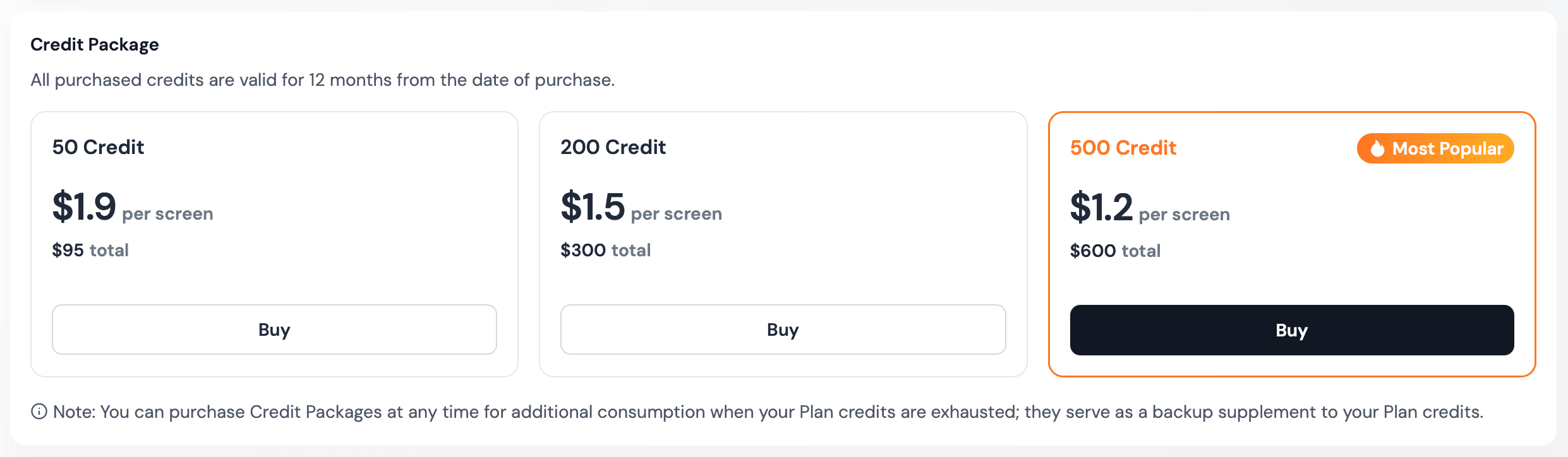
Phalcon Compliance publishes the full 5-tier structure, which itself departs from the sales-quote norm in this category. The Free plan covers 3 screenings per month on all supported chains. It includes basic screening but no custom Risk Engines, no Analytics, no SAR or STR reports, and email-only notifications, so a small team can evaluate the workflow before spending anything. The Screening Packages tier is the pay-as-you-go entry. Credit packs come in sizes of 50, 100, 200, 500, 1000, or 2000 screenings, starting at $95 with a per-unit cost between $1.10 and $1.90, valid for 12 months. The pack carries full-chain coverage, Analytics, 3 custom Risk Engines, and audit report export. The Essential tier starts at $39 per month for 25 to 500 screenings per month. It adds 10 custom Risk Engines, SAR and STR report generation, CSV export, and multichannel notifications. The Scale tier starts at $699 per month for 750 to 5000 screenings per month and is the entry point for API integration. Scale adds Webhook, 20 custom Risk Engines, and all 7 notification channels. The Enterprise tier is quote-based. It carries unlimited screenings, multi-seat team collaboration, dedicated support, and Monitor included.
| Tier | Starting price | Screening volume | Key capability |
|---|---|---|---|
| Free | Free | 3 per month, all supported chains | Basic screening; no custom engines, Analytics, or SAR |
| Screening Packages (PAYG) | $95 ($1.10 to $1.90 per check) | 50 to 2000 credits | Full-chain, Analytics, 3 custom Risk Engines, audit reports, 12-month validity |
| Essential | $39 per month | 25 to 500 per month | 10 custom Risk Engines, SAR and STR, CSV export, multichannel alerts, first Monitor seat free |
| Scale | $699 per month | 750 to 5000 per month | API access, Webhook, 20 custom Risk Engines, all 7 notification channels, first Monitor seat free |
| Enterprise | Contact sales | Unlimited | Multi-seat team collaboration, dedicated support, expanded Monitor seats |
Two gating rules matter for a small VASP that plans a growth path. API integration is available only on Scale and Enterprise, so a team that wants to embed screening inside its own onboarding or transaction flow needs to reach the Scale tier at $699 per month. Multi-seat team collaboration is available only on Enterprise, so a compliance function that needs more than one seat working inside the tool is looking at a quote-based contract. The referral program offers up to 20% cashback on referred paid users; the official pricing pages document the full terms. The engineering side of that gate is covered in the guide on how to integrate a KYT API into a crypto exchange, which walks through the rate limits, quota order, and webhook wiring that the Scale tier unlocks.
The structure, not the headline number, is what makes the tool affordable for a small VASP. A team that screens a handful of wallets per week can live on a $95 credit pack for months. A team whose volume has stabilized can move to Essential at $39 per month and only later reach for Scale when it needs API integration. The cost follows the workload. A rigid annual subscription cannot offer that. The tier ladder is also one piece of the broader crypto AML compliance workflow, where screening, monitoring, and reporting draw on the same credit structure.
ROI: When Pay-as-You-Go Beats a Fixed Annual Subscription
Break-even math turns the pricing structure into a decision a small VASP can defend to its finance function. Consider a small operator screening 200 to 500 wallets per month. Under pay-as-you-go, that volume maps to a $95 to $380 one-time credit purchase that may cover the team for several months depending on how the checks cluster. Under the Essential subscription, the same volume maps to $39 to roughly $109 per month, depending on the exact plan band chosen. Against the industry-typical six-figure annual subscription, both numbers are a rounding error. The decision is not whether to save money but whether to spend it on the right cost shape.
Annual prepayment rewards teams whose volume has stabilized. Phalcon Compliance subscriptions run up to 30 percent cheaper on annual billing than on monthly billing at the highest Scale tier, and roughly 15 to 17 percent on entry tiers such as Essential. The Essential 100 screenings per month plan illustrates the gap at $109 per month on monthly billing and at the equivalent of $92 per month on annual billing. The upgrade path is equally forgiving. Moving up a tier charges only the prorated difference for the remaining days and never double-bills, so a team that underestimates its volume early is not punished for correcting mid-term.
The decision rule is simple. A team with volatile or unknown screening volume should start on the Free tier, validate the workflow, then buy a $95 pay-as-you-go pack and track how fast it burns. If the pack lasts more than two to three times the equivalent subscription window, pay-as-you-go is the cheaper path. If the pack burns inside one subscription window and the volume is repeatable, move to Essential and consider annual billing to capture the tier discount. Reach for Scale only when API integration becomes a requirement, because that is the tier where the per-month cost steps up meaningfully. The anonymized six-figure annual subscription is the baseline to beat, never a target to aspire to.
Start Pay-as-You-Go Screening from $95
A small VASP does not need a six-figure contract to meet its AML obligation. Phalcon Compliance lets a compliance team start with a free tier. From there it can move to a $95 pay-as-you-go credit pack, and step into a subscription only when volume and API needs justify it. Start Phalcon Compliance pay-as-you-go screening and run the break-even math on the team's own screening volume before committing to any annual contract.