
A crypto AML vendor can be evaluated against six dimensions: coverage, accuracy, integration, pricing transparency, regulatory alignment, and auditability. A vendor that is weak on any one of them surfaces that weakness months into the contract, not in the first month. The cost of picking the wrong vendor is rarely the license fee. It is the re-integration, the re-training, and the gap in the audit trail that appear when a regulator asks why a sanctioned address was cleared. This page is a working evaluation framework for compliance officers and tradfi compliance teams who are about to sign a crypto AML contract. It is part of a broader crypto AML compliance platform and answers one question: how do you evaluate a crypto AML compliance vendor before the cost of being wrong becomes irreversible. This page is part of the AML Compliance Hub.
Why Vendor Evaluation Matters
Picking the wrong crypto AML vendor is a multi-year liability, not a refundable mistake. The cost shows up as compliance gaps, migration cost, and regulatory accountability. A structured evaluation before contract is the only reliable defense.
The cost of a wrong pick compounds along three lines. The first is the compliance gap itself. A vendor whose label database is stale or whose risk scoring is opaque will pass addresses it should flag. Each cleared address is a latent finding that only appears during a regulator exam, a law-enforcement request, or an internal incident review. The second line is migration cost. Crypto AML tools embed themselves into onboarding flows, transaction monitoring pipelines, and SAR drafting workflows. Ripping one out and re-integrating a replacement is a quarter of engineering work, not a cancellation email. The third line is regulatory accountability. Examiners hold the regulated entity responsible for the tool it chose, not the vendor that sold it. A defensible vendor selection record is what an examiner asks for when a screening failure lands, and a record built on a sales deck rather than a structured checklist is hard to defend.
The FATF virtual assets risk framework reinforces this by making the regulated entity, not the tool vendor, the accountable party for screening outcomes. FinCEN guidance on virtual currency makes the same accountability explicit at the national level, treating the choice of screening tool as a decision the regulated entity owns. That accountability is why vendor due diligence is a regulatory expectation rather than a procurement preference. The framework a compliance officer uses to evaluate a vendor should be repeatable, documented, and independent of the vendor's own marketing.
The 6-Dimension Evaluation Framework
A crypto AML vendor can be evaluated against six dimensions: coverage, accuracy, integration, pricing transparency, regulatory defensibility, and support. The six dimensions turn an open-ended vendor comparison into a repeatable checklist that survives a sales cycle and holds up in an exam.
-
Coverage. How many chains does the tool screen, how large is the labeled-address database, and how often is it refreshed? Coverage is the floor. A vendor that returns empty hits on the chains a business actually transacts on is not an option regardless of what else it does well. The relevant question is whether coverage maps to the entity's own chain exposure, including the bridges and cross-chain paths that funds actually take.
-
Accuracy. What is the false-positive rate on a realistic workload, and can the tool explain why an address was flagged? A risk score with no exposed basis is a black box. Compliance teams live or die by triage time, and a tool that flags thousands of addresses a week without explaining any of them turns a two-person team into a queue. The relevant test is whether the scoring is interpretable enough that an analyst can defend or overturn a flag without escalating every case.
-
Integration. Is there a production-grade API, how long does deployment take, and is the API available on the tier the business can actually buy? Many vendors gate API access behind an enterprise contract, which means a small team can evaluate the product but cannot actually embed it. The relevant question is whether the integration path matches the team's deployment plan and budget at the same time.
-
Pricing transparency. Is pricing published, or is every quote a sales conversation? Pay-as-you-go and tiered pricing let a buyer model cost against real screening volume before signing. Opaque enterprise-only pricing makes evaluation impossible, because the buyer cannot separate the tool's value from the commercial pressure applied during the sales cycle.
-
Regulatory defensibility. Does the tool produce evidence an examiner accepts? A structured risk assessment with traceable indicators, data provenance, and a clear exposure path is defensible. A folder of screenshots is not. The relevant test is whether the tool's output can stand on its own in a filing, a suspension decision, or a law-enforcement handoff.
-
Support. What does onboarding look like, what is the SLA, and is there a named contact when a screening failure lands at three in the morning? A compliance tool without a support path is a liability during the exact moments its value is supposed to show.
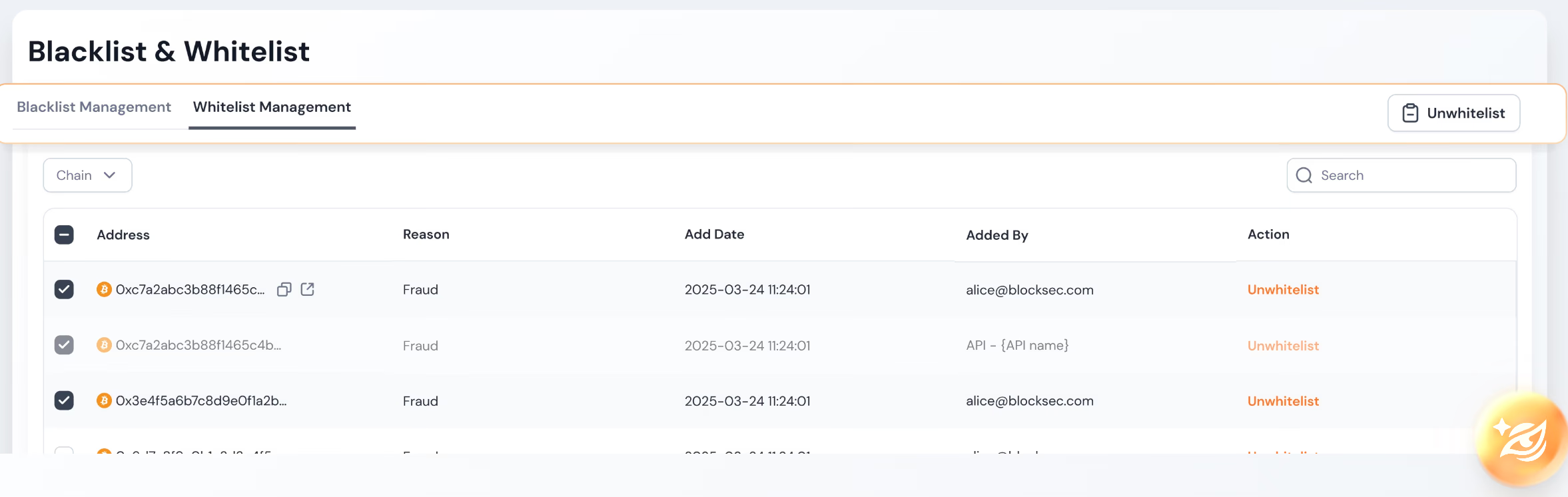 These six dimensions are not a wish list. They are the criteria that separate a vendor that helps a compliance program pass an exam from one that produces alerts and stops there. A compliance officer who evaluates against all six has a record. A compliance officer who evaluates against whichever three the sales deck emphasized has a vulnerability.
What to Verify in a POC or Trial
A proof of concept or trial is where marketing claims meet verifiable evidence, and four checks separate a real evaluation from a demo. The checks cover API response samples, a measured false-positive rate, the labeled-address scale and refresh cadence, and the full pricing picture. Each check turns a marketing claim into evidence, and evidence is what a defensible selection record is built from.
The core blind spot in vendor evaluation is the gap between a marketing claim and a verifiable fact. A vendor can claim broad coverage, low false positives, and transparent pricing on a website. A POC is where each claim has to produce evidence. Four checks cover the gap.
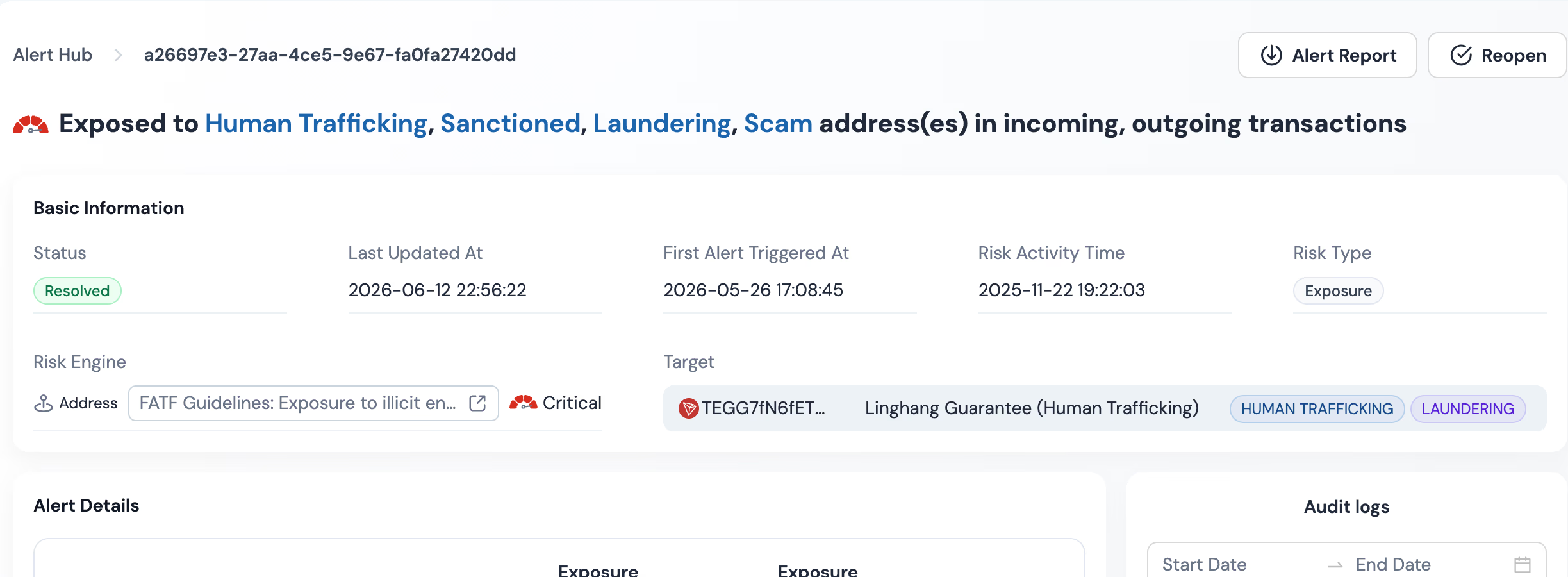
The first check is API response samples that expose the judgment basis. A vendor that returns only a binary risk flag is asking the compliance team to trust the output. A vendor that returns a structured response with named risk indicators, an exposure score, and traceable source references gives the team something it can defend.
Phalcon Compliance, the platform this Spoke sits inside, is the example for the interpretable pattern. Its risk engine is built on 17 categories of Risk Indicators, each traceable to a labeled source. Behind those sit more than 200 granular risk signals that feed a quantified Risk Exposure score rather than a flat flag. A compliance officer evaluating any vendor should ask for the same shape of evidence: not a risk verdict, but the indicators and exposure math behind it. The full five-step independent verification procedure, including how to inspect an API response sample, is documented in the do-blockchain-analytics-tools-actually-work guide; the checks below stay at the vendor-evaluation level rather than restating each step.
The second check is a measured false-positive rate on a realistic workload. A demo dataset curated by the vendor will always look clean. The POC workload should be drawn from the entity's own historical traffic, including the borderline cases that actually consume analyst time. The relevant number is not the vendor's published accuracy but the false-positive rate measured on the entity's own data.
The third check is labeled-address scale and refresh cadence. A vendor should state how many addresses are labeled, across how many chains, and how often the set is updated. A label set in the hundreds of millions, refreshed continuously, gives an analyst something to work with at any hour. A stale or thin set returns empty hits on the exact addresses that matter.
The fourth check is the full pricing picture, including API tier gating. A pay-as-you-go credit entry point that starts at $95, with credit packs valid for 12 months, lets a small team evaluate and operate without a sales conversation. The same vendor's API access may be gated to a higher tier, which is the detail a compliance officer needs before building an integration plan around it. Asking for the full tier map up front is how a buyer avoids discovering the gating during deployment.
Red Flags That Disqualify a Vendor
A small set of red flags disqualifies a crypto AML vendor before contract. A compliance officer who treats them as exit criteria rather than negotiation points avoids the most expensive category of mistake. The red flags are opaque pricing, black-box scoring with no exposed basis, no API trial, and case studies presented as effect evidence.
The red flags cluster around the same gap: the vendor is asking the buyer to trust a claim that could be demonstrated.
Opaque pricing is the first red flag. If a vendor will not publish a tier map or a pay-as-you-go entry point, the buyer cannot model cost against screening volume, and every commercial conversation becomes a negotiation against information the vendor holds. Pricing transparency is not a courtesy. It is a precondition for evaluation.
Black-box scoring is the second. If a vendor returns a risk flag with no exposed indicators, no exposure breakdown, and no traceable source, the compliance team cannot triage, defend, or overturn it. The only path left is to escalate every case. A risk score that cannot be explained cannot be defended in an exam.
No API trial is the third. A vendor that demos a product but will not let a buyer call the API on real addresses is gating evaluation behind a sales relationship. A genuine trial gives the buyer a sample of the API response, a chance to measure false positives, and a path to integration before contract.
Case studies presented as effect evidence are the fourth. A logo wall, a case study, or a testimonial is not evidence that a tool reduces risk. It is evidence that a customer signed a contract. Effect evidence is a measured false-positive rate, a documented label-refresh cadence, and a defensible audit trail. A vendor that substitutes the first for the second is asking the buyer to confuse adoption with performance.
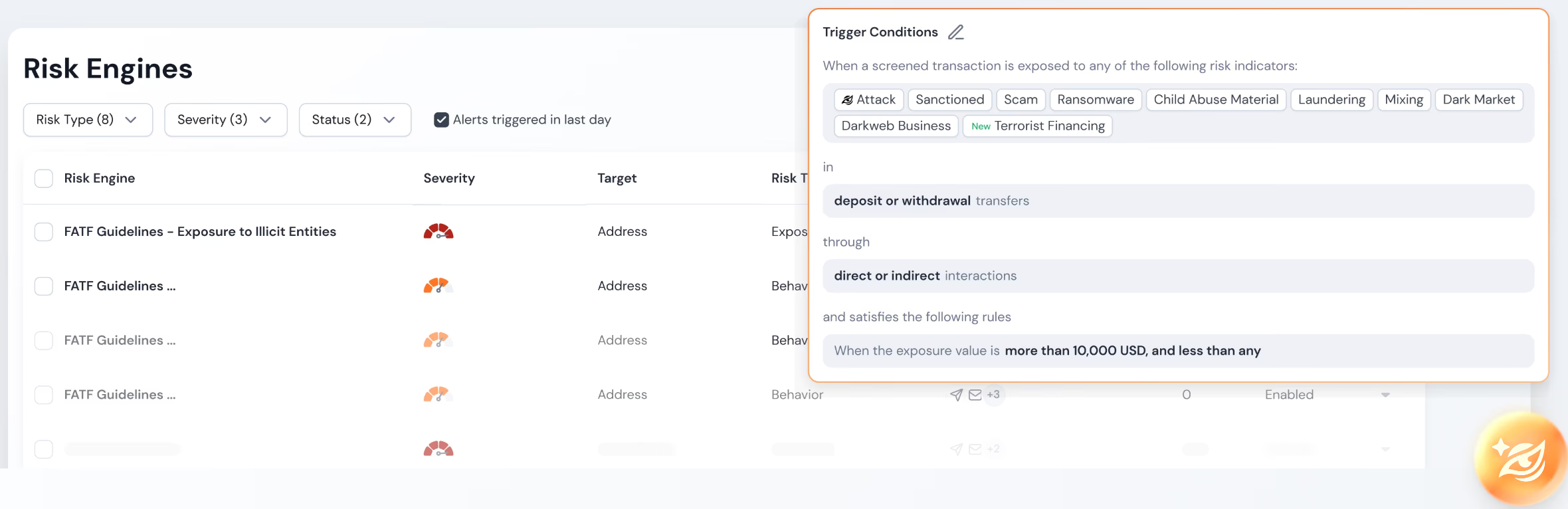 None of these red flags require naming a competitor or running a comparison leaderboard. They are properties of the vendor's behavior during evaluation. A vendor that clears all four has earned a contract. A vendor that fails any one has produced the exact evidence a compliance officer needs to walk away.
Request a Phalcon Compliance POC
If the six-dimension framework and the POC checklist above describe what a compliance officer needs, the next step is to run a real evaluation against a real workload. A Phalcon Compliance POC gives a compliance team API access to a risk engine built on 17 traceable Risk Indicator categories. It pairs that with a quantified Risk Exposure score and pay-as-you-go pricing that starts at $95.
A vendor selection record is only as strong as the evidence behind it. Request a Phalcon Compliance POC and judge it against the six-dimension framework rather than against a sales deck. Run it on the entity's own historical workload, measure the false-positive rate, inspect the API response that exposes the indicators behind each score, and compare the published tier map against the team's deployment plan. That is the evaluation a compliance officer can defend in an exam, and it is the evaluation this framework is built to support.