
Yes, blockchain analytics tools work, but only after you test three things. First, the tool must cover the chains and entities you actually touch. Second, its risk calls must land right on your own transactions. Third, your analysts must re-check each result on their own. A polished demo will not show how a tool performs on your transactions. Buyers separate customer stories from measured product performance and run these checks before they sign. This guide shows how to run those checks as part of a broader crypto AML compliance program. This page is part of the AML Compliance Hub.
What Effectiveness Means: Coverage, Accuracy, Verifiability
Effectiveness for a blockchain analytics tool is not a single metric. It is the answer to three separate questions: what the tool can see, how often it is right, and whether a reviewer can re-check each judgment. These three questions are coverage, accuracy, and verifiability. A tool that fails any one of them is not effective, regardless of how polished its case studies look.
Coverage is the first question. It asks how many chains the tool reads, how many addresses it has labeled, and how often it refreshes that label set. A tool that covers a handful of chains with a stale label database will return empty hits on the exact addresses that matter in a live investigation. Coverage in the hundreds of millions of addresses, refreshed around the clock, is the floor for a tool that claims to screen real-world risk.
Accuracy is the second question. It asks how the tool behaves on false positives and false negatives. Industry research has documented false-positive rates in a very wide range across compliance tooling, but that range describes the category, not any single tool. A buyer cannot inherit a category-level number as a product-level promise. Accuracy has to be measured on the buyer's own data, which is why verifiability exists as the third question.
Verifiability is the third question and the one that separates a tool that works from a tool that merely sounds convincing. It asks whether the tool returns the basis behind each risk judgment, and whether that basis traces to named signals or data sources. It also asks whether a second reviewer can re-check the decision and reach the same result. A tool that emits a risk score with no exposed basis is asking the compliance officer to take the judgment on faith. A tool that exposes its basis hands over evidence the compliance officer can defend.
Why Case Studies Are Not Effectiveness
A case study proves that a tool followed a specific trace once, under specific conditions, with skilled operators. It does not prove the tool will behave the same way in a different environment, against a different threat, or under a different auditor. Treating case-study evidence as effectiveness evidence is the most common and the most expensive mistake a buyer can make.
The skepticism is not an edge case. Compliance officers and blockchain investigators share a recurring skepticism: vendor slide decks and case studies look compelling, yet the underlying effectiveness cannot be independently verified. The same concern surfaces in audit preparation and procurement, and it points to one structural gap. A case study proves a tool could follow a specific trace once, not that it will behave the same way in a different environment.
The structure of a case study is the problem. A vendor selects a successful investigation, narrates it forward, and presents the outcome as representative. The cases that failed, stalled, or produced ambiguous results do not become case studies. An investigator reading the polished deck has no way to know the base rate of success or the conditions that produced it. The same tool might not reach the same conclusion on a slightly different fund-flow pattern.
Marketing metrics carry the same structural weakness. A headline coverage figure or accuracy percentage quoted in a slide deck rarely carries a methodology footnote. It is not clear whether the number was measured against a benchmark, inferred from a sample, or extrapolated from a model. Without methodology, the number is a claim, not evidence. This is why the FATF virtual assets risk framework emphasizes risk-based, demonstrable supervision, and why FinCEN guidance on virtual currency treats independent verification of screening outcomes as a compliance-program expectation. Defensibility is impossible without verifiable decision basis, and a case-study narrative is not a verifiable basis.
The research side has surfaced the same gap. The field lacks shared benchmarks, reported performance numbers are difficult to compare across tools, and effectiveness in a controlled experiment does not translate cleanly to live, adversarial laundering behavior. A buyer who treats any single effectiveness claim as settled science is overreading the evidence. The structured path from this skepticism to a defensible decision is covered in the crypto AML compliance vendor evaluation guide.
Explainable and Verifiable: Make Effectiveness Auditable
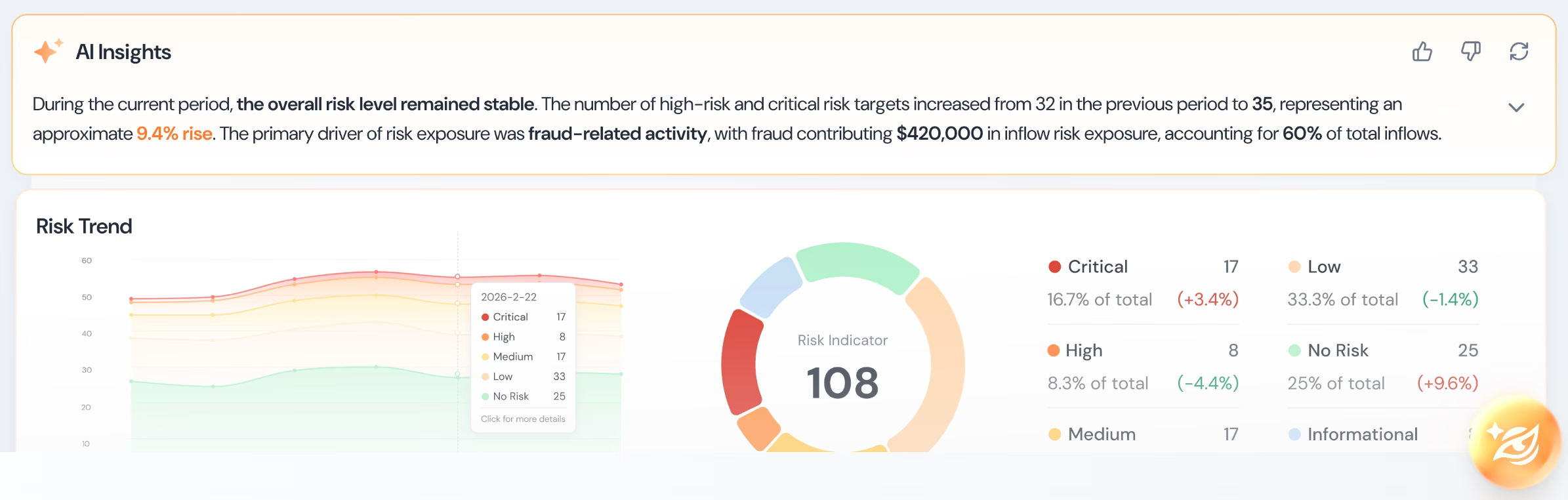
A useful analytics tool should show how it reached each result. Phalcon Compliance organizes more than 200 signals into 17 Risk Indicator categories, identifies the indicators behind each alert, quantifies Risk Exposure in value and percentage terms, and links behavioral alerts to named templates. Analysts and auditors can review the evidence behind the result.
Phalcon Compliance makes the decision basis inspectable by exposing 200+ signal types organized into 17 Risk Indicator categories as a transparent set, where every risk decision returns the indicator IDs that drove it. A screening result is no longer a black-box score. It is a judgment with a named basis, and each named indicator can be examined, challenged, and defended. Risk Exposure Engine quantifies exposure as Exposure Value in USD and Exposure Percentage, so the size of a risk can be read as a number and re-checked rather than inferred from a tier label. A compliance officer reporting exposure to a board or a regulator can point to the dollar figure and the percentage, not to a color code.
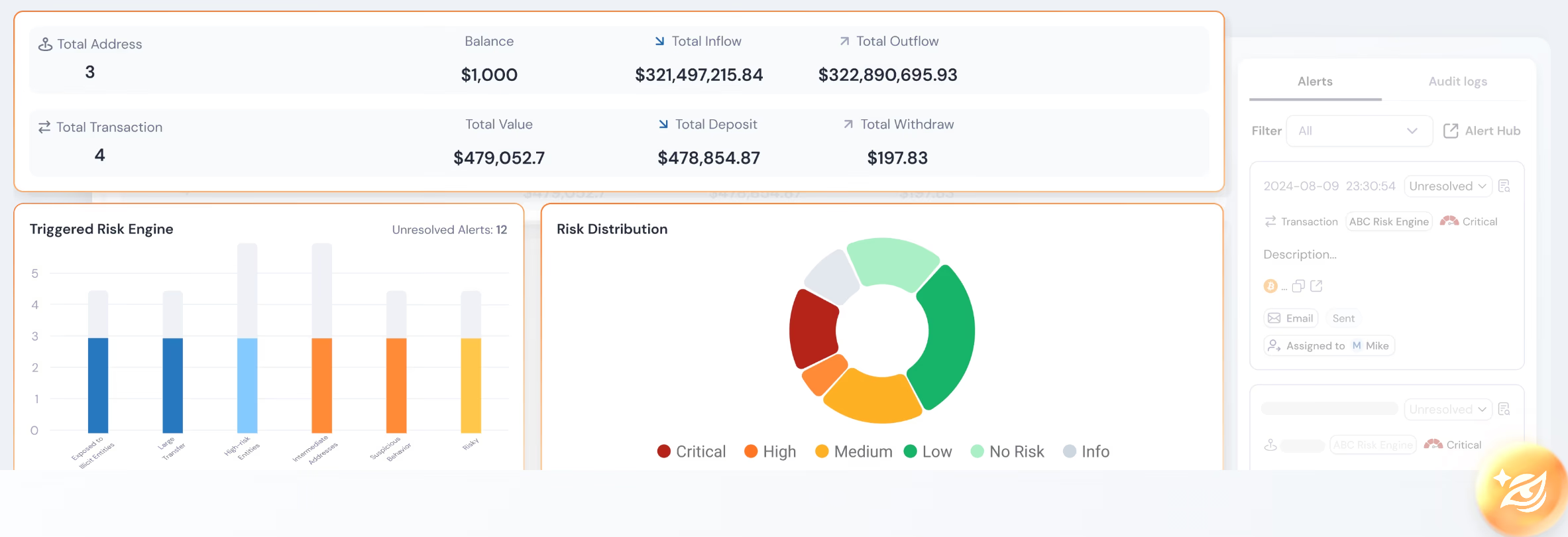 Behavioral Risk Engine includes 3 address templates and 2 transaction templates. Each alert shows which template was triggered, so the reviewer can explain why the activity was flagged. Phalcon Compliance also uses more than 600 million labeled addresses and over 200 signal types, refreshed continuously, to support its screening results.
The verifiability path closes the loop. API responses return the decision basis and data provenance behind each risk judgment, so a compliance officer or auditor can independently re-check how a screening result was reached. The comparison below maps the explainable model against the black-box alternative.
| Dimension | Black-box risk score | Explainable model |
|---|---|---|
| Decision basis | Not exposed | 200+ signal types across 17 Risk Indicator categories, each traceable by ID |
| Risk quantification | Tier label only | Exposure Value in USD and Exposure Percentage |
| Behavioral detection | Opaque alerts | 3 address and 2 transaction templates, each named |
| Independent re-check | Not possible | Auditor can re-trace the decision path |
| Coverage behind the decision | Unverified | 600 million-plus labeled addresses, refreshed continuously |
How Buyers Can Independently Verify a Tool Effectiveness
A buyer does not need to take any vendor's effectiveness claim on faith. Five concrete steps let a compliance team verify a blockchain analytics tool independently: request a sample API response, inspect the label database, and run a false-positive test on the buyer's own data. The team should also require a proof-of-concept on live cases and require each decision to return its basis.
Request a sample API response first. The response either contains a decision basis or it does not. A response that returns only a score and a tier label is a black box. A response that returns the indicator IDs, the data sources, and the provenance trail is a glass box. This single inspection separates the two categories of tool without a sales conversation.
Inspect the label database second. Ask how many addresses are labeled, across how many chains, and how often the set is refreshed. A label set measured in the hundreds of millions and refreshed around the clock is materially different from one measured in the tens of millions and updated quarterly. Coverage determines whether the tool will recognize the addresses that actually appear in a live screening.
Run a false-positive test on the buyer's own data third. Industry-published false-positive ranges describe the category, not the product. A buyer needs a test on its own transaction pattern, its own customer book, and its own risk appetite. Even a small sample run on real addresses will surface whether the tool over-alerts on legitimate activity, which is the single largest practical cost of a wrong choice.
Require a proof-of-concept on live cases fourth. A structured POC on a handful of real investigations, with the results compared against the team's own findings, tells a buyer more in a week than a slide deck can in a year. The POC should test the verifiability path explicitly, by asking the team to re-derive each risk judgment from the exposed basis.
Require each decision to return its basis fifth. This is the test that turns effectiveness from a claim into evidence. A tool that cannot expose the basis behind its decisions is asking the buyer to defend filings on faith. A tool that exposes the basis hands the buyer evidence it can put in front of an auditor, a regulator, or law enforcement.
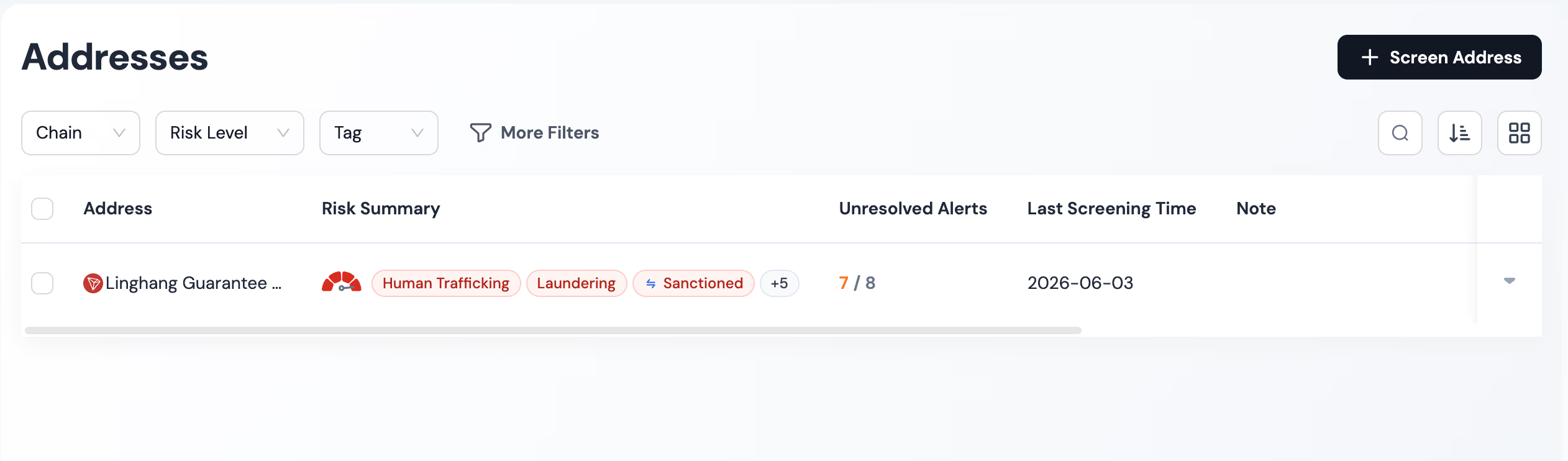
Verify Phalcon Compliance Explainable Risk Scoring
A blockchain analytics tool actually works when a reviewer can re-check its effectiveness, not when its case studies look compelling. The explainable model laid out above is the shape of that re-checkable evidence. Verify Phalcon Compliance explainable risk scoring and run the five-step independent verification on a real case before signing any contract.