Back to Blog

Lead in: Phalcon's Hack Blocking Saga

April 23, 2024

Since BlockSec's debut in 2021, we have long maintained that code auditing alone cannot solve all Web3 security issues. Therefore, we have been investing in exploring new paradigms for Web3 security. Thus we created Phalcon, the world's first crypto hack-blocking system.

Before the launch of Phalcon, the system had been running internally for 2 years, successfully blocking over 20 hacks, and rescuing more than 20 million USD worth of assets, including $3.8M for Saddle Finance, $2.4M for Platypus, $5M for ParaSpace, and more.

In this series of articles, we will present representative stories of our system Phalcon. In sharing these cases, we aim to do more than validate the effectiveness of our system. We also want to demonstrate the transformative effect of proactive defense measures.

In the face of threats, we are not powerless. Together, we can usher in a new era of Web3 security.

Breaking Down: A Comprehensive Overview
About Phalcon

Phalcon is a security platform developed by BlockSec to monitor and block hacks. The system detects suspicious transactions, instantly alerts users, and takes automated actions in response.
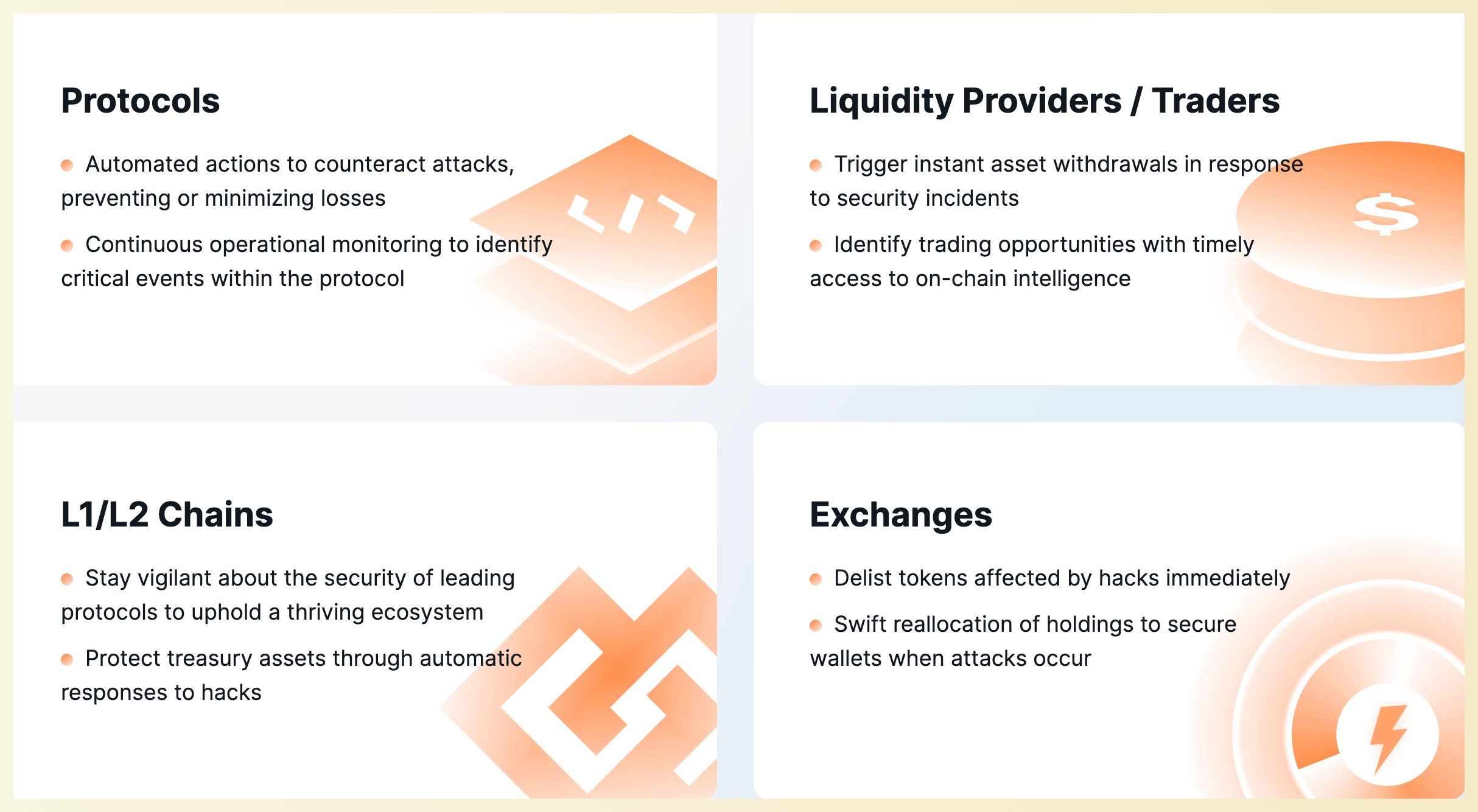
Use cases of Phalcon

Phalcon is a SaaS platform where users can directly log in through our official website to view different pricing plans and features, and subscribe immediately (supporting both credit card and crypto payments). For any questions, feel free to book a demo with our security experts who will address your concerns.

Support Tool: Phalcon Explorer

Phalcon Explorer is a support tool for the Phalcon platform. This powerful transaction explorer is designed for the DeFi community. It provides comprehensive data on call flows, balance changes, and transaction fund flows, as well as supports transaction simulation. This helps developers, security researchers, and traders to more intuitively understand transactions.
Sign up for the latest updates
Weekly Web3 Security Incident Roundup | Mar 16 – Mar 22, 2026
Security Insights

Weekly Web3 Security Incident Roundup | Mar 16 – Mar 22, 2026

This BlockSec weekly security report covers seven DeFi attack incidents detected between March 16 and March 22, 2026, across Ethereum, BNB Chain, Polygon, and Polygon zkEVM, with total estimated losses of approximately $82.7M. The most significant event was the Resolv stablecoin protocol's infrastructure-key compromise, which led to over $80M in unauthorized USR minting and cross-protocol contagion across lending markets. Other incidents include a $2.15M donation attack combined with market manipulation on Venus Protocol, a $257K empty-market exploit on dTRINITY (Aave V3 fork), access control vulnerabilities in Fun.xyz and ShiMama, a weak-randomness exploit in BlindBox, and a redemption accounting flaw in Keom.

Building a Secure Stablecoin Payment Network: BlockSec Partners with Morph
Partnership

Building a Secure Stablecoin Payment Network: BlockSec Partners with Morph

BlockSec has partnered with Morph as an official audit partner for the $150M Morph Payment Accelerator. By offering exclusive discounts on smart contract audits and penetration testing, BlockSec provides institutional-grade security to payment builders, ensuring a safe and resilient foundation for the future of global stablecoin payments.

Weekly Web3 Security Incident Roundup | Mar 9 – Mar 15, 2026
Security Insights

Weekly Web3 Security Incident Roundup | Mar 9 – Mar 15, 2026

This BlockSec weekly security report covers eight DeFi attack incidents detected between March 9 and March 15, 2026, across Ethereum and BNB Chain, with total estimated losses of approximately $1.66M. Incidents include a $1.01M AAVE incorrect liquidation caused by oracle misconfiguration, a $242K exploit on the deflationary token MT due to flawed trading restrictions, a $149K exploit on the burn-to-earn protocol DBXen from `_msgSender()` and `msg.sender` inconsistency, and a $131K attack on AM Token exploiting a flawed delayed-burn mechanism. The report provides detailed vulnerability analysis and attack transaction breakdowns for each incident.