Crypto compliance software answers obligations, not feature lists: the category exists to carry screening, monitoring, and reporting duties that crypto businesses already hold. Institutions and platforms entering the market do not need to invent a compliance program from nothing; they need their on-chain obligations translated into tooling, and that translation is exactly what this software category sells. This guide maps the mapping itself: which capability answers which duty, and where responsibility stays with the operator.
Start from the Obligation, Not the Tool
The buying conversation usually starts with tools, which is backwards. A crypto business holds three obligation groups before it evaluates any software. Screening duties: know the risk of the addresses you transact with, at onboarding and at every covered touchpoint. Monitoring duties: watch relationships continuously, because risk changes after onboarding. Reporting and record duties: escalate suspicious activity in time, and keep evidence that survives examination. FinCEN's materials describe the underlying anti-money-laundering rationale, and the FATF Recommendations set the international frame.
The entry problem institutions describe is a translation problem: the obligations are familiar from traditional finance, the terrain is not. Compliance software that maps cleanly onto those obligations turns an unfamiliar risk surface into a familiar program.
Which Tool Capability Answers Which Obligation
Obligations map to capabilities cleanly: screening duties need label depth, monitoring duties need event triggers and latency, and reporting duties need explainable evidence trails.
| Obligation | Capability that answers it | What to demand |
|---|---|---|
| Screening (entry and touchpoint) | Labeled-address intelligence | Scale in the hundreds of millions, continuous updates, multi-chain coverage |
| Monitoring (continuous) | Event-triggered re-screening | Designation-driven re-checks, millisecond response, tiered alerts |
| Reporting (escalation) | Evidence assembly | Machine-generated trails, explainable signals, exportable formats |
| Record-keeping (examination) | Audit-grade logging | Every check timestamped with its intelligence basis |
The numbers a vendor should be able to state plainly: Phalcon Compliance evaluates each screened transaction against over 200 risk signals, drawing on a labeled library spanning hundreds of millions of addresses and refreshed continuously. Numbers stated without a checkable basis deserve the skepticism they invite.
The mapping discipline beats feature checklists: teams that buy against obligations end up with tools they actually use, while checklist buyers pay for modules that never fire. For a broader walk through the category, see the crypto compliance software guide; for how leading options compare, see 6 Best Blockchain and Crypto Compliance Software Solutions.
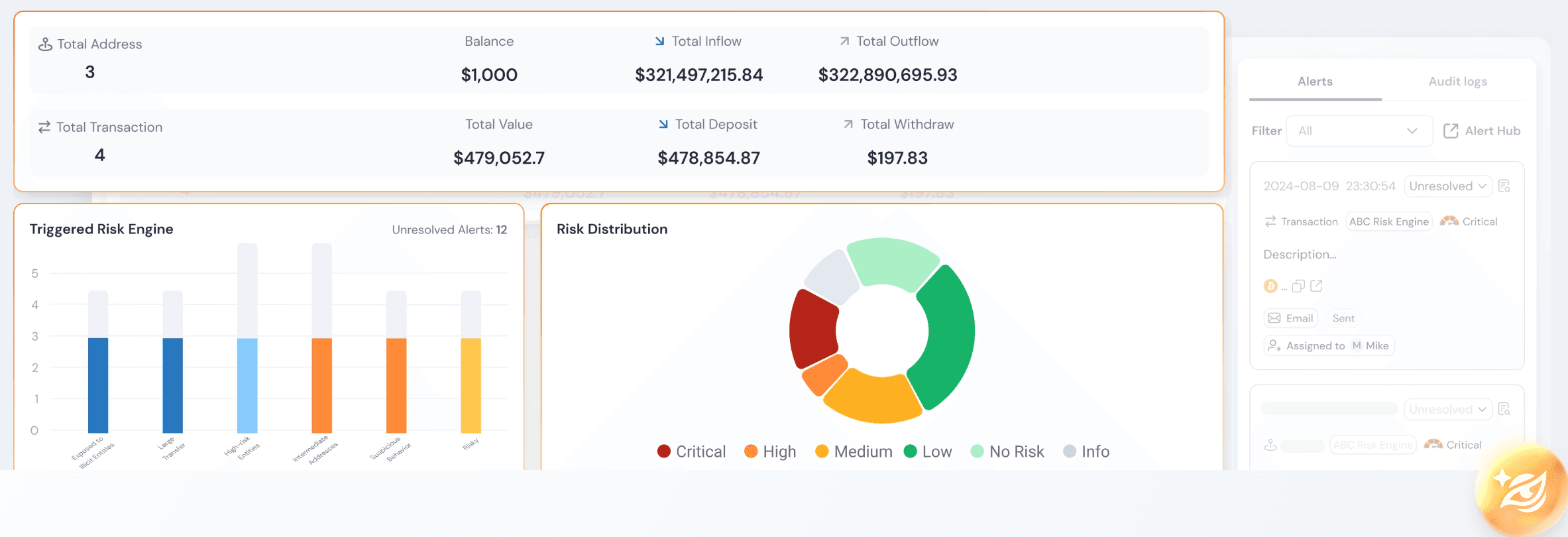
Deployment Shapes: API, Platform, or Both
| Shape | What it is | Fits when |
|---|---|---|
| API-first | Screening calls embedded in your product flows | Payments, exchanges, custody: risk decisions execute in-flow |
| Platform | Analyst-facing workspace for review and investigation | Compliance teams running case queues and periodic reviews |
| Both | Shared intelligence layer under API and workspace | Operations that screen at volume and investigate by exception |
Most operating teams run both shapes on one intelligence layer. The evidence an API call produces is the same evidence an investigator needs later, and reassembling it from two systems is how examinations turn painful.
Book a demo of Phalcon Compliance and check the three obligation groups against one labeled-intelligence layer, deployed by API, platform, or both.
FAQ: Crypto Compliance Software
Does compliance software make us compliant? No. Phalcon Compliance produces the signals, evidence, and drafts; the decisions and the accountability stay with your institution. Software that promised compliance itself would be promising something no supervisor accepts.
Is this the same as KYC tooling? No. Identity verification is a separate discipline with its own category. On-chain compliance software covers the address and transaction layer and interlocks with identity verification rather than replacing it.
How is it priced? Per-call usage-based and subscription models both exist; per-call fits volume that swings with market cycles, subscriptions fit steady high volume.
What should we verify before buying? Label library scale and update cadence, response latency under your peak load, alert explainability, and chain coverage, in that order.