A compliance officer types a wallet address into a search bar and waits. The address was clean in a background check last quarter, but the counterparty landscape around it shifts every block. What the officer needs is not another identity file. What they need is a risk read on the address itself, returned fast enough to act before the funds move on. Crypto address risk screening is that read. You submit a single wallet address. The system runs it against a labeled address database, matches it against a fixed set of risk indicators, and returns a risk level with an exposure figure the team can act on.
What Crypto Address Risk Screening Actually Means
Crypto address risk screening is the one-time AML and CFT risk assessment of a single wallet address. You submit an address, the system evaluates it against all active address-type risk engines, and it returns a risk level with exposure figures. Screening does not verify who the customer is. It reads the risk profile of the address itself, as a snapshot at the moment of the query.

The keyword is one-time. Screening answers a point-in-time question: what is the risk of this address right now. A compliance team screens when a deposit is pending, when a counterparty appears, or when an analyst pulls an address for review. The result is a still frame, not a feed.
That makes screening distinct from monitoring. Screening is a single assessment triggered by a manual or API query. Monitoring is continuous. Once an address is put on monitor, the system re-runs analysis on a dynamic schedule and pushes alerts when the risk level changes or a new risk indicator hits, without anyone re-submitting the address. Screening is the snapshot. Monitoring is the live feed. The definitional walkthrough of the continuous side lives in the address-based AML monitoring guide.
Screening is the minimum action unit of Know Your Address, or KYA. It is the atomic step that every broader AML workflow builds on. A compliance program can run thousands of screens, escalate the risky ones, and put a subset on monitor. But the screen is the base unit, and defining it precisely is the entry point to the rest of the control stack. That duty sits inside the FATF risk-based approach, which expects a VASP to assess risk before transacting. The address screen is the smallest unit that meets it at the wallet layer, per the FATF RBA Guidance for VASPs.
How Screening Works: The Four-Step Mechanism
The screening act splits into four sequential steps, and each step maps to a concrete data or decision node. The mechanism is not abstract. It is the product logic of the KYA (address screening) module of Phalcon Compliance, so defining how screening works is also defining how the product works.
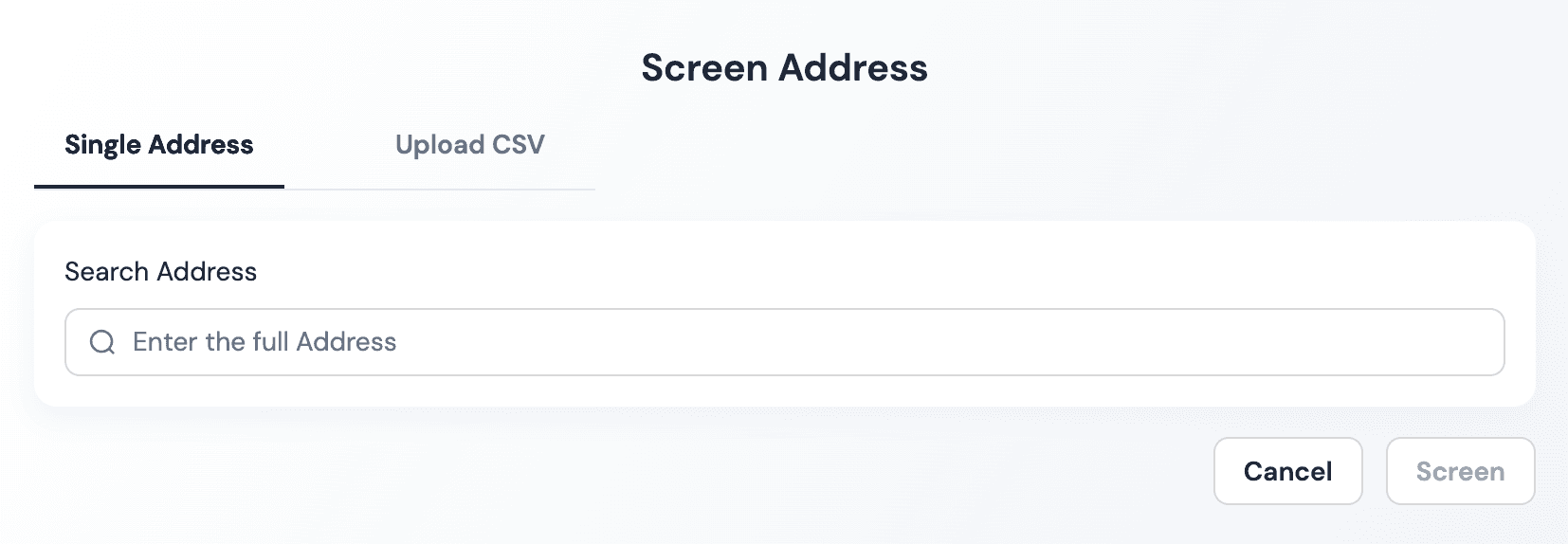
Step one is address input. A compliance analyst submits a single address through the screen-an-address action, or uploads a CSV batch with up to one hundred addresses per file. The address is automatically screened against every active address-type risk engine in the project. No engine selection is needed at the point of query, because the address runs the full active set.
Step two is label library matching. The submitted address is matched against the BlockSec verified address database, which holds 600 million+ labeled addresses. Labels are system-generated and immutable, drawn from that verified database, so an analyst cannot hand-edit a label to soften a result. A label might read as a known exchange hot wallet or a recognized illicit service. Alongside labels, the address carries tags. System tags, such as sanctioned or mixer, are immutable. Custom tags are editable, with a cap of five tags per address combined.
Step three is risk indicator hit. The Risk Exposure Engine evaluates whether the address associates with any of seventeen risk indicators. The full indicator set:
-
Sanctioned
-
Attack
-
Scam
-
Ransomware
-
Child Abuse Material
-
Laundering
-
Mixing
-
Dark Market
-
Darkweb Business
-
Blocked
-
Gambling
-
No KYC Exchange
-
Terrorist Financing
-
FATF Grey List Jurisdiction
-
FATF High Risk Jurisdiction
-
Human Trafficking
-
Drug Trafficking
The engine evaluates three templates: Entity, a risk label on the address itself; Interaction, a link to a known risk entity in the interaction graph; and Blacklist, a direct transaction with a blacklisted address.
Step four is risk scoring and exposure output. The address lands in one of five risk levels, from Critical down through High, Medium, and Low to No Risk. Beside the level, the engine returns Exposure Value. That is the total USD value of assets that originated from or ever interacted with a risk source. It also returns Exposure Percentage, the share of contaminated assets relative to the total inflow or outflow value of the address. The level tells the team how severe. The exposure figures tell them how much.
That four-step pipeline, from input to exposure output, is what the phrase address risk screening refers to in practice. To see how the same pipeline runs inside a wallet screening workflow, the operational walkthrough sits on the crypto wallet screening spoke.
Risk Levels and the Seventeen Risk Indicators
The output of a screen is two-dimensional. One axis is severity, captured by the five risk levels. The other is category, captured by the seventeen risk indicators. Together they tell a compliance officer both how bad and what kind.
Each risk level's meaning in policy terms is defined by the organization itself, configured to match its internal compliance program and risk appetite. The platform supplies the framework. The team supplies the thresholds.
The seventeen risk indicators are the fixed category set, enumerated in the mechanism section above. For a deeper walkthrough of how each indicator maps to a risk level, see our Address Screening deep dive.
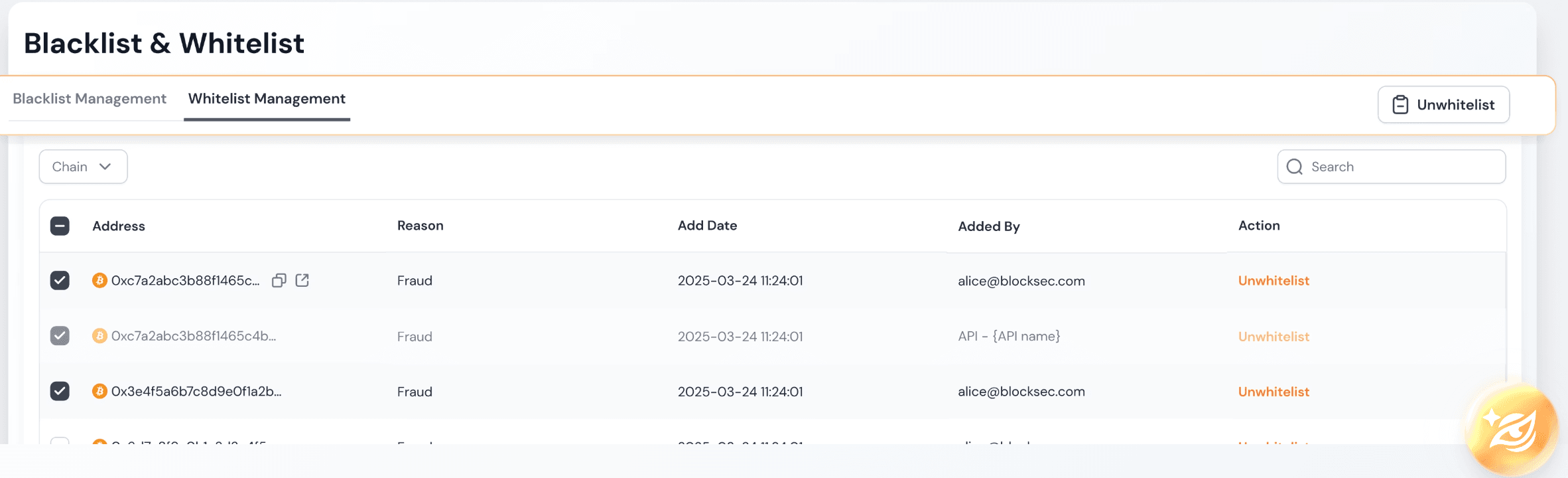
Two override mechanisms sit on top of the standard engine. A blacklisted address is automatically assigned Critical risk and bypasses the standard risk engine screening. Any address that transacts directly with a blacklisted address is also marked Critical. A whitelisted address is automatically assigned No Risk and also bypasses the standard engine. These overrides are hard overrides, not advisory. They let a compliance team pin a known-bad or known-good address so that no future screen softens or escalates it through the normal rule path.
From Screening to Continuous Monitoring
Definition is the entry point. Once a compliance team can name what a screen is, how the four steps run, and what the six-by-seventeen output means, the next question is what happens after the snapshot. An address cleared today can be linked to illicit activity next week. A one-time screen does not catch that drift. The natural next step is to put the address on monitor. The system then re-runs analysis on a dynamic schedule and alerts the team when the risk level changes or a new indicator hits, with no manual re-query needed. In a North American context, address screening is also the minimum action that meets OFAC sanctions screening and FinCEN AML program expectations at the wallet layer, before a deposit is credited.
That continuous side is a separate definition, covered in the monitoring walkthrough. For the deeper read on how KYA screening fits into the broader AML and CFT compliance stack, the main line lives on the Phalcon Compliance hub.
Frequently Asked Questions
Is crypto address risk screening the same as monitoring?
No. Screening is a one-time risk assessment of a single address, triggered by a manual or API query. Monitoring is continuous. Once enabled, the system re-runs analysis on a dynamic schedule and pushes alerts when risk changes, without re-submitting the address.
What is the minimum screening unit for an address?
A single wallet address. An analyst can screen one address at a time, or upload a CSV batch with up to one hundred addresses per file. Each address is automatically screened against every active address-type risk engine in the project.
What do Exposure Value and Exposure Percentage measure?
Exposure Value is the total USD value of assets that originated from or ever interacted with a risk source. Exposure Percentage is the share of contaminated assets relative to the total inflow or outflow value of the address. The first tells you how much is exposed. The second tells you the proportion.
How do blacklist and whitelist addresses affect screening?
A blacklisted address is automatically assigned Critical risk and bypasses the standard risk engine. Any address that transacts directly with a blacklisted address is also marked Critical. A whitelisted address is automatically assigned No Risk and also bypasses the standard engine. Both are hard overrides, not advisory rules.