In 2024 alone, OFAC added dozens of digital currency addresses to its Specially Designated Nationals (SDN) list. Each designation landed on a public blockchain, where the wallets had already moved funds through exchanges, mixers, and payment platforms hours earlier. Address-based AML monitoring is the control layer that watches those wallets in real time, before a compliance team ever sees the alert. For VASPs and crypto compliance officers, the question is no longer whether to screen addresses, but how fast a screening system can react when a counterparty wallet surfaces on a sanctions list mid-transaction.
What Address-Based AML Monitoring Means
A wallet address walks into your platform at 10:03 AM. By 10:17 AM, it has already submitted a withdrawal request to a counterparty address that received funds from a sanctioned entity six hops back. Traditional AML, built around customer identity, would catch none of this. The customer passed onboarding. The address is the problem.
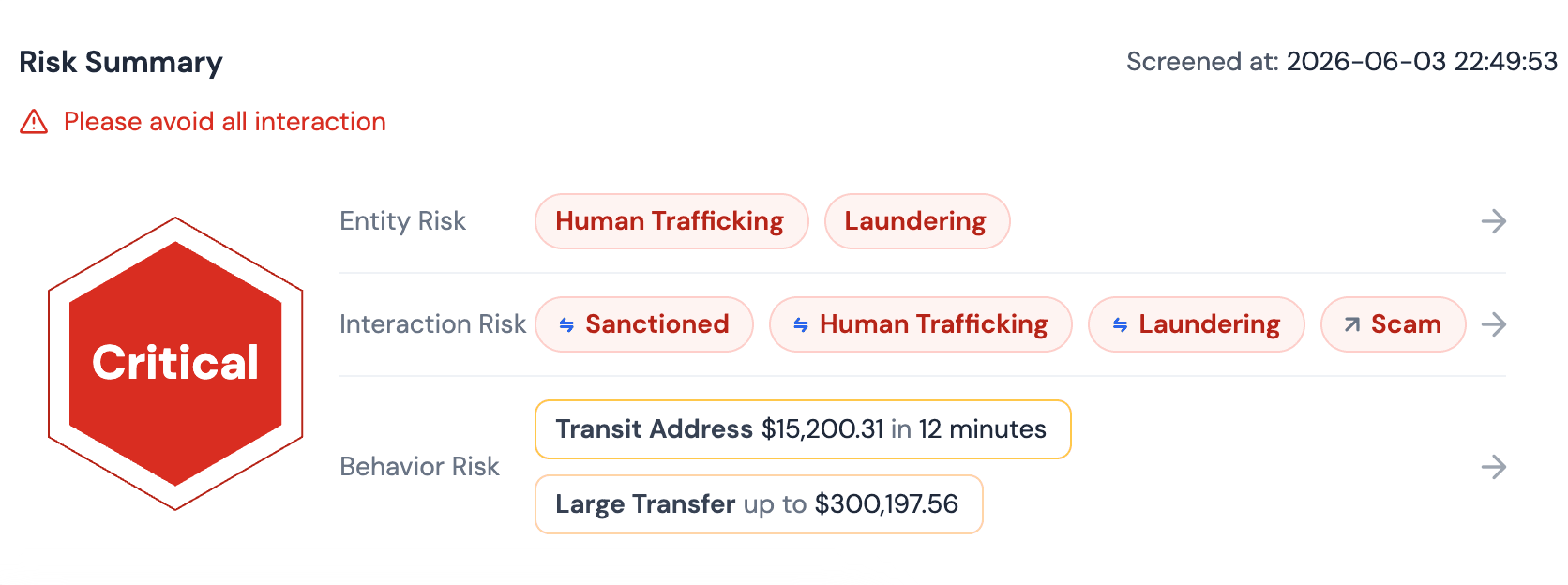
Address-based AML monitoring is the practice of continuously screening blockchain wallet addresses against risk intelligence, sanctions lists, and behavioral labels to detect illicit crypto exposure at the address level. Unlike identity-based controls, which verify who a customer is at onboarding, address monitoring evaluates where the money has been, what the wallet has touched, and who it connects to on-chain.
The mechanism rests on three properties unique to public blockchains. Every transfer is recorded on an immutable ledger. Every address has a transaction graph that anyone can trace backward. And risk signals, once attached to an address, propagate forward to every wallet that later touches it. Address monitoring turns those properties into a compliance control by matching incoming and outgoing wallets against curated risk labels in real time.
This is why address-based monitoring is the first line of defense for crypto AML. Stablecoins now account for the majority of illicit crypto transaction volume, and those flows move between addresses, not between verified identities. Identity verification happens once at onboarding. Money laundering happens every minute after, through addresses.
Why On-Chain Address Monitoring Matters for Crypto Compliance
On-chain money flows are transparent but pseudonymous, and that combination is exactly what makes address monitoring the backbone of modern crypto AML. Regulators can read every transaction, but they cannot read who owns the wallet. The only way to convert blockchain transparency into a compliance signal is to evaluate the address itself.
Three forces are converging to make address monitoring non-optional. First, FATF's risk-based approach (Recommendation 1) applied to virtual assets under Recommendation 15 requires VASPs to conduct ongoing monitoring of transactions and counterparties (Recommendation 10). Second, FinCEN's Bank Secrecy Act obligations extend to money services businesses handling convertible virtual currency, which means sanctions screening and suspicious activity reporting must cover address-level exposure. Third, regional regimes like MiCA in the EU and VARA in the UAE have layered additional wallet-verification and transaction-monitoring duties on top.
The operational consequence is direct. When a deposit arrives at a VASP, the platform must decide, in milliseconds, whether the source address carries risk. Batch screening run weekly no longer satisfies regulators who expect near-real-time detection. The same logic applies to DeFi frontends, payment processors, and stablecoin issuers.
The Core Workflow of Address-Based AML Monitoring
What happens between the moment a deposit address hits your mempool and the moment your compliance queue receives a decision? That gap, measured in milliseconds, is where address monitoring lives.
The screening itself follows a four-step mechanism: address input, label matching, indicator hit, and scoring, detailed in our address risk screening guide. Monitoring layers continuous re-analysis on top of that one-time screen.
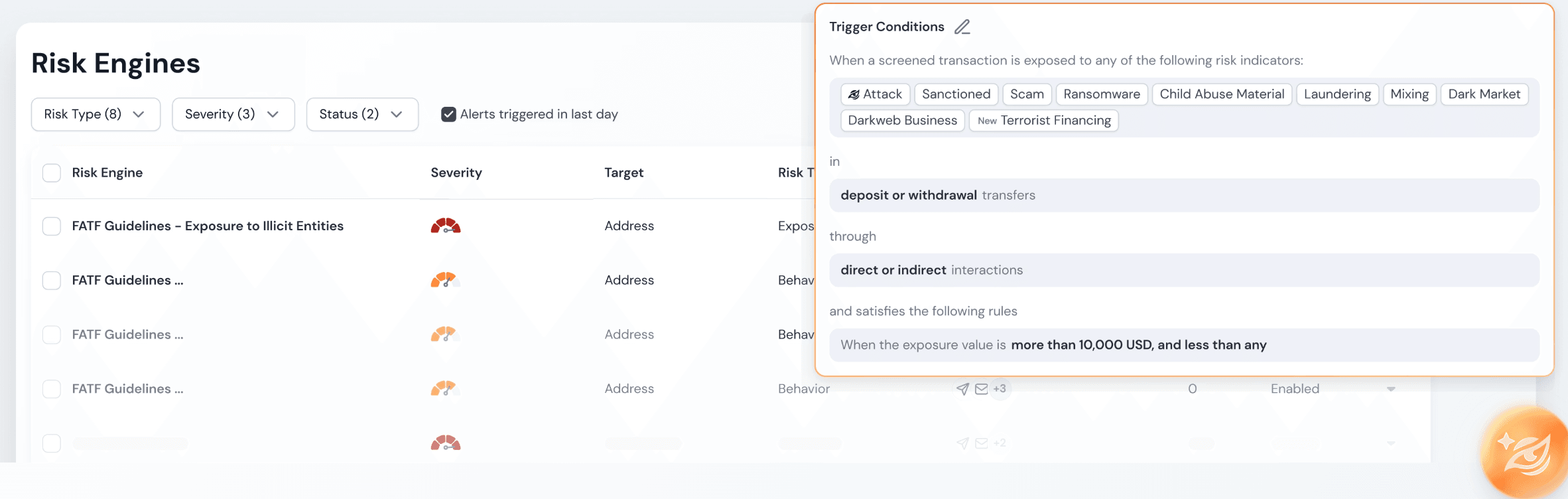
The distinction is the point. A one-time screen runs once when an address first appears, then stops. Monitoring keeps evaluating that same address as new labels attach, as its counterparties change, and as risk propagates forward through the transaction graph. The screen answers whether the address is risky right now; monitoring answers whether it has become risky since we last looked.
The output is not a binary pass-or-fail. It is a layered risk profile that maps to specific business actions: clear, hold for review, require enhanced due diligence, or block. That mapping is what turns raw blockchain data into something a compliance team can act on, audit, and defend to a regulator.
Address Monitoring vs Transaction Monitoring, and Why You Need Both
Most compliance teams inherit both terms and rarely get a clear answer on where one ends and the other begins. The distinction matters because the two controls detect different failure modes, and running only one leaves a measurable gap.
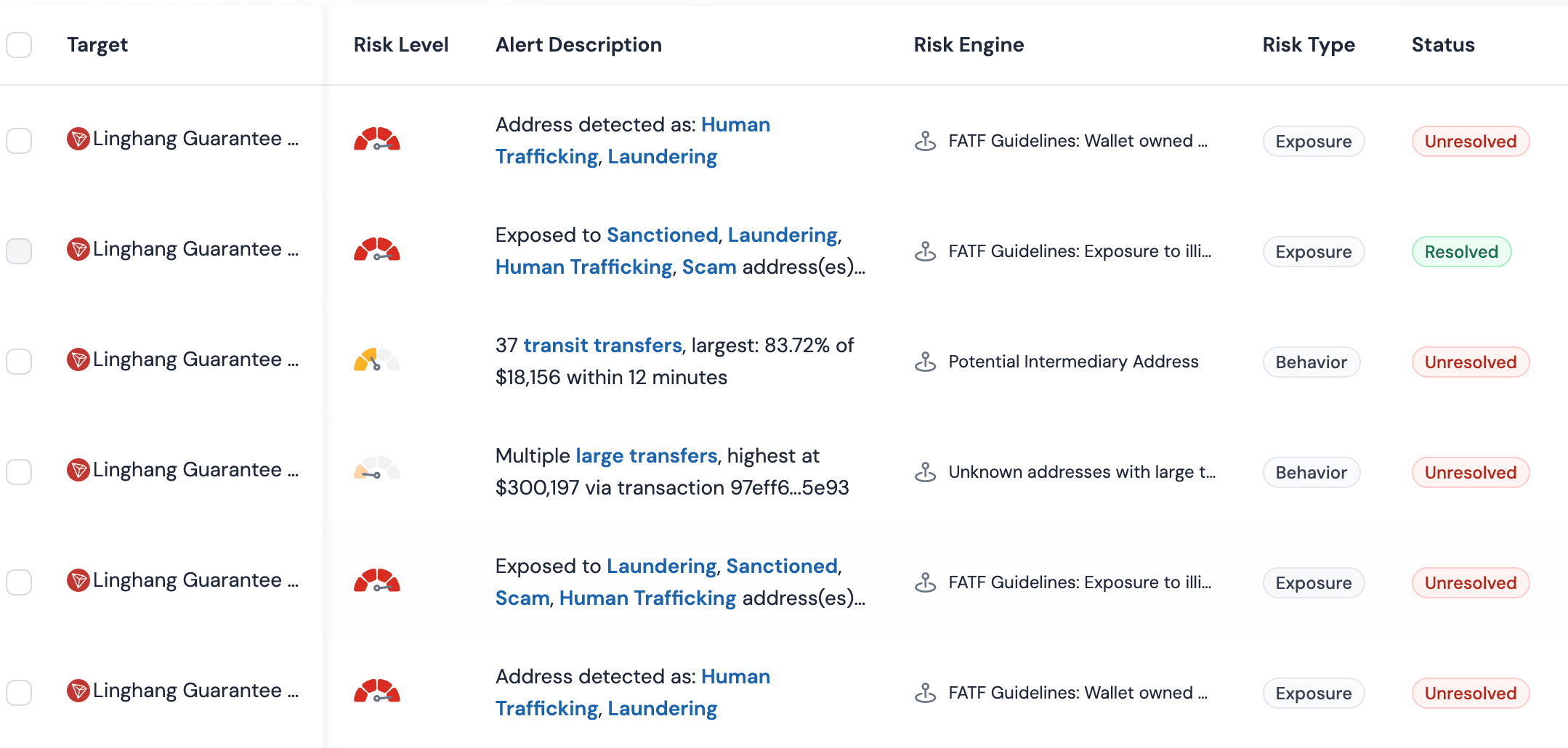
Address monitoring, often framed as KYA (Know Your Address), evaluates the standing risk profile of a wallet: its labels, its fund sources, its counterparties, its sanctions exposure. Transaction monitoring, framed as KYT (Know Your Transaction), evaluates the real-time flow of funds: whether a specific transaction is moving contaminated value through your platform right now.
| Dimension | Address Monitoring (KYA) | Transaction Monitoring (KYT) |
|---|---|---|
| Primary object | The wallet address | The transaction in flight |
| Time orientation | Historical exposure | Real-time movement |
| Core question | Is this address risky? | Is this transaction laundering illicit funds? |
| Typical trigger | Counterparty surfaces on sanctions list | Funds trace back to a known exploit |
| Output | Address risk score and label set | Transaction-level alert with fund path |
| Compliance impact | Blocks onboarding of tainted wallets | Stops illicit flow at settlement |
In practice, compliance teams need both running together. KYA stops a known-bad address from ever entering the platform. KYT catches a freshly contaminated transaction the moment it moves. For how the real-time side is operationalized, see KYT Compliance. A platform that screens addresses but does not monitor transactions will miss the window between a label update and the next deposit. A platform that monitors transactions but does not screen addresses will re-evaluate the same risky wallet on every single transfer, burning analyst time.
→ Book a Phalcon Compliance demo and operationalize address-based AML monitoring across your transaction lifecycle: Book a demo
FAQ
What is address-based AML monitoring? It is the practice of continuously screening blockchain wallet addresses against risk labels, sanctions lists, and behavioral signals to detect illicit crypto exposure at the address level, rather than relying on customer identity alone.
How is address monitoring different from KYC? KYC verifies who a customer is at onboarding. Address monitoring evaluates where the customer's funds come from and what wallets they connect to on-chain. The two controls are complementary, not substitutes. BlockSec provides address and transaction screening (KYA and KYT), not identity verification.
Does address monitoring satisfy FATF obligations? Address monitoring supports the risk-based approach required under FATF Recommendation 15, including ongoing monitoring of transactions and counterparties. It does not replace the Travel Rule or any identity-transmission obligation; it addresses the on-chain screening layer.
How fast does an address screening system need to be? Fast enough to return a decision before settlement. A system running at 500+ transactions per second, with sub-100ms API latency, can screen counterparties inline, leaving no exploitable gap between an on-chain event and the compliance response.
What types of illicit activity does address monitoring detect? It flags addresses linked to phishing, pig-butchering scams, hacker exploits, mixer usage, terrorist financing, and sanctioned entities. The reference label database draws on 600 million+ labeled addresses (Phalcon Compliance Docs).
Where to Go Next
If you are building out an address-monitoring program, start with the educational layer before evaluating tools. Read up on how KYA and KYT fit together in a full crypto AML stack. When you are ready to see how a production-grade engine handles 600 million+ labels and 200-plus signals in real time, BlockSec's Phalcon Compliance platform is the operational system that puts these concepts into practice.