
The Short Answer: A Stablecoin Is a Cryptocurrency Pegged to a Stable Asset
A stablecoin is a cryptocurrency engineered to hold its value close to something stable, most often the US dollar. Instead of floating like Bitcoin or Ethereum, a stablecoin tries to keep one coin worth one unit of its reference asset. That makes it useful as a store of value and as a way to pay inside crypto, without the price swings that make other tokens hard to use for everyday money.
The word "stable" is doing the work here. A peg is a commitment: the issuer, or the protocol, promises that one coin will always be worth roughly one dollar, one gram of gold, or one unit of whatever asset it tracks. When the promise holds, a stablecoin behaves like digital cash. When it breaks, it behaves like a falling asset, which is why the definition and the backing mechanism matter to a compliance officer.
One widely used definition captures the idea precisely. A stablecoin is a cryptocurrency that aims to maintain a stable value relative to a specified asset, or a pool or basket of assets. That definition comes from the Financial Stability Board and the Bank for International Settlements, and it is the cleanest way to separate a stablecoin from a volatile token. Notice the word "aims": stability is a design goal, not a guarantee.
Stablecoins exist because volatility limits what crypto can be used for. A merchant does not want to accept a token that could lose a fifth of its value overnight, and a compliance team does not want to audit value that keeps moving. Stablecoins give both parties a predictable unit of account, which is why they have become the settlement layer for trading, payments, and cross-border transfers.
The rest of this article explains the two families of stablecoins, the regulatory frameworks that now apply to them, and the point at which a compliance team needs dedicated tooling.
How Stablecoins Are Categorized
Stablecoins fall into two broad families. The first is collateralized: each coin is backed by reserves that give it value. The second is algorithmic: each coin tries to hold its peg by adjusting supply, without a full reserve behind it. Most of the coins a compliance team will actually meet are collateralized.
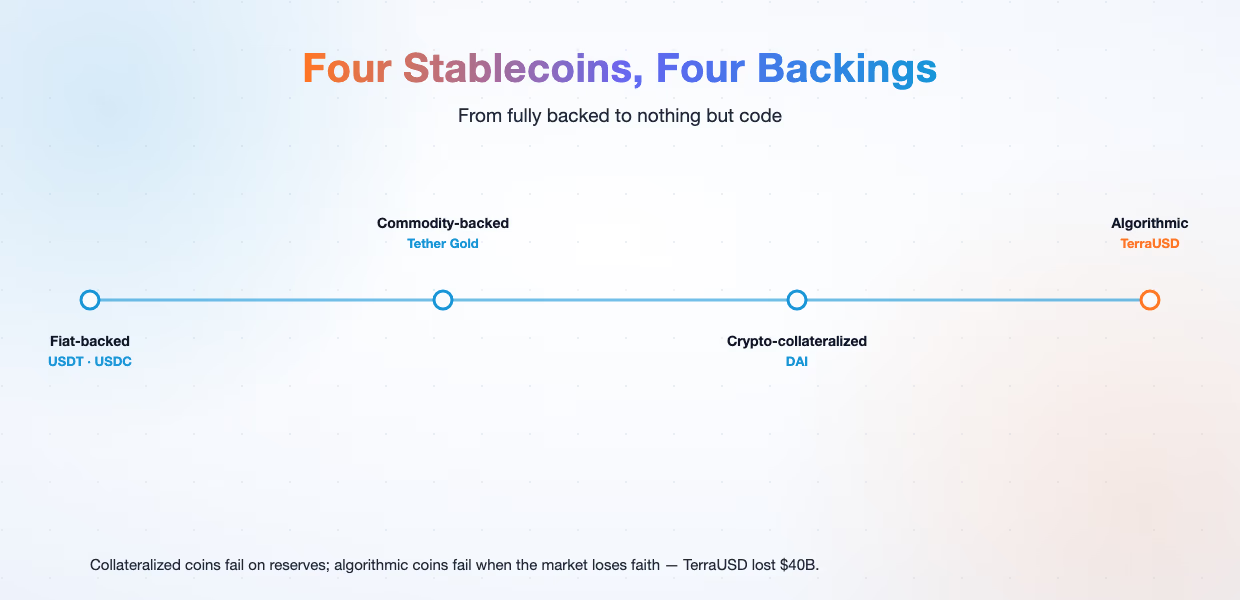
Collateralized stablecoins come in three flavors: fiat-backed coins such as USDT and USDC, commodity-backed coins such as Tether Gold, and crypto-collateralized coins such as DAI, which is over-collateralized against assets like ETH. Fiat-backed coins are the most common because they are the easiest to understand: one token, one dollar in reserve, held by a custodian and attested to by periodic reports.
Commodity-backed coins extend the same idea to physical assets. A gold-backed token promises one coin for a fixed weight of gold held in a vault. Crypto-collateralized coins go a step further and use other crypto as collateral, which is why they demand over-collateralization. Because the collateral itself can swing in price, a coin like DAI is backed by more than a dollar of crypto for every dollar of stablecoin issued.
Algorithmic stablecoins take the opposite approach. They hold little or no collateral and instead rely on code that mints and burns tokens to defend the peg. TerraUSD is the cautionary tale: its collapse alongside LUNA destroyed more than $40 billion in value, the largest single loss in Web3 history. When the market stopped believing the peg, the algorithm could not restore it.
The two families fail differently. Collateralized coins fail when their reserves turn out to be less solid than promised. Algorithmic coins fail when the market loses confidence in the peg itself, which is exactly what happened to TerraUSD. For a compliance officer, the lesson is that "stable" is a claim that must be verified, not assumed.
The stablecoin categories side by side:
| Category | What backs the peg | Examples | Compliance angle |
|---|---|---|---|
| Fiat-backed | Cash and cash-equivalent reserves held by a custodian, attested in periodic reports | USDT, USDC | Easiest to audit: one token, one unit of reserve |
| Commodity-backed | A fixed weight of a physical asset held in a vault | Tether Gold | The reserve is off-chain, so reserve report quality carries the weight |
| Crypto-collateralized | Other crypto assets, over-collateralized to absorb price swings | DAI | The collateral itself can swing, which is why over-collateralization is required |
| Algorithmic | Little or no collateral; code mints and burns tokens to hold the peg | The exception in current practice | The peg is a design claim rather than a reserve |
How Stablecoins Are Regulated
Stablecoin issuers now answer to a patchwork of frameworks: FATF global standards, MiCA in the European Union, the Bank Secrecy Act in the United States, and the Payment Services Act in Singapore. The US also passed its first federal stablecoin statute, the GENIUS Act, signed on July 18, 2025: it creates a licensing regime for payment stablecoin issuers, with substantive requirements phasing in over an eighteen-month implementation window that runs into early 2027, so it is law but not yet fully in force. Each framework asks a similar set of questions: who issues the coin, what backs it, how it is redeemed, and how the issuer manages money-laundering and sanctions risk.
The direction of travel is the same everywhere. Regulators want stablecoin issuers to be licensed or registered, to disclose what actually backs the coin, and to honor redemption requests. They also expect issuers to run anti-money-laundering controls equivalent to those of a bank or a money transmitter. A stablecoin issuer that cannot show who its customers are and where its funds come from is now a regulatory liability rather than an innovation.
The market this regulation governs has grown fast, and its size is reported in different ways depending on the source and date. One market study measured the total at about $165 billion as of July 2024, roughly 6.8 percent of the entire crypto market. A product-page figure cites $250 billion for 2025, alongside an estimated $36.3 trillion in annual transaction volume. A whitepaper cites $320 billion as of May 2026, sourced from DefiLlama. The three figures differ because they were measured on different dates with different methods. They agree on the direction: the stablecoin market now runs into the hundreds of billions of dollars, and that scale is why regulators have moved from observation to rule-making.
That scale is also highly concentrated. USDT and USDC together account for more than 90 percent of the market, and the top five stablecoins account for 96 percent. Concentration matters to regulators because a handful of issuers can carry systemic weight across borders. A failure at any one of them would ripple through every exchange and payment service that relies on them.
How Phalcon Compliance Fits the Stablecoin Landscape
The stablecoin category needs the same controls as any other part of crypto: screening, monitoring, and reporting. Phalcon Compliance is a real-time AML/CFT compliance and risk management platform that helps crypto businesses, including stablecoin issuers, payment companies, and exchanges, build FATF-aligned compliance programs. This is the role Phalcon Compliance plays in the stablecoin landscape.
For a stablecoin issuer or a payment company moving stablecoins, the platform maps risk in two ways that matter in practice. Phalcon Compliance screens against a library of more than 600 million labeled addresses. It reads risk across 17 Risk Indicator categories rather than from a single label. Together these mean a stablecoin operation can see whether incoming funds carry sanctions, fraud, or mixing exposure, and can document that decision for a regulator or an auditor.
That visibility is what turns a stablecoin program from a set of promises into a set of auditable facts. An issuer can show that a deposit did not come from a sanctioned address. It can show that a redemption did not flow toward a mixer. And it can show that the whole flow was logged in a way an examiner can review. Compliance here is not a tax on the product; it is the evidence that the product can be trusted at scale.

What to Do Next
Stablecoins are no longer an edge case. They are a mainstream payment rail with a growing regulatory surface, and compliance teams need a way to see the risk behind the token. Start by mapping the stablecoin flows your business touches, and check them against a risk engine built for the task.
Understand stablecoins with Phalcon Compliance, or Download the stablecoin freeze risk whitepaper for a deeper look at issuer freeze risk and treasury controls.
For the tokens themselves, the stablecoin list with types and examples covers each design and how it holds its peg. For the latest developments market by market, the stablecoin regulation news tracker follows each framework as it moves.
For the full picture of stablecoin rules, freezing risk, and payment AML, start from the Stablecoin Compliance guide.