
The Short Answer: Treasury Security Means Managing Asset Availability
A stablecoin issuer's biggest treasury risk is that the treasury's own tokens stop being usable at the moment the business needs them most, not that someone steals the private keys. Treasury security in the stablecoin era is about managing asset availability, not just safeguarding assets. An issuer can keep control of its private keys and still lose the use of its own stablecoins when the issuer, a contract, or a redemption path restricts the funds.
A freeze can arrive from an address flagged for sanctions exposure, from a redemption halt at the issuing entity, or from a wallet whose funds have been mixed into the main pool. A treasury team that treats custody as the whole job only discovers the gap after the freeze has already landed. The lesson is simple: custody answers the question of who holds the keys, while treasury security answers the question of whether the funds stay usable.
Freeze risk is a distinct category from private-key risk. In a freeze, the issuer still controls the keys but no longer controls whether the tokens circulate. That distinction is what moves treasury thinking from custody to availability.
Treasury security is governed through five actions and four features, and the tool that holds the routine together is continuous screening rather than one-time checks. The sections below walk through the framework so a treasury manager can put it into practice without waiting for the first freeze to arrive.
The Five Governance Actions for Treasury Security
A treasury that manages availability well runs the same five controls repeatedly. They read as a list but work as a system, because each one closes a channel that a freeze could travel.
BlockSec's treasury security management service organizes freeze-risk governance into five actions: layering wallets and funding pools, managing stablecoin exposure, isolating risk, running daily screening and review, and preparing a freeze-event plan. Each action answers one specific way that a treasury can lose availability.
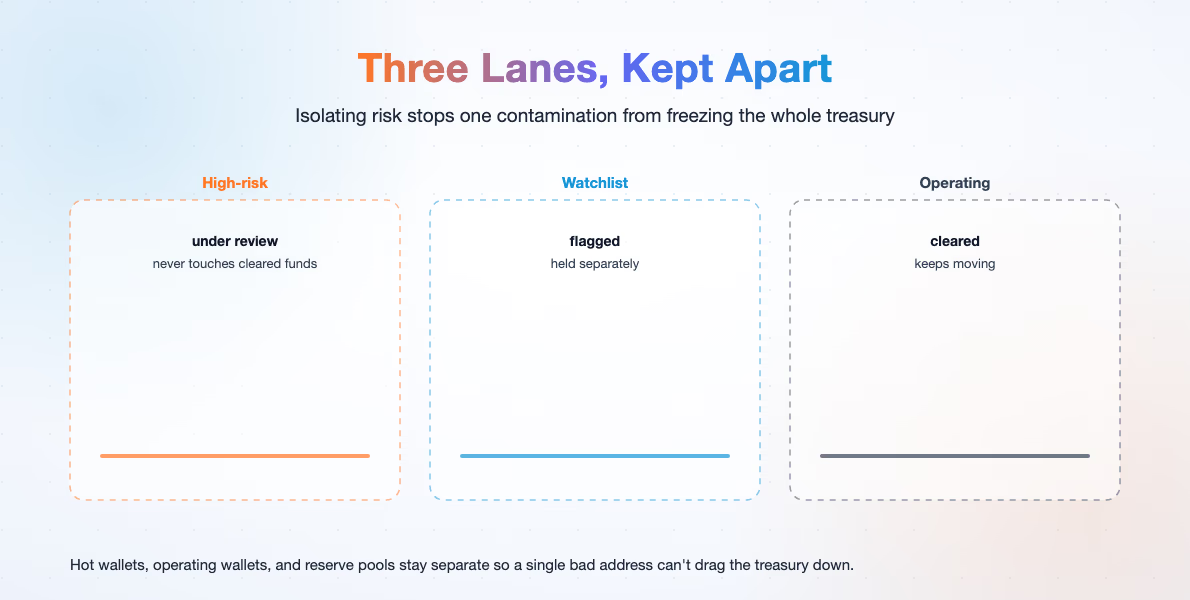
Wallet and pool layering reduces the chance that risk spreads from an edge address into the main pool. Hot wallets, operating wallets, and long-term reserve pools stay separate, so a single contaminated address cannot drag the entire treasury into a freeze.
Stablecoin exposure management avoids concentrating critical operating liquidity in one issuer or one chain version of a stablecoin. When one redemption path is frozen, the treasury still has liquid alternatives to keep operations moving. Spreading liquidity across issuers and chain versions is a balance-sheet decision, not just a security decision.
Risk isolation keeps high-risk batches, watchlist batches, and the main operating batch in separate lanes. Assets under review never touch assets that have already been cleared. This separation is what keeps a single flagged wallet from freezing the whole treasury, because the contaminated lane can be held while the cleared lanes keep moving.
Daily screening and review makes inbound collection, consolidation, outbound transfers, and periodic re-review part of the standard operating routine, not an emergency response. In the United States, that screening cadence backs the AML program obligations set out in FinCEN's statutes and regulations. Screening becomes a cadence instead of a crisis response, which is exactly the shift that keeps availability predictable.
A freeze-event plan sets the escalation path, the materials to prepare, and the communication approach before a freeze happens. The team then responds from a rehearsed procedure rather than improvising under pressure.
| Governance action | The freeze channel it closes |
|---|---|
| Wallet and pool layering | Risk spreading from an edge address into the main pool |
| Stablecoin exposure management | One frozen redemption path halting all operating liquidity |
| Risk isolation | Assets under review contaminating cleared batches |
| Daily screening and review | Risk landing between checks and sitting undetected |
| Freeze-event plan | An improvised, slow response when a freeze lands |
The Four Foundational Features
Features differ from actions. An action is something you do once; a feature is something that keeps working for you under pressure, in the middle of an incident.
BlockSec's framework defines four foundational features for a treasury security program: risk identification, risk isolation, freeze cause tracing and communication, and continuous governance. These are the features a treasury team needs to keep the five governance actions running over time.
Risk identification means continuously reading risk on addresses, chains, the other side, and pools, not checking once at onboarding and then stopping. Risk isolation means layering high-risk, watchlist, and operating funds so contamination stays contained.
Freeze cause tracing and communication means piecing together what happened, the timeline, and how far the impact reaches after an event, and producing material that the issuer and outside parties can act on. Continuous governance turns each case into policy, process, and architecture changes, so the next event is cheaper to absorb.
A treasury can run the five actions as one-off projects, but it holds the program together only when these four features are in place. Features are what make the actions repeatable across teams and across cycles.
How Phalcon Compliance Supports Treasury Governance
Phalcon Compliance sees the risk through continuous KYA and KYT scanning, while the treasury security management service manages the risk through layering, cause tracing, and communication methods. Together they turn a written framework into a routine a treasury team can run every day.
Phalcon Compliance fits into four treasury control points: before accepting an inbound payment, before consolidating assets into the main pool, before an outbound transfer, and during periodic re-review of held assets. Risk control becomes a standing loop rather than a one-time acceptance check. The point of the loop is that each control runs on current risk data, not on a snapshot taken at onboarding.
This is how Phalcon Compliance turns the governance framework into a daily operating routine. The screening layer supplies current risk data at each control point, and the management service turns that data into isolation, cause tracing, and communication decisions.
What to Do Next
Treasury security starts with a decision to manage availability, not just custody. Separate the wallets and pools, cap stablecoin exposure, isolate the batches under review, and put daily screening on a schedule. Then bring in a screening layer that watches the treasury the way an issuer watches a balance sheet. The five actions and four features are a management framework, not a software feature. The screening layer turns the framework into a live control a treasury team can demonstrate to issuers, partners, and auditors.
To act on the five governance actions, Manage stablecoin freeze risk with Phalcon Compliance. For the full framework behind this article, Download the stablecoin freeze risk whitepaper.
For the freeze and blacklist controls behind these actions, see how issuers manage freeze and blacklist risk. For the day-to-day counterpart of these governance actions, how to monitor stablecoin counterparty risk sets the re-check rhythm.
For the full picture of stablecoin rules, freezing risk, and payment AML, start from the Stablecoin Compliance guide.