
False positives are the hidden tax on a KYT program. Every alert that fires on a benign transaction costs analyst time, slows legitimate users, and erodes the credibility of the control itself. When a team spends its day closing alerts that should never have opened, the alerts that matter get less attention. Reducing that noise is a rule configuration problem, not a tooling problem. This guide covers why KYT rules over-fire, how rule configuration differs from post-alert review, and the tuning, scoring, testing, and measurement practices that bring precision back. For the full KYT surface, see Phalcon Compliance. This page is part of the KYT Resource Center.
Why KYT Rules Produce False Positives
A KYT rule is a trigger condition: when an address or transaction crosses a defined risk threshold, the rule fires an alert. The false positive problem is structural to that design. A rule set to catch every risky counterparty also flags every address that ever touched a risky service indirectly, which in a connected chain economy is a very large set. The broader the trigger, the more legitimate activity it sweeps in. Industry reporting consistently describes false positives as the dominant operational burden of transaction monitoring across financial services and crypto, with false alerts far outnumbering confirmed cases. The point is not to pin a number. It is to acknowledge that over-firing is the baseline condition of rule-based monitoring, not the exception.
That monitoring is not optional: under the FATF risk-based approach for virtual assets, reinforced in the US by FinCEN's AML program rule (31 CFR 1022.210) and suspicious activity reporting rule (31 CFR 1022.320), ongoing transaction monitoring is a continuing obligation, so a team cannot solve false positives by turning rules off, only by tuning them.
Four configuration choices drive most of that noise. Thresholds set too low flag everything above a trivial risk score, treating a one-time indirect exposure the same as a direct interaction with a sanctioned entity. Trigger conditions that ignore context - amount, frequency, direction, counterparty depth - collapse distinct risk patterns into one stream. Rules that never get tuned after deployment keep firing on patterns the team has already cleared. And rules that score in a black box force analysts to treat every alert as potentially real because they cannot see why it fired. Each is a configuration failure, fixable at the rule layer before any alert reaches a human.
The cost compounds. An analyst working through a queue of false positives develops alert fatigue - the tendency to disengage from a signal that is wrong too often. True positives buried in the noise then get closed with less scrutiny, because the analyst's prior is that the alert is probably wrong. A noisy rule set does not just waste time. It lowers the quality of review on the alerts that actually matter.
Fix Rules Upstream, Not Alerts Downstream
These two layers are often talked about as if they were the same problem. They are not, and confusing them is the first thing that derails a false positive reduction effort. Rule configuration is the work of defining, before any transaction is screened, which conditions produce an alert. It lives upstream. Post-alert review is what an analyst does after an alert has fired: investigating it, deciding whether it is a true positive, and dispositioning it. It lives downstream. The distinction matters because reducing false positives at the rule layer prevents the alert from ever being created, while reducing them at the review layer only clears the existing queue faster. Both have value, but they are different work done by different people - rule configuration by whoever owns the monitoring program, post-alert review by analysts working the queue.
A useful test for which layer a problem belongs to: if the same kind of alert keeps firing on the same kind of benign activity, the fix is in rule configuration. If a given alert is hard to disposition because the evidence is thin, the fix is in the review tooling. The first prevents noise. The second works through it faster. This page covers only the first.
Tuning Rules to Cut Noise
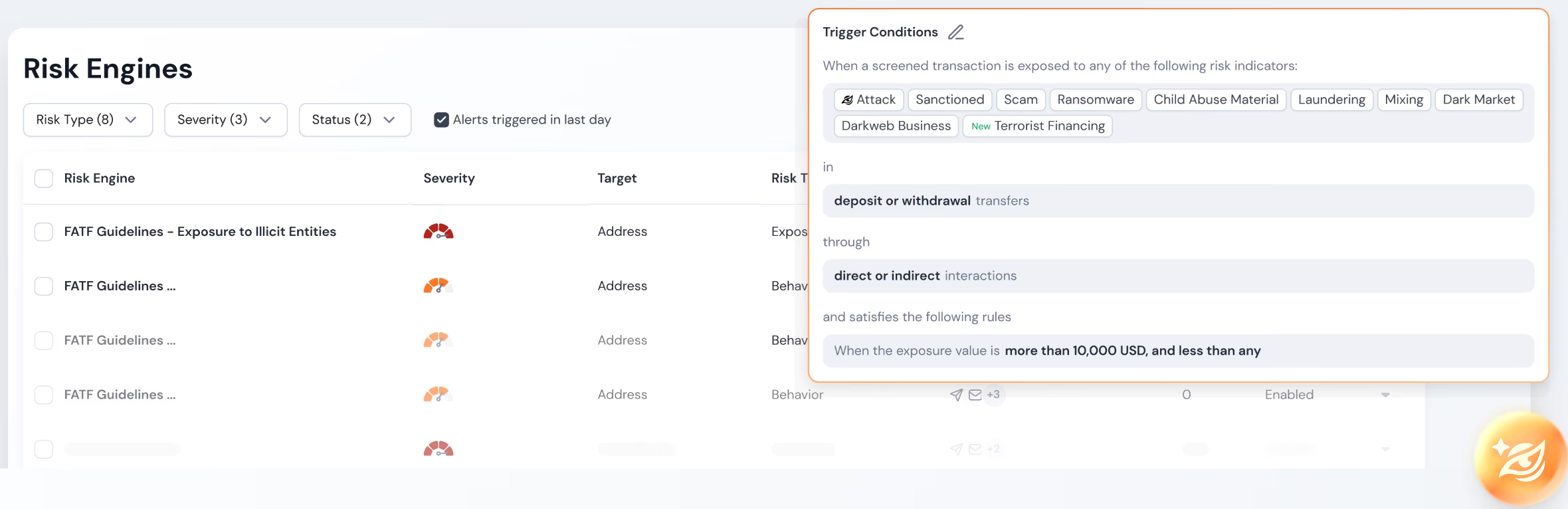
Rule tuning is the most direct lever for reducing false positives, and it works on the four configuration choices that cause over-firing. Threshold tuning is the first move. A rule that fires on any risk score above zero will over-fire. Moving the threshold to a band that reflects real exposure - and pairing it with a hold band below the block threshold so borderline cases go to manual review - cuts the volume of low-signal alerts. Phalcon Compliance exposes this through its configurable Risk Engine, which ships with five preset templates and a default rule set built around the FATF risk-based approach, and allows thresholds, triggers, and notification routing to be adjusted per rule rather than forcing one global setting.
Trigger condition tuning is the second move. A rule that fires on counterparty risk alone ignores whether the exposure was a one-time indirect touch or a repeated direct interaction. Adding context - minimum amount, repeat frequency, direction of funds, depth of counterparty exposure - separates patterns that indicate real risk from patterns that are normal in a chain economy where addresses touch many counterparties. The configurable Risk Engine lets these conditions be layered per rule, so a team can start broad and narrow as it learns which filters separate true positives from noise.
The third move is the tuning cadence. Rules degrade. A threshold set in quarter one may be wrong by quarter three because counterparty behavior shifts and the address mix changes. The teams that hold false positives down review their rule set on a fixed cadence - monthly or quarterly - using already-dispositioned alerts as the evidence base. If a rule produced eighty alerts last month and seventy-five were false positives, it is a candidate for adjustment. Tuning is not a one-time setup. It is a recurring practice.
The fourth move is notification routing. The platform supports multichannel notification, including webhook, so rules route by severity rather than dumping every alert into one queue. High severity goes to an immediate channel, medium to a review queue, low to a log. Routing by severity means the queue that reaches an analyst is pre-filtered for the alerts that warrant human attention.
Explainable Scoring Reduces False Positives
The single biggest amplifier of false positives is a risk score that returns a number with no explanation. When a rule fires on an opaque score, the analyst cannot tell whether it fired because of a direct exposure to a sanctioned entity, an indirect exposure through a mixer, or a behavioral pattern that looks like layering. Every alert has to be treated as potentially real, because there is no signal to discount it. The result is a queue where everything is reviewed at the same depth - the definition of low precision.
Explainable scoring breaks that pattern. Phalcon Compliance returns a glass-box risk score built on more than 600 million labeled addresses and 17 risk indicator categories. The score comes with the indicators that drove it and the exposure figures behind it, so when a rule fires, the analyst can see why. If it fired on a single indirect counterparty exposure with no behavioral indicators, it can be closed quickly with confidence. If it fired on a stack of behavioral indicators plus direct exposure to a known illicit service, it gets full scrutiny. The indicators do not just speed up review. They let the rule itself be tuned more precisely, because the team can see which indicators correlate with true positives and set triggers accordingly.
This is the difference between a rule set that gets more precise over time and one that stays noisy. With an opaque score, tuning is guesswork - the team moves a threshold and hopes precision improved. With explainable scoring, tuning is evidence-based: the team can see which indicators are producing the false positives and adjust the trigger to weight them differently, or drop them. The 17 risk indicator categories are not just a detection surface. They are the evidence base that makes the rule set tunable.
Testing Rule Changes Before Going Live
A rule change that reduces false positives but introduces false negatives has not improved the program. It has moved the failure mode. The way to avoid that trade is to test rule changes against historical data before they go live, so the team can see what the new configuration would have caught and missed.
Backtesting is the baseline practice. The team takes a window of historical alerts - typically three to six months - already dispositioned, and replays them against the proposed configuration. The output is a comparison: how many alerts the old configuration produced, how many the new one would produce, and whether any the old one caught would have been missed. A change that cuts alert volume by half but drops three true positives is a regression, not a win, and the backtest catches it before production.
Gray rollout is the second practice, for teams that cannot fully backtest or want to validate against live traffic. The new configuration runs in parallel with the old one, firing alerts into a shadow queue no human reviews, while the old configuration drives the live queue. After a defined period the team compares the two streams: did the new configuration catch what the old one caught, catch anything it missed, and suppress the false positives it was designed to suppress. Only when the comparison holds does the new configuration go live. Because the Risk Engine is configured rule by rule, a shadow comparison can be staged without a separate environment.
The testing discipline matters most when a rule change is driven by an incident. A team that just missed a typology will rush to broaden a trigger to catch it, which is exactly the move that produces a wave of false positives. Testing the broadened trigger against historical data before it goes live catches the over-correction early, when it is cheap to fix.
Measuring Effectiveness Over Time
A false positive reduction effort that is not measured will not hold. Alert volume drops for a week after a tuning pass, drifts back up the next quarter, and the team does not notice until the queue is noisy again. Measurement is what turns a one-time cleanup into a durable precision gain.
Three metrics carry most of the signal. Precision is the share of alerts that are true positives, and it is the headline measure of false positive rate. A precision of ten percent means nine out of ten alerts are noise. Recall is the share of true risky activity the rules actually catch, and it is the guardrail against a tuning pass that reduced false positives by letting true positives slip through. If precision rises and recall falls, the rule set is under-firing, not improving. Time to disposition - how long an alert sits before an analyst closes it - tracks review efficiency and, indirectly, whether explainable scoring is doing its job. When indicators are visible, disposition time drops.
The measurement cadence should match the tuning cadence. Monthly or quarterly, the team reviews precision, recall, and disposition time against the previous period, identifies the rules whose precision has dropped, and prioritizes them for the next tuning pass. This is the loop: configure, deploy, measure, tune, repeat. A KYT rule set is a control that has to be maintained the same way the rest of the compliance program is maintained - on a schedule, with evidence.
The teams that succeed at false positive reduction treat rule configuration as an ongoing practice rather than a setup task. They tune on a cadence, score with explanation rather than opacity, test before they ship, and measure precision and recall together so noise reduction never comes at the cost of detection. The result is a rule set that fires less often and hits harder when it does. To see how Phalcon Compliance's configurable Risk Engine and glass-box risk indicators fit that practice, read the KYT compliance overview.