
Transaction monitoring rules are not set-and-forget. A rule set that worked at program launch drifts as counterparty behavior shifts, new typologies emerge, and the exchange's own customer mix changes. The FATF risk-based approach obliges a VASP to monitor on an ongoing basis, and FinCEN's AML program rule (31 CFR 1022.210) and suspicious activity reporting rule (31 CFR 1022.320), taken together, make ongoing monitoring necessary for crypto exchanges and other US money services businesses. The practitioner framing is blunt: compliance officers ask, in plain terms, how to know whether their rules are effective, and the most common self-criticism is that misaligned transaction monitoring rules are noisy and miss typologies at the same time. This page is part of the KYT Resource Center.
A noisy rule set floods the queue with benign alerts, which trains analysts to dismiss alerts quickly. A rule set that misses typologies lets real exposure through. The worst outcome is both at once, and it is also the most common one, because rules tuned to suppress noise tend to also suppress the signals that matter.
This guide covers how to evaluate rule effectiveness, calibrate thresholds and triggers, and iterate rules in production. For the screening platform that backs this workflow, see Phalcon Compliance.
Why Rule Tuning Matters
A transaction monitoring rule is a hypothesis. It says: if this address behavior or this transaction pattern appears, then exposure worth investigating is likely present. Like any hypothesis, a rule has a shelf life. Counterparty clusters evolve as launderers rotate addresses, mixers give way to cross-chain bridges, and sanctions designations update. A rule that fired accurately on a 2024 typology can be inert by the next quarter, or worse, fire on patterns that no longer correlate with risk.
The community operator framing is worth taking at face value because it identifies a specific failure mode. Misaligned rules do not fail cleanly. They fail in two directions simultaneously: too many false positives on benign activity, and too many false negatives on the typologies that actually matter. The reason is mechanical. When analysts tune a rule to suppress a noisy false positive, they usually raise a threshold or narrow a trigger. That same change suppresses the next real signal that shares the pattern, and the typology slips past the rule entirely. Tuning one rule in isolation, without measuring its effect on coverage, is how a monitoring program quietly degrades.
Rule tuning is therefore an ongoing discipline rather than a launch task. The goal is not a static configuration that works forever. It is to build a loop that measures rule effectiveness, makes a controlled change, and measures again before promoting that change to production. The rest of this guide walks that loop.
What Makes a Transaction Monitoring Rule Effective
Before tuning a rule, define what effective means for that rule. Effectiveness is not a single metric. It is a combination of four properties, and a rule is only as strong as its weakest of the four.
The first property is coverage. The rule has to fire on the typology it was written to catch. A rule written to flag peel chains has to actually fire when a peel chain enters the flow. If a backtest against known historical cases shows the rule missing the cases it was designed for, coverage is broken and no amount of threshold tightening fixes it. The rule's logic itself has to be rewritten.
The second property is precision. The rule has to not fire on benign activity. Every alert that an analyst dispositions as no risk is a false positive, and false positives cost analyst time, budget, and attention. A rule that fires on every transaction above a threshold will catch the typology but will also catch every large legitimate trade.
The third property is actionability. When the rule fires, the alert has to carry enough context for an analyst to act. A bare flag that says high risk with no indicator breakdown forces the analyst to rebuild the investigation from scratch. A flag that names the specific Risk Indicators driving the score, the exposure figures, and the counterparty history lets the analyst disposition the alert in minutes rather than tens of minutes.
The fourth property is auditability. Every firing has to be reconstructable. An examiner asking why a transaction was flagged has to get a deterministic answer that traces back to the rule's trigger conditions and the data on the address at firing time. A rule whose logic is opaque cannot be defended in an examination.
A rule is effective when all four hold. Tuning moves a rule toward that state and keeps it there as conditions change.
Tune Rules: From Template to Production
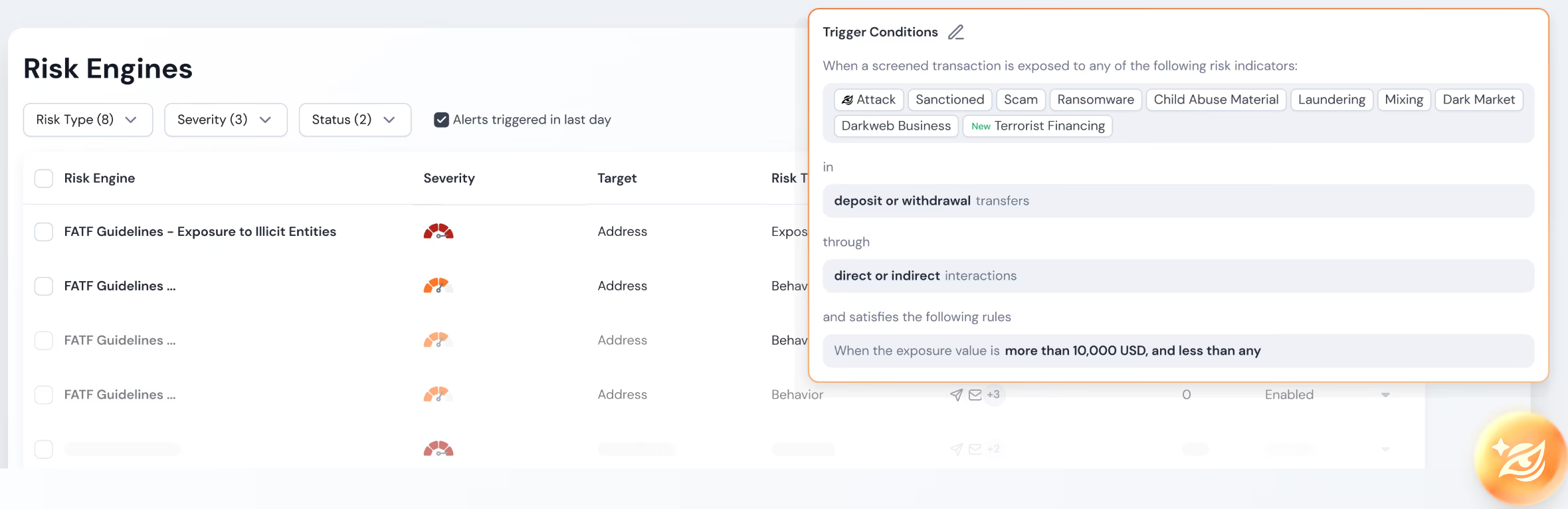
The tuning workflow on Phalcon Compliance runs on top of the Phalcon Compliance Risk Engine, which is the rule layer that evaluates addresses and transactions against configurable Risk Indicators. The engine ships with five prebuilt templates plus a default rule set built around the FATF risk-based approach, so the starting point is a working rule set rather than a blank page. From there, the workflow is measure, change, measure again, promote.
The five prebuilt templates split into two families. Three Address templates evaluate the address itself, drawing on its on-chain history, counterparties, and exposure profile. Two Transaction templates evaluate the specific transaction in context, including patterns and behavioral signals. The Address and Transaction templates each include behavioral variants, which flag patterns of activity rather than static properties. The behavioral templates are where tuning pays off most, because behavioral patterns drift fastest and need the most frequent recalibration.
A default rule set built around the FATF risk-based approach sits underneath the templates and provides a baseline, giving a coverage floor the team can extend but does not have to author from scratch. The default set is useful as a comparison baseline during tuning: if a custom template stops outperforming the default on a typology, the custom template has drifted and needs work.
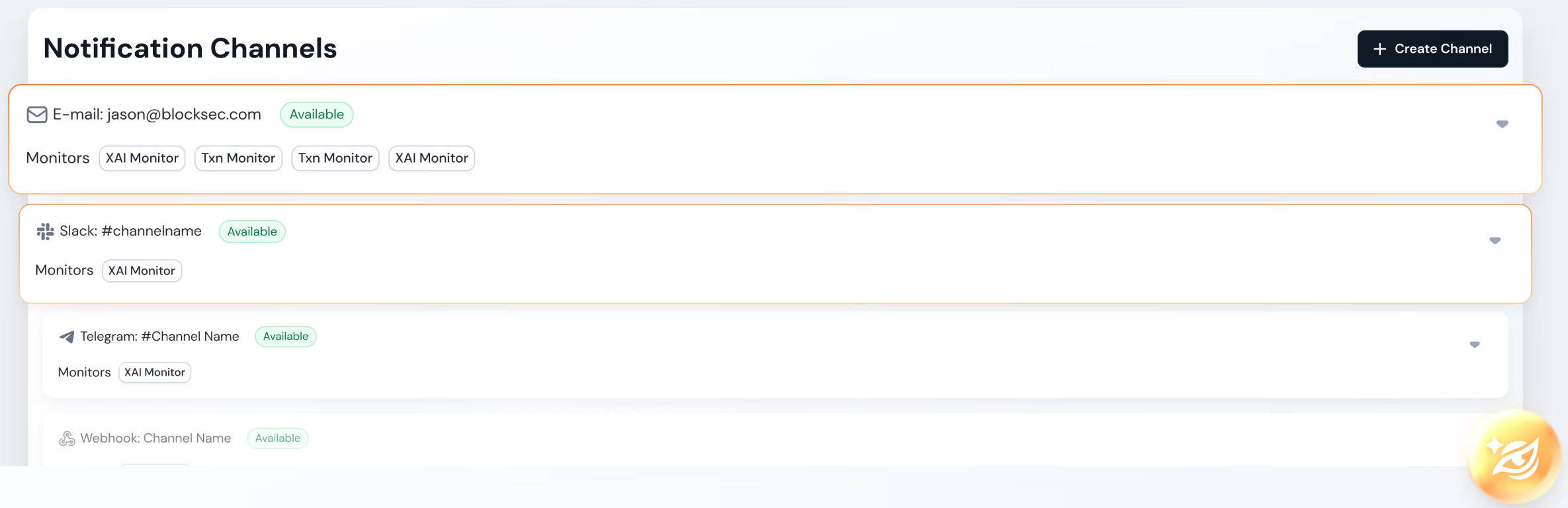
Each rule within the engine exposes the fields a tuning cycle actually touches. The rule name and description are editable, so a rule can be labeled with its purpose and its typology target rather than carrying a generic identifier. The risk level is configurable, which lets the team control how an alert is routed and surfaced without rewriting the trigger. The trigger conditions themselves are editable, which is where most tuning work happens: the thresholds, the indicator combinations, and the time windows that define when a rule fires. And the notification channels are configurable per rule, so a high-severity rule can page a queue immediately while a lower-severity rule routes to a digest.
A typical tuning pass on a single rule looks like this. Pull the rule's recent firings, segment them into true positives and false positives based on analyst dispositions, and identify which trigger condition is driving the false positives. Adjust that condition, run the modified rule against historical data as a backtest, and compare the false positive rate and the coverage rate against the current production version. If the change improves both, or improves one without degrading the other past an agreed threshold, promote the change. If it trades coverage for precision, that trade has to be a deliberate decision, not an accident.
Balancing False Positives Against Missed Typologies
The hard problem in tuning is that the four properties pull against each other. Tighten a threshold to suppress false positives and coverage drops. Loosen it to recover coverage and false positives climb. A team that treats this as a single dial oscillates. A team that treats it as a measured tradeoff makes progress.
The right unit of decision is the typology, not the rule. For each typology the team monitors, track the true positive count, the false positive count, and the missed-case count over a rolling window. A rule change is judged on its effect on those three numbers for the typology it targets, not on aggregate alert volume. Aggregate alert volume is easy to game by suppressing noise and is the wrong target.
The Expire mechanism helps here. An alert expires automatically when the conditions that triggered it no longer apply - for example, when the triggering engine is disabled, deleted, or edited so the target no longer matches. Expire is a queue hygiene tool, not a tuning tool. It does not change how many false positives the rule generates; it changes how many stale firings sit in the queue. Use Expire to keep the queue clean, and use trigger changes to change what enters it.
The glass-box nature of the Risk Engine matters for this balance. Because the analyst can see which Risk Indicators drive each firing, the team can tune the specific indicator rather than the overall threshold. A rule that fires too often on a single indicator can have that indicator's weight reduced or its condition narrowed, leaving other indicators intact. This is more precise than raising a global threshold, which dampens every indicator at once and is the mechanical reason that noise suppression tends to also suppress real signals.
Testing and Iterating Rules
A rule change should never go straight to production. Evaluate it as a backtest first: run the modified rule against historical addresses and transactions, and read the firings before any live traffic hits the new logic. Backtesting answers the two questions that matter. Does the change catch the typology it targets, measured against known historical cases? And does the change generate a manageable false positive volume, measured against the historical baseline?
For larger changes, a gray rollout is the safer path. Run the modified rule alongside the production rule on live traffic without surfacing its alerts to the queue, log the differences, and compare. This catches drift that historical data does not, because live traffic includes the current counterparty mix rather than last quarter's. Once the gray run confirms the change holds on live data, promote it.
Iteration cadence matters as much as iteration method. Rules do not need to be tuned every week, but they do need to be reviewed on a regular schedule. A quarterly review of top-firing rules, with a typology coverage check against any recent incidents or sanctions updates, is a reasonable baseline. Ad hoc tuning should follow any case where a real exposure was missed or a single rule generated an outsized share of the queue's false positives.
Common Tuning Pitfalls
Four pitfalls account for most failed tuning efforts.
The first is over-tightening to suppress noise. A team under alert pressure raises thresholds broadly, false positives drop, and the queue looks cleaner. What actually happened is that the rule stopped firing on the typology as well, and the team will not find out until a real exposure slips through downstream. The fix is to measure coverage on every threshold change, not just alert volume.
The second is over-loosening to recover coverage. After a missed typology, the team loosens triggers to make sure the next case fires. Coverage returns, but so does noise, and the rule becomes a near-blanket flag the analyst queue cannot sustain. The fix is the same measurement discipline, applied in the other direction.
The third is tuning rules in isolation. A typology is often covered by more than one rule, and tightening one rule can shift load onto another unnoticed. The fix is to tune at the typology level, tracking the combined firings of all rules that target a given typology.
The fourth is not evaluating effectiveness at all. A rule set never measured against coverage and precision is a rule set the team cannot defend. An examiner asking why a rule exists, or why it was not tuned after a known miss, gets no answer. The fix is to build the measurement loop into normal operations, so effectiveness data exists before it is needed.
Done well, rule tuning is what keeps a transaction monitoring program effective over time. The templates and the default rule set built around the FATF risk-based approach give a strong starting configuration. The configurable trigger conditions, risk levels, and notification channels give the team the controls it needs. The discipline of measure, change, measure again, promote is what turns those controls into a program that actually catches the typologies it is supposed to catch, without burying the queue in noise. Explore the Phalcon Compliance Risk Engine and start tuning.