MetaDock is a simple-to-use, infinitely beneficial plugin that is free, ad-free, and open-source. It can seamlessly enhance 10 blockchain browsers including Etherscan, and after installation, you can see more useful information ahead of others, such as address label libraries, fund flow charts, and batch download codes for transaction analysis on Phalcon and Openchain.
Currently, it’s supported for installation and use on Chrome, Safari, Edge, Firefox, and Brave browsers.
After much anticipation, MetaDock’s big move has finally launched today! We have integrated GPT to allow you to easily see through every transaction on Etherscan, just like OG.
Breaking Down Barriers
As blockchain applications continue to evolve, the barrier to entry for newcomers in Web3 is also increasing. How do you interpret an on-chain transaction? What mysteries lie within it? How can you truly DYOR? There are many unmet needs, but few have listened.
As a blockchain security company, we not only help project teams resist risk events, but also hope that every newcomer can enter this world of wonder and risk with ease, efficiency, and safety.
Integrating GPT into MetaDock is to achieve this goal.
In the past, we have provided a large amount of exclusive risk information and useful feature shortcuts to enhance blockchain explorers such as Etherscan. Powered by GPT, MetaDock can also explain the key content of each transaction in plain language.
Now say goodbye to confusing, jargon-filled transaction data!
Hands-on Experience
If you are already a MetaDock user, from today onwards, when you query each transaction, a GPT explanation will appear above the corresponding Etherscan page.

If you haven’t installed MetaDock, don’t worry. It won’t change your Etherscan usage habits. Installing it will only let you see more useful information on Etherscan than on others. 😉
Installation address: https://blocksec.com/metadock
Here are some examples of transaction interpretations:
- Message transfer (Paraspace): https://etherscan.io/tx/0x8eb65ef100eb65273e42f227fb4b4b639531c2c892f4aa60c118c84dc677f98b

On March 17th of this year, hackers launched an attack on ParaSpace, but were successfully intercepted by the BlockSec team, saving over $5 million worth of digital assets. Many people heard about the hacker begging openly on the chain but did not know it came from the message included in this transaction.
- NFT Trade on Blur
https://etherscan.io/tx/0x9a6c9949f70a9bfa55bcfd02f755e0f928da2fcc69640892d679d3014f41030f

- Phishing Scam: https://etherscan.io/tx/0x9c3a6dfd79c5a4faa0341d284805ff770440b6f2059d69d42ec16a1fc08566ec

- Staking with Time: https://etherscan.io/tx/0x0767d2217dd6e8d2207017d0eaea0bedd551da233e1c047890f3a2e47478b489

We do not advocate for GPT to replace security audits. Instead, we use it from the perspective of an ordinary user to solve current problems.
Hope this function is helpful for you!
By now, MetaDock has covered most transaction types. If you find any omissions or incomplete interpretations, please contact us at: [email protected] or join TG Group: t.me/BlockSecTeam
Product Innovation
We are dedicated to our mission of constructing blockchain security infrastructure to make web3 accessible and secure for everyone, regardless of their background or level of expertise.
As a blockchain security company, we not only provide security audit services for project parties but also productize the team’s cutting-edge technological strength with an open and constructive attitude. Through “product innovation”, we aim to make “security” accessible to different types of users like water and electricity.
MetaDock is one of our products that firmly adheres to this philosophy. Since its launch just a few months ago, it has been embraced by a large number of users and has recently received support from almost 200 individuals on Gitcoin. We are incredibly grateful for the love and support our product has received!
Keep Building!🦾

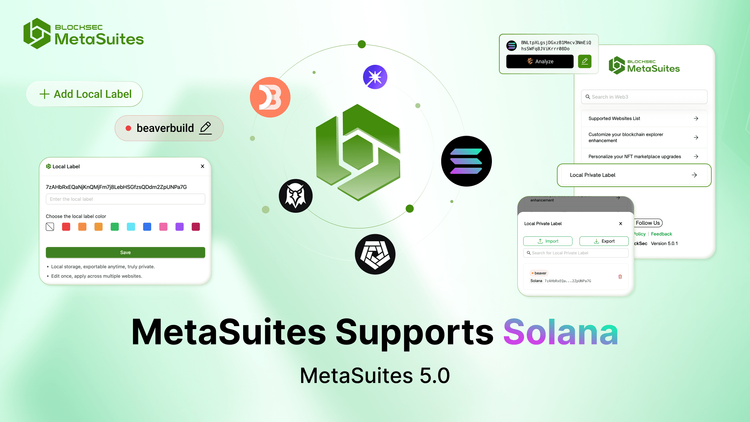
Please note that MetaDock has undergone a name change and is now known as MetaSuites, effective from February 2024. The new name reflects our commitment to providing a comprehensive suite of services and solutions to our valued users. We appreciate your continued support and look forward to serving you under our new brand, MetaSuites.
Related reading
[1]https://blocksecteam.medium.com/metadock-breaks-through-6k-users-18478819a9cd
[2]https://www.youtube.com/watch?v=BWgCkpSzzNM
About BlockSec
BlockSec is a pioneering blockchain security company established in 2021 by a group of globally distinguished security experts. The company is committed to enhancing security and usability for the emerging Web3 world in order to facilitate its mass adoption. To this end, BlockSec provides smart contract and EVM chain security auditing services, the Phalcon platform for security development and blocking threats proactively, the MetaSleuth platform for fund tracking and investigation, and MetaSuites extension for web3 builders surfing efficiently in the crypto world.
To date, the company has served over 300 esteemed clients such as MetaMask, Uniswap Foundation, Compound, Forta, and PancakeSwap, and received tens of millions of US dollars in two rounds of financing from preeminent investors, including Matrix Partners, Vitalbridge Capital, and Fenbushi Capital.
Official website: https://blocksec.com/
Official Twitter account: https://twitter.com/BlockSecTeam