Why does latency matter in blockchain monitoring tools? Because response latency decides where screening runs: inside the transaction flow, or beside it as after-the-fact review. Feature lists blur this line, but it determines everything about what a monitoring deployment can actually do, which risks your systems can act on and which they can only document. This guide explains the latency line, what milliseconds buy, and how to evaluate it before buying.
The Latency Line: Inside the Flow or Beside It
Monitoring tools occupy one of two positions relative to the transactions they watch. In-flow screening evaluates a transaction before it executes: a screening call completes, the risk verdict returns, and the transaction proceeds or holds accordingly. Beside-the-flow screening evaluates after the fact: the transaction has broadcast, the check runs, and a finding surfaces for follow-up. The difference is not speed for its own sake; it is the difference between prevention and archaeology.
| Position | Latency required | What your system can do with the verdict | What it cannot do |
|---|---|---|---|
| In-flow | Millisecond level | Return a verdict in time for your gateway to hold the withdrawal | Nothing after broadcast |
| Beside-the-flow | Seconds to minutes | Detect, document, escalate | Stop anything |
The obligations framing lives at FinCEN and the FATF Recommendations; the latency line is how tooling meets those obligations operationally.
What Milliseconds Buy: The Enforcement Window
Milliseconds buy an enforcement window: risk screening completes before a transaction broadcasts, so exposure is caught while intervention is still possible rather than documented afterward. Three concrete gains follow. The interception window: a withdrawal headed toward a sanctioned entity or a hack-linked cluster can be held by your own risk routing, because the verdict arrives before broadcast. The frictionless path: legitimate transactions clear without perceptible delay, so compliance stops being a latency tax on honest users. The throughput hold: screening that stays fast under peak load keeps the enforcement window open exactly when volumes, and incidents, spike together.
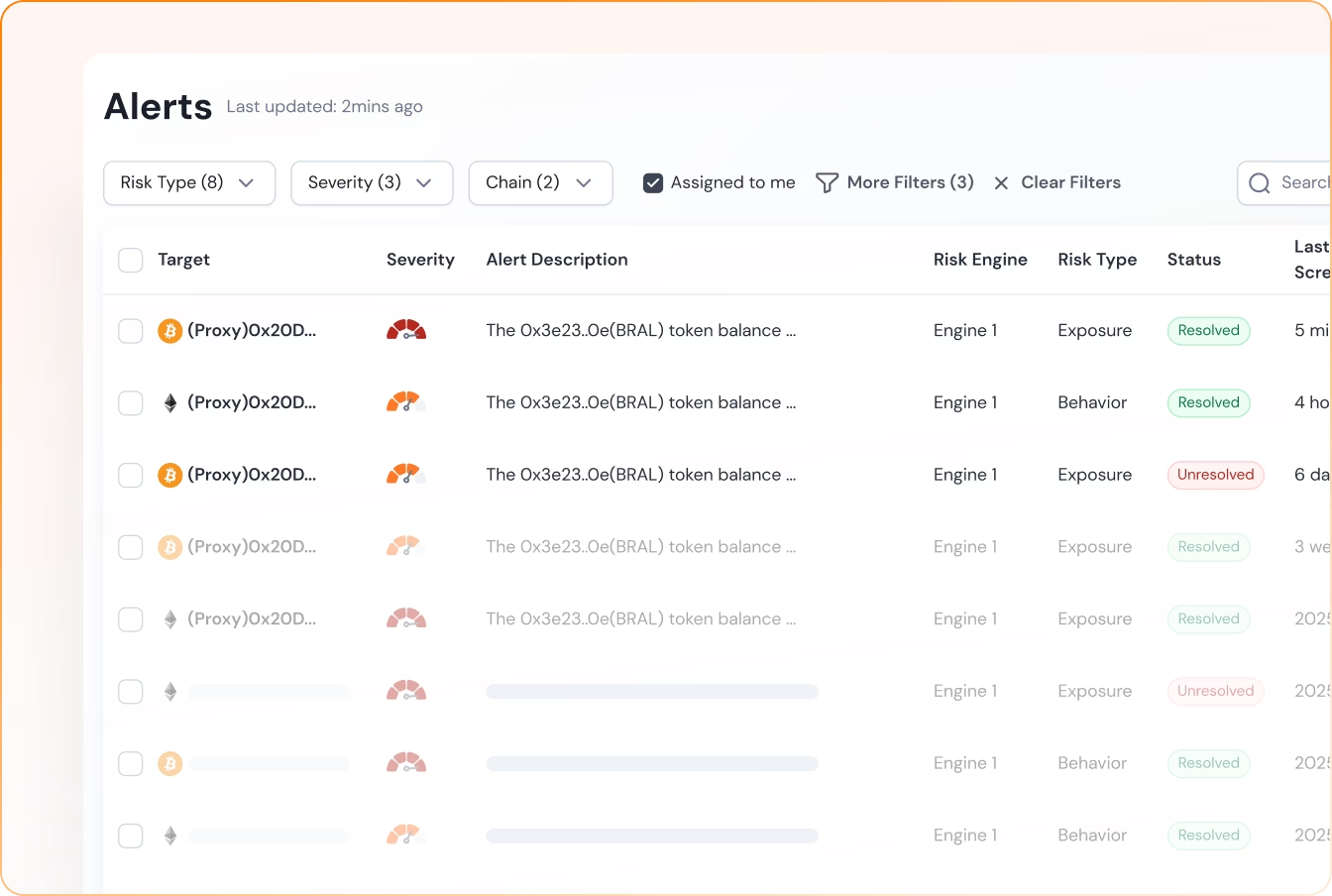
Phalcon Compliance answers screening calls at millisecond level, against labeled-address intelligence covering over 600 million addresses updated around the clock. Those two numbers travel together for a reason: latency without intelligence depth is fast ignorance, and intelligence depth without latency is a very well-informed post-mortem.
Test Latency Under Your Own Peak Load
Teams evaluating monitoring tools should test latency under their own peak load, because vendor benchmarks measured on idle systems rarely survive real payment-flow volumes. The evaluation protocol is straightforward: reproduce your highest realistic transaction rate, fire screening calls at that rate, and measure response distribution, not averages, the tail. A tool whose 95th percentile stays in-flow-viable at your peak is deployable inside the flow; one whose tail climbs into seconds at load belongs beside the flow no matter what the datasheet says.
The second test is intelligence currency: latency on a stale label library is fast blindness. Ask how often labels update, what the coverage is across your chains, and what evidence accompanies a verdict. The third is alert discipline: at your volumes, tiered and explainable signals, the verdict shape Phalcon Compliance returns, keep the review queue proportionate, which is the difference between monitoring that operates and monitoring that gets muted. For how leading platforms answer these questions side by side, see 6 Best Blockchain and Crypto Compliance Software Solutions.
| Evaluation question | What a good answer looks like |
|---|---|
| P95 latency at our peak volume | Millisecond-band, stated plainly with methodology |
| Label update cadence | Continuous, with coverage across major chains |
| Alert shape | Tiered signals with visible evidence basis |
Book a demo of Phalcon Compliance and test screening latency under your own peak load.
FAQ: Blockchain Monitoring Tools
Why does latency matter more than feature count? Latency decides the deployment position, and the position decides whether your systems can act on the verdict before broadcast, or only document it afterward.
What latency is 'good enough' for in-flow screening? Millisecond-level response at your peak volume; anything slower pushes screening beside the flow.
How do we benchmark honestly? Reproduce your peak rate, measure the response tail, and check that intelligence coverage holds for your chains.
Does faster screening mean more false positives? Not inherently; tiering and explainability govern alert quality independently of response speed.