
The right cross-chain investigation tool holds the fund trail across every hop through a bridge, a mixer, and a DEX swap without losing attribution. You can test any candidate against five dimensions: cross-chain penetration depth, label coverage, entity attribution, evidence export, and chain support. A sanctioned address dropping funds into a bridge contract is now the default opening move of an investigation, not an edge case. The deciding factor is whether the tool can reassemble the trail after the single-chain view breaks. That question is what this guide answers, and it sits inside a broader crypto AML compliance program. This page is part of the AML Compliance Hub.
Why Cross-Chain Investigation Is Hard
Why does a trace die at the first bridge? Chain-hopping is now the default laundering method. Funds move through bridges, mixers, privacy chains, and DEX swaps, and each hop can sever the trail a single-chain tool was following. Investigators need a way to follow funds across every hop instead of losing them at the first bridge.
Chain-hopping works by breaking the on-chain link between source and destination. A deposit on one chain enters a bridge contract. The bridge locks that asset and mints a representative token on a second chain. The investigator who was tracing the source address now sees an empty wallet. The funds have not disappeared. They live on the other side of the bridge under a new address. From there the trail is often routed through a mixer that pools and reshuffles deposits, or through a DEX swap that exchanges one asset for another to muddy the trace. Privacy chains add another wall. Each of these mechanisms is designed to defeat single-chain tracing.
Regulators have flagged the systemic scale of this risk. The FATF virtual assets risk framework identifies cross-chain and cross-service flows as a structural money-laundering channel that no single jurisdiction or chain-level view can capture. The OFAC sanctions list and compliance guidance defines the screened-address baseline that any cross-chain trace must be able to resolve. A sanctioned address dropping funds into a bridge is the exact scenario a tool has to follow rather than lose. Forensic research on cross-chain tracing frames the same gap from the technical side: investigators need methods that follow value across heterogeneous ledgers rather than treating each chain as a sealed unit. The practical takeaway for an investigator is that any tool limited to one chain, or one that breaks at the bridge, is already behind the threat.
The vocabulary investigators use tells the same story. They talk about tracing across chains, about bridges and mixers, about chain-hopping, and about whether a given tool can actually follow funds rather than just draw a static graph on one ledger. That vocabulary maps directly to what a cross-chain investigation tool has to do.
The 5-Dimension Selection Framework
A tool selection decision becomes repeatable when it is pinned to concrete dimensions. Investigators can evaluate any cross-chain investigation tool against five dimensions: cross-chain penetration depth, label freshness and coverage, query latency, evidence pack defensibility, and pricing transparency. These five dimensions turn a vague tool comparison into a repeatable selection decision.
-
Cross-chain penetration depth. Can the tool follow funds through bridges, mixers, privacy mechanisms, and DEX swaps without manual re-entry? The key question is whether tracing continues automatically after a bridge hop or stops dead, forcing the investigator to export an address and re-seed a second tool. Unbroken cross-chain tracing through DeFi, mixers, and bridges is the ceiling; a bridge-truncated trail is the floor.
-
Label freshness and coverage. How many addresses are labeled, across how many chains, and how often is the label set updated? An investigator can only act on what the label database recognizes. Coverage in the hundreds of millions, refreshed continuously, gives an analyst something to work with at three in the morning. A stale or thin label set returns empty hits on the exact addresses that matter.
-
Query latency. Is the tool built for real-time interaction or for batch jobs? Investigators often work under time pressure, chasing funds that are still moving. A tool that returns results in a near-instant visual graph lets an analyst pivot during an active investigation. A batch-mode tool that returns results the next morning can miss the window entirely.
-
Evidence pack and defensibility. When the trace has to support a filing, a suspension, or law-enforcement handoff, what does the tool export? A structured evidence pack with data provenance, timestamps, and a clear visual path is defensible. A folder of screenshots stitched together by hand is harder to defend and easier to challenge.
-
Pricing transparency and on-demand access. Investigators and small teams are budget-sensitive. Rigid annual subscriptions lock out the exact teams that need the capability, and opaque enterprise-only pricing makes evaluation impossible. On-demand or self-serve entry points let an investigator test the tool on a real case before committing.
These five dimensions are not a wish list. They are the criteria that separate a tool that helps close a case from one that produces a pretty graph and stops there. Those criteria also anchor the broader crypto AML compliance workflow, where a screening tool is judged on the same labels and evidence it must export.
Automated Cross-Chain Visualization vs Manual Stitching
Mapped against the five framework dimensions, automated cross-chain tracing and manual stitching separate cleanly. The table below is the dimension-level comparison: where each approach sits on cross-chain penetration, label coverage, query latency, evidence-pack defensibility, and pricing.
The comparison below maps the five framework dimensions against the two approaches. The manual-stitching baseline is described in generic terms because what matters to an investigator is the workflow gap, not any specific vendor's parameter set.
| Dimension | Manual stitching baseline | Automated cross-chain tracing |
|---|---|---|
| Cross-chain penetration | Multiple tools stitched by hand; trail breaks at the bridge | Unbroken tracing through DeFi, mixers, and bridges, with the target chain continuing in the same workspace |
| Label coverage | Each tool's label set differs, with gaps at exactly the addresses that matter | 600 million-plus labeled addresses, refreshed around the clock |
| Query latency | Batch or slow, with tool-switching overhead between hops | Interactive visualization returned in near real time |
| Evidence pack | Screenshots assembled by hand; hard to defend in a filing | Structured export with data provenance and traceable source |
| Pricing | Typically rigid annual subscriptions | On-demand, self-serve entry points |
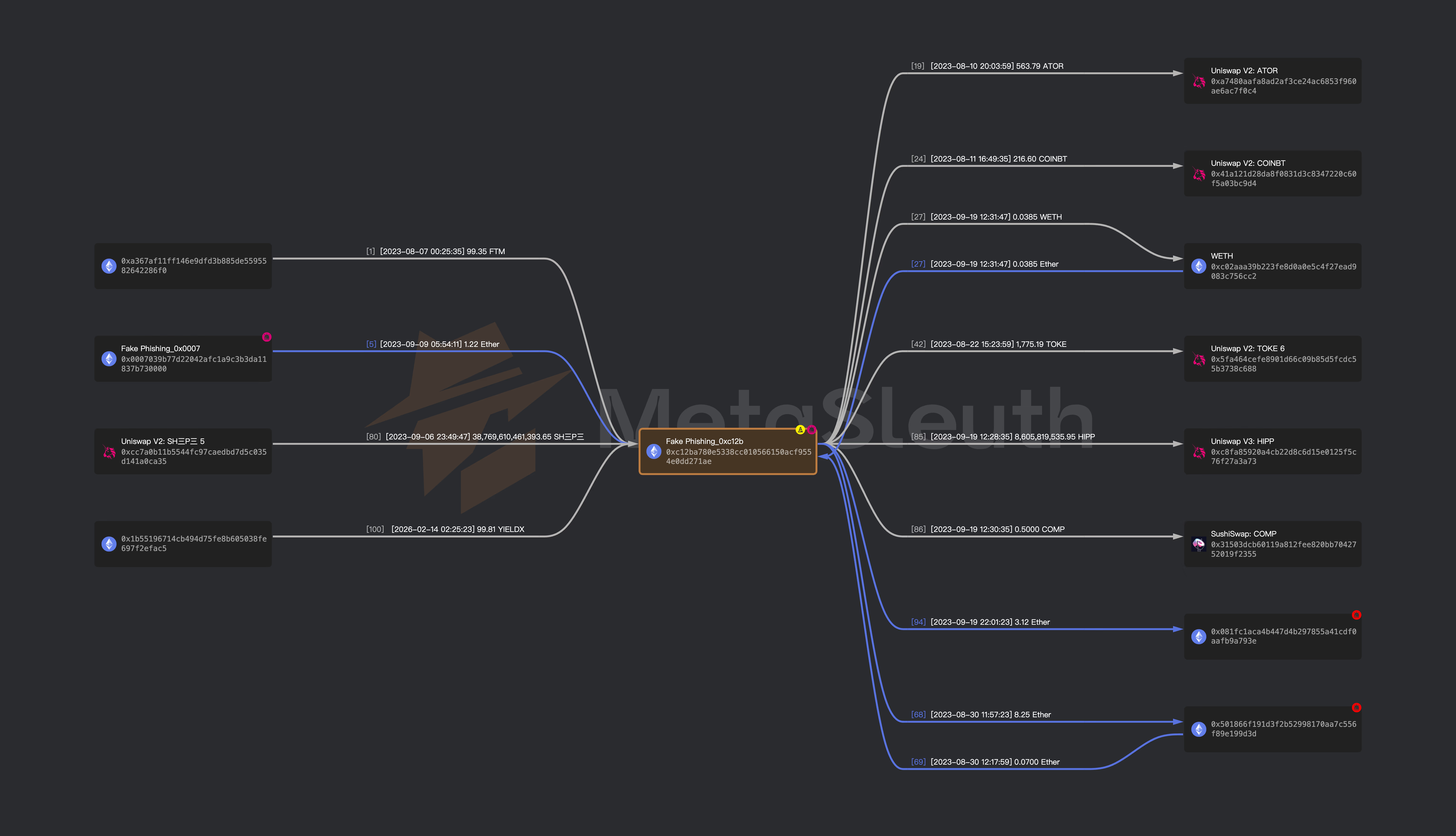
 This is where the tool under evaluation has to earn its place. MetaSleuth is built to follow funds across chains without the manual handoff. Its cross-chain tracing runs through DeFi protocols, mixers, and bridges without manual re-seed, so when funds cross a bridge the target chain opens in the same workspace and the trace continues rather than resetting. Behind the visualization sits a database of more than 600 million labeled addresses, shared with the Phalcon Compliance platform. That means the addresses an investigator hits mid-trace already carry risk context instead of appearing as unknown nodes. The point of the comparison is not that manual stitching is impossible. It is that manual stitching is slow, lossy at the seams, and hard to defend precisely when defensibility matters most.
Automated Visualization vs Manual Stitching: The Workflow Difference
The difference between the two workflows is where the seams fall. In manual stitching the seams are between tools, and every seam is a place to lose a hop or introduce an error. In automated cross-chain tracing the seams disappear, and the investigator spends time analyzing the path instead of reassembling it.
The manual-stitching workflow is familiar to anyone who has worked a cross-chain case. The investigator seeds a starting address in tool A and traces it to a bridge contract. The trail stops there. The investigator exports the bridge address, opens tool B, seeds the address on the destination chain, and starts again. If the next hop is a mixer, the process repeats. Each handoff is a chance to drop a hop, mis-key an address, or lose the thread entirely. The result is a reconstructed path assembled from fragments, with gaps where the tools did not agree.
The automated workflow collapses those steps. The investigator seeds the starting address once. The tool follows the funds through the bridge, highlights the destination-chain activity in the same workspace, and continues through the mixer or DEX swap without a manual re-seed. The full path renders as one connected graph. The investigator's job shifts from reassembly to analysis: reading the path, identifying the cash-out point, and preparing the evidence pack.
The investigation scenarios where this matters are concrete. Tracing hacked funds after an exploit, reconstructing the flow of social-engineering proceeds, or rebuilding a sanctions-evasion path all depend on following funds across chains without losing hops. The detailed step-by-step procedure for tracing stolen crypto through a mixer is covered in its own guide. A related question is whether the analytics tool actually works on a buyer's own data, which sits in its own evaluation guide.
Try MetaSleuth for Cross-Chain Tracing
If the selection framework above points toward automated cross-chain tracing, the next step is to run a real trace on it. Investigators can try MetaSleuth on an active case and see whether the five dimensions hold up against their own evidence.
The decision an investigator faces is rarely about features in the abstract. It is about whether a tool can follow a specific set of funds, across the specific chains and mechanisms in play, fast enough to act on the result. Try MetaSleuth cross-chain tracing on a real address and judge it against the five-dimension framework rather than against a sales deck.