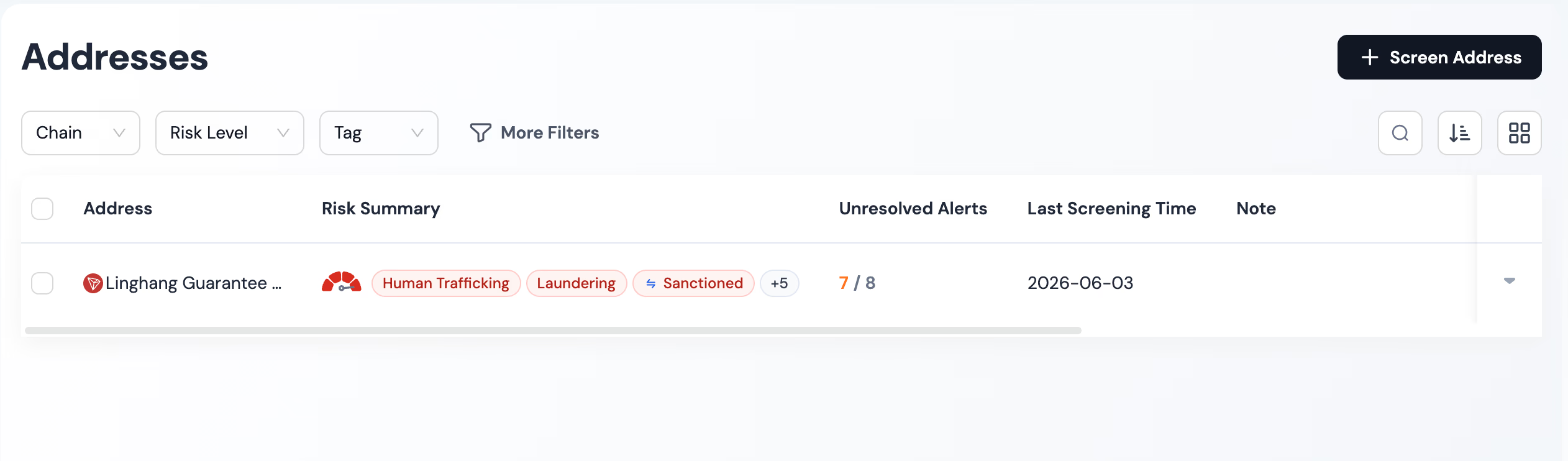
Direct exposure means a wallet has transacted with a sanctioned or illicit entity itself. Indirect exposure means the contact sits one or more hops upstream through a counterparty. A defensible read of either combines hop distance, tainted share, entity attribution, and timing, and never treats the flag as binary. This page is part of the AML Compliance Hub.
An analyst who sees an address flagged for indirect exposure faces exactly that judgment call. The wallet itself has never touched a sanctioned entity, its counterparty has two hops upstream, and the identity check on the owner came back clean. The question on the desk is whether that upstream contact is real risk, or noise. A blacklist-only screen would either miss it entirely or escalate it without discrimination. That question, repeated across every queue, is what exposure judgment answers.
Exposure is not a binary state. It is a layered read of how risk propagates through fund flows: direct contact, indirect contact, hop distance, tainted share, and the entity behind each hop. This article lays out the onchain AML compliance and investigation discipline for exposure judgment. It separates direct from indirect exposure, explains why hop distance alone is not enough, and shows how to combine signals into an Allow, Review, or Block disposition.
Direct vs Indirect Exposure: When Upstream Contact Becomes a Risk Read
The distinction between direct and indirect exposure is the foundation of every judgment that follows. Direct exposure means a wallet transacts with a sanctioned or otherwise illicit address itself. This is the strongest possible signal, and it is usually sufficient to escalate. Indirect exposure means the wallet's funds touched a risk source upstream, one or more hops away, so the wallet appears clean in isolation while the funds moving through it are not.
The judgment question that analysts actually face sits inside indirect exposure. A wallet with a clean identity check, sometimes called a clean know-your-customer (KYC) profile, receives funds that passed through a mixer or a sanctioned entity one or two hops earlier. The wallet owner is not the illicit actor. The funds may still carry risk. Whether that risk is material depends on how much of the flow is tainted, how many hops separate the wallet from the source, who the source is, and how recently the contact occurred. None of those dimensions reduces to a yes-or-no.
This distinction matters because the two failure modes are symmetric. A tool that reads only direct exposure will miss the laundered funds passing through clean wallets, which is most of them. A tool that flags every indirect touch without weighing exposure share or hop distance will drown the queue in noise. The framework below prevents both failures.
Hop Distance: Why One Hop, Two Hops, and Multi-Hop Are Not Equal
Hop distance measures how many transaction steps separate the screened wallet from a risk source, and the signal weakens as the distance grows. One-hop exposure, where the wallet transacts directly with a sanctioned or illicit address, is the strongest signal and is typically treated as High risk on its own. Two-hop exposure, where the wallet's counterparty transacts with a risk source, is moderate and needs support from exposure percentage and entity attribution before it can be escalated. Multi-hop exposure, three hops or more, covers a wider surface but the per-link signal is weak and the system becomes prone to over-alerting if hop count is the only variable.
Hop distance alone is insufficient because propagation is not attenuation. A two-hop link to a ransomware cash-out address is not automatically less serious than a one-hop link to a gambling site. Severity depends on what sits at the other end, how much of the flow came from there, and whether the funds have been layered since. Indirect exposure three hops from a mixer may be unremarkable in one wallet and material in another, depending on volume and timing.
This is also where the boundary to scoring sits. Hop distance is an input. How hop distance, exposure percentage, and entity attribution combine into a single explainable risk score is a separate question, covered in detail in how signals become an explainable risk score. This article stops at the inputs and the judgment logic, not the score itself.
Exposure Percentage and Fund Provenance: Why a Blacklist Alone Is Not Enough
The two signals that do the most work in exposure judgment are exposure percentage and fund provenance, and both expose the limit of blacklist-only screening.
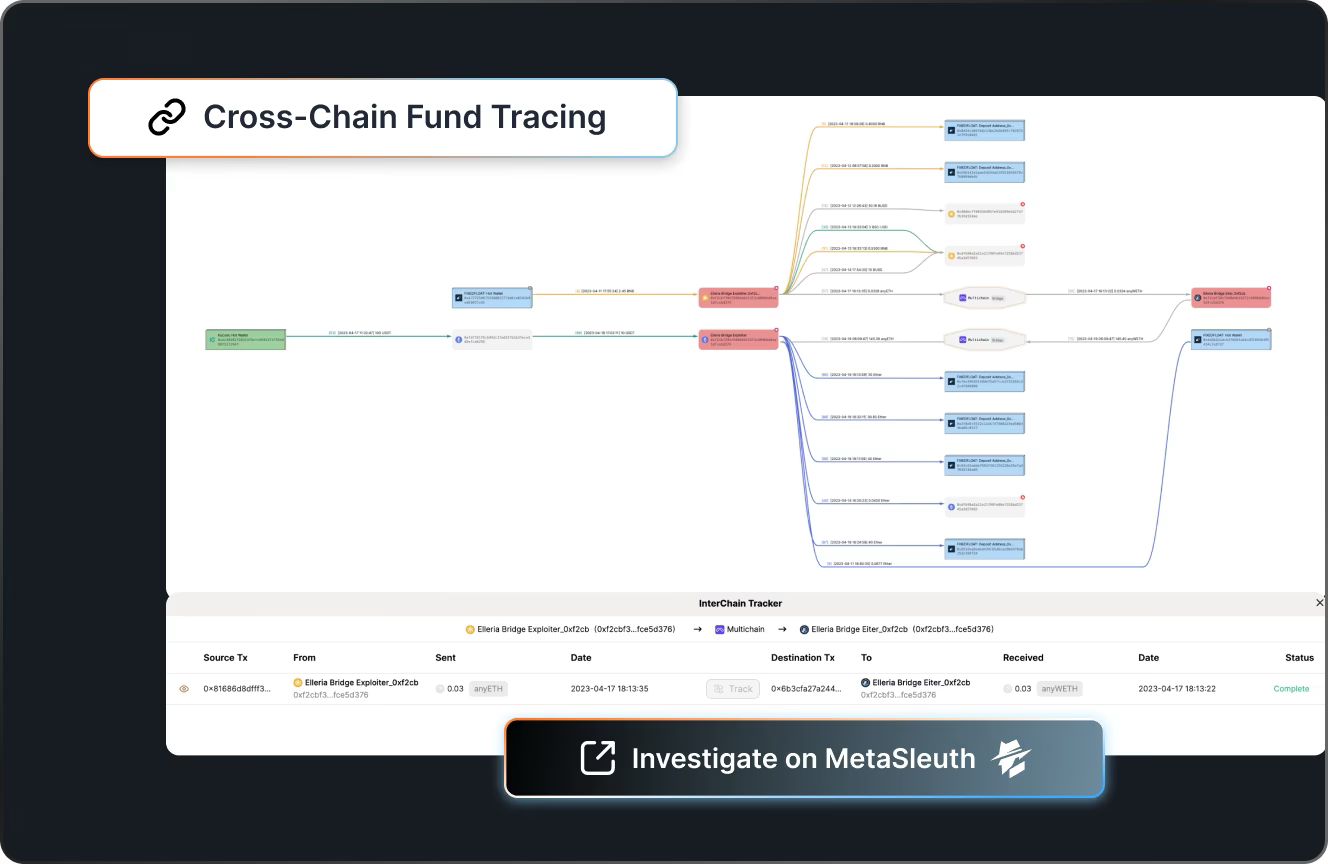 Exposure percentage, the tainted share of an address's total inflow or outflow value, behaves nothing like a blacklist match. Five percent exposure to a mixer and ninety-five percent exposure to the same mixer are completely different judgments, yet a blacklist match treats them identically. A wallet with a small contaminated deposit inside a much larger legitimate flow is not the same risk as a wallet whose entire balance is laundered proceeds, and an exposure-aware read has to reflect that.
Fund provenance asks where the money came from, traced along its path rather than matched against a fixed list. A blacklist is binary: an address is on it or it is not. Provenance is continuous: it follows the fund flow back through hops, attributes each hop to an entity, and quantifies the tainted share at every step. This is what makes indirect exposure legible. A blacklist-only screen will either miss indirect exposure entirely, because the wallet itself is not listed, or over-alert on every micro-contamination, because any touch registers as a hit.
Exposure judgment becomes concrete in a working engine. The example of multi-dimensional exposure judgment is the Phalcon Compliance Risk Exposure Engine, which pairs an address-label database with on-chain interaction tracing, quantifies Exposure Value and Exposure Percentage, and hops through fund flows to surface indirect exposure a blacklist would miss. Two quantities anchor that read, both defined formally here. Exposure Value is the total USD value of crypto assets that originated from or have interacted with a specified risk source. Exposure Percentage is the share of tainted assets relative to an address total inflow or outflow value. A third mechanism carries the indirect-exposure read across hops. Interaction-based monitoring traces funds across multiple transaction hops and fires when any address in the fund flow carries a risk label, under customizable rules for transfer direction and amount threshold. These are the inputs to judgment, not the judgment itself.
Why Indirect Exposure Drives False Positives
Indirect exposure is the single largest source of false positives in crypto AML monitoring, and the mechanism is structural. The common indirect sources are mixers, sanctioned entities, and illicit services such as drainers, dark markets, and ransomware cash-out addresses. Each of these touches a large and diffuse set of downstream wallets. By the time funds have moved two or three hops past a mixer, the surface of wallets with some non-zero exposure is enormous, while the share of those wallets that represent real risk is small.
The failure mode is easy to describe. A purely hop-based or blacklist-based alert fires on every wallet in that surface. The queue fills with alerts where the underlying activity is benign. A payment processor that settled a transaction for an exchange customer who once used a mixer. A merchant wallet that received a deposit with a tiny contaminated fraction. A user who interacted with a defi pool that also received tainted inflows. None of these warrants a block. All of them match a hop or list rule. The analyst is left to triage by hand, and the genuine investigations are buried.
The remedy is not a better threshold. The remedy is multi-dimensional judgment that refuses to escalate on a single signal. A wallet flagged for two-hop mixer contact is reviewed differently at two percent exposure than at sixty percent, and differently again when the time gap is three days versus eighteen months. The detailed playbook for reducing false positives in crypto AML monitoring lives on its own page, because the tuning workflow deserves its own treatment. The point here is structural: indirect exposure without weighting always over-alerts, and weighting is the only way to keep the queue usable.

Multi-Dimensional Judgment: From Exposure Signals to Allow, Review, or Block
The decision an analyst actually makes is whether to allow, review, or block a wallet. That decision is defensible only when it rests on more than one signal.
| Dimension | What it measures | Weakest alone | Strongest combined |
|---|---|---|---|
| Hop distance | Steps from wallet to risk source | Three-hop can be noise or signal | Anchors proximity to the source |
| Exposure percentage | Tainted share of total flow | Five percent vs ninety-five collapse together | Separates trace from material contact |
| Entity attribution | What the source and intermediaries are | A mixer hit equals a sanctioned hit | Distinguishes severity by entity type |
| Transaction behavior | Pattern around the exposure event | Ignores how funds move after contact | Surfaces layering or rapid transit |
| Time decay | Recency of the upstream contact | A 2021 touch equals a same-week touch | Weighs recent contact more heavily |
| Fund flow direction | Deposit source vs withdrawal destination | Direction-blind exposure reads mislead | Separates inbound contamination from outbound risk |
No single signal is sufficient. A defensible exposure read combines hop distance, exposure percentage, entity attribution, transaction behavior, time decay, and fund flow direction before converting to a Low, Medium, or High risk tier and an Allow, Review, or Block disposition. Every individual signal has a failure mode. The only protection against those failures is to require corroboration.
Consider an anonymized case. A wallet receives funds with two-hop contact to a mixer. Exposure percentage is moderate, in the mid-teens. Entity attribution confirms the source is a mixer rather than a sanctioned address. The upstream contact is recent, within weeks. Transaction behavior around the deposit is unremarkable, with no rapid transit and no structuring. Fund flow direction is an inbound deposit. Read individually, the hop count and recency might push toward escalation. Read together, the moderate percentage, the mixer source, and benign post-deposit behavior pull the disposition toward Review rather than Block. The analyst documents the basis, sets the disposition, and moves on. That is what multi-dimensional judgment produces: a decision that survives an audit because each dimension is recorded, not a gut call.
What operationalizes this is the Risk Exposure Engine. The Risk Exposure Engine uses an address-label database together with on-chain interactions to identify risk and assess whether a screened address or transaction is associated with a known risk entity. The Address Exposure Engine ships three templates covering entity risk, interaction risk, and blacklist interaction. The Transaction Exposure Engine ships three templates covering participant risk, interaction risk, and blacklist interaction. Risk is classified across five levels: Critical, High, Medium, Low, and No Risk. The 17 Risk Indicator categories, including Sanctioned, Mixing, Ransomware, Dark Market, and FATF Grey List Jurisdiction, give the analyst a stable vocabulary for what was found at each hop. The conversion from these inputs into a single auditable score is the subject of the explainable-scoring page, not this one.
The regulatory anchor is this: FATF Recommendation 15 expects a risk-based approach that identifies and assesses exposure, not only static list matching. The same risk-based logic sits behind FinCEN's Customer Due Diligence requirements, which obligate covered institutions to understand customer relationships and monitor for suspicious activity rather than rely on list matching alone. A program that escalates only on direct hits cannot defend its misses. A program that escalates on every indirect hit cannot defend its workload. The FATF risk-based approach for virtual assets is the reason multi-dimensional exposure judgment is the standard, not a refinement.