Back to Blog

Seal Finance 安全事件

Code Auditing
January 3, 2021
5 min read

2020年11月30日,我们的安全事件监控系统ThunderForecast通过扫描以太坊上的历史交易,发现Loopring协议遭受攻击(中文博客CN)。结论是,此次攻击的根本原因在于sellTokenForLRC函数缺乏访问控制。攻击者利用了80.97个ETH,按当时价格计算,相当于48,849.2美元。

2020年12月11日,我们的监控系统ThunderForecast报告了一系列交易异常的交易。随后,我们使用我们研究团队开发的EthScope系统分析了这些交易,并发现这是一起利用Seal Finance Protocol漏洞进行套利的攻击。

什么是Seal?

Seal在白皮书中提到:“SEAL——一个实验性协议,作为主要DeFi协议代币之间的中介,在它们之间创造更深层次的流动性。”截至目前,存在超过10个流动性池将Seal与其他不同的知名代币(如UNIYFIUSDTSNX等)连接起来。为了获得奖励,投资者需要将LP代币存入SEAL奖励合约,并触发Farm合约中的breed()函数来生成新的SEAL代币。Farm合约部署在每个Seal池中,该合约中的breed()函数用于发行新的Seal代币。根据breed()的设置,它额外发行1.6%的Seal Token。此外,0.8%的已发行Seal代币会兑换成另一种存入该池的代币,与另外0.8%的已发行Seal代币作为流动性。然而,由于breed()函数没有设计访问控制,任何人都可以触发该函数,而这个原始设计成为了此次报告攻击的根本原因。

以下是breed()函数的已确认源代码:

function breed() external {
	require(now / 1 days > today);
	today += 1;
 
	uint256 sealPairAmount = seal.balanceOf(address(cSeal));
	uint256 tokenPairAmount = token.balanceOf(address(cSeal));
	uint256 newSeal = sealPairAmount.mul(spawnRate).div(1e18);
	uint256 amount = UniswapV2Library.getAmountOut(newSeal, sealPairAmount, tokenPairAmount);
 
	seal.mint(address(cSeal), newSeal);
	if(address(seal) < address(token))
    	cSeal.swap(0, amount, address(this), "");
	else
    	cSeal.swap(amount, 0, address(this), "");
	token.transfer(address(cSeal), amount);
	seal.mint(address(cSeal), newSeal);
	cSeal.mint(address(this));
}

详情

我们现在开始披露此次攻击的更多细节,其中一次攻击交易。在此次交易中,攻击者在10个Seal池中重复了攻击逻辑,以最大化其利润。在接下来的分析中,我们将重点关注在Seal-SNX池中发起的攻击。
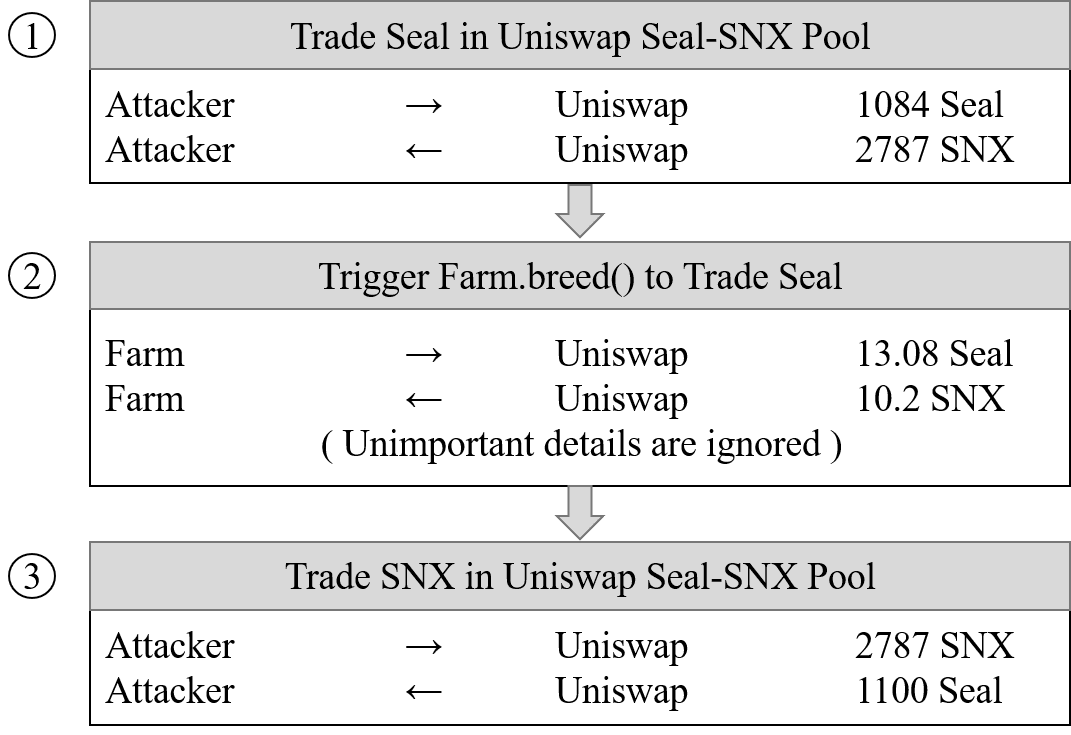
攻击涉及三个步骤:

  • 步骤1:在Seal-SNX池中将1,084个Seal兑换为2,787个SNX。交易汇率为:1 Seal = 2.57 SNX
  • 步骤2:触发Farm合约中的breed()函数。此函数发行13.08个Seal并将其兑换为10.20个SNX。交易汇率变为:1 SNX = 0.78 Seal。原因是池中大部分SNX已兑换成Seal,导致SNX和Seal的数量之间存在巨大差异。然后,根据Uniswap的价格计算算法,SNX在池中变得极其有价值(价格上涨超过3倍)。
  • 步骤3:在Seal-SNX池中将2787个SNX兑换为1100个Seal。由于此次兑换进一步推高了SNX的价格,攻击者套利出更多的Seal代币(额外16个Seal)。

为了进一步衡量和确认损失,我们使用我们的EthScope系统在攻击前的区块状态下重放了breed()函数。结果显示,与正常调用相比,Farm发行了18个额外的Seal代币。攻击者取出了16个Seal,池中仅剩下2个Seal。

收益与损失

在此次交易中,攻击者总共获得了175个Seal

攻击规模

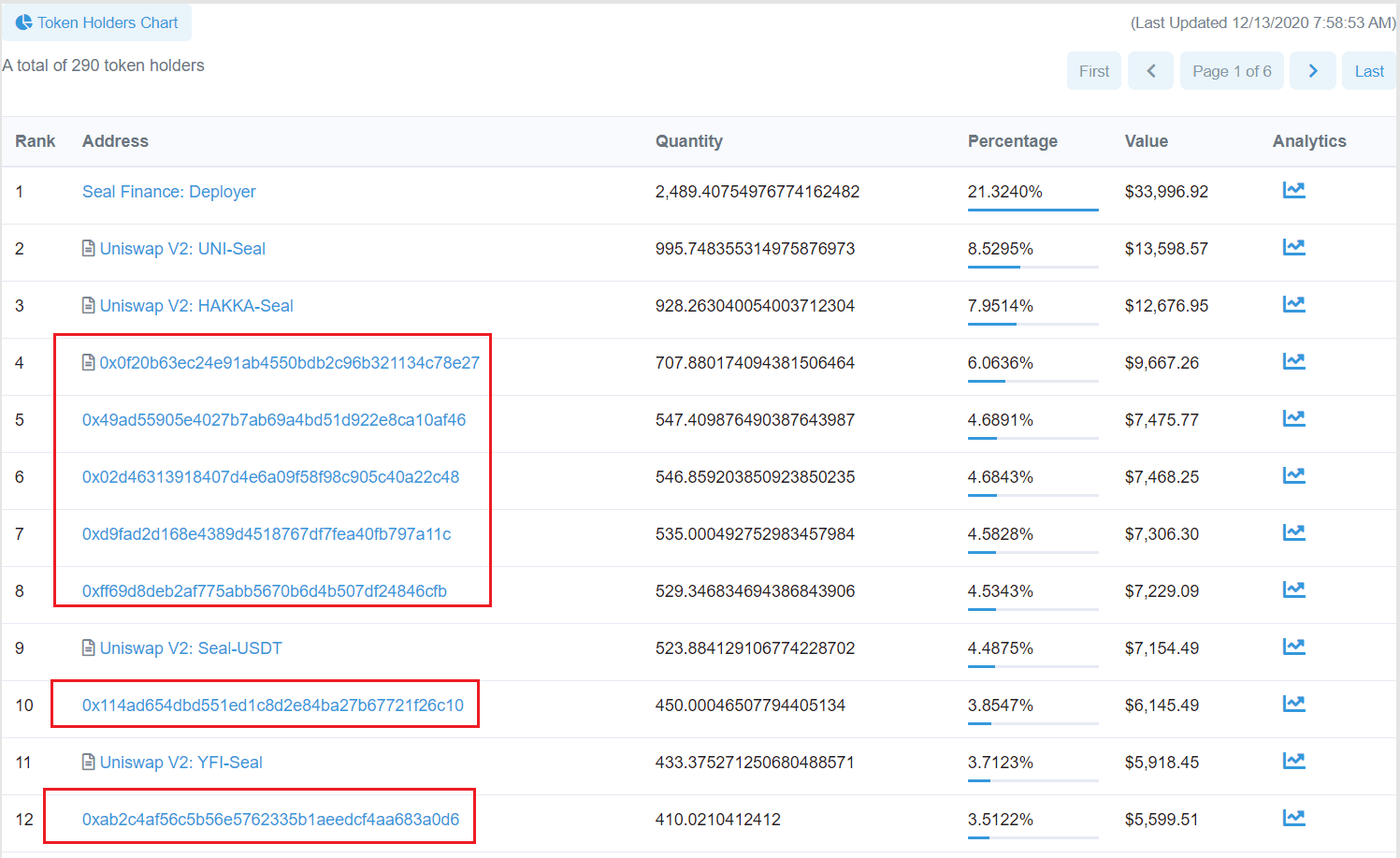
截至2020年12月13日,链上部署了3个恶意合约(0x49f93e0x8b37100x0f20b6),并成功发起了22笔交易,共计4,247枚Seal代币。按当时价格计算,攻击者通过利用Seal协议的漏洞获得了约58,467美元。值得注意的是,Seal协议的漏洞仍在被攻击中!!!

此外,通过分析获得的Seal代币的流动,我们发现约有900枚Seal代币被存入DEX,其余的则分配到6个不同的地址。如下图所示,除Seal Finance和Uniswap V2中的流动性池外,这些地址都是Seal代币的顶级持有者。
结语

随着以太坊DeFi生态系统的发展,各种安全问题逐渐显现。事实上,此次攻击的根本原因——访问控制——导致Seal在截至2020年12月13日的22笔交易中遭受了相当大的损失(58,467美元)。

更新(2021/01/04)

在2020年11月30日首次攻击后,攻击者又部署了一个第三方攻击合约并发起了五次攻击。最后一次攻击发生在2020年12月24日,并将获得的Seal代币转账到了该地址。在此过程中,攻击者获得了6,021枚Seal代币。

时间线:

  • 2020/12/11:发现可疑交易
  • 2020/12/12:完成分析
  • 2020/12/13:报告给Seal Finance
  • 2021/01/03:发布细节
  • 2021/01/03:分配CVE-2021–3006

关于BlockSec

BlockSec是一家开创性的区块链安全公司,由一群享誉全球的安全专家于2021年创立。公司致力于提升新兴Web3世界的安全性和可用性,以促进其大规模采用。为此,BlockSec提供智能合约和EVM链安全审计服务、用于安全开发和主动阻止威胁的Phalcon平台、用于资金追踪和调查的MetaSleuth平台,以及供Web3开发者在加密世界高效冲浪的MetaSuites扩展。

截至目前,该公司已为MetaMask、Uniswap Foundation、Compound、Forta和PancakeSwap等300多家知名客户提供服务,并在两轮融资中从Matrix Partners、Vitalbridge Capital和Fenbushi Capital等知名投资者那里获得了数千万美元。

官方网站:https://blocksec.com/

官方Twitter账号:https://twitter.com/BlockSecTeam
Sign up for the latest updates
The Decentralization Dilemma: Cascading Risk and Emergency Power in the KelpDAO Crisis
Security Insights

The Decentralization Dilemma: Cascading Risk and Emergency Power in the KelpDAO Crisis

This BlockSec deep-dive analyzes the KelpDAO $290M rsETH cross-chain bridge exploit (April 18, 2026), attributed to the Lazarus Group, tracing a causal chain across three layers: how a single-point DVN dependency enabled the attack, how DeFi composability cascaded the damage through Aave V3 lending markets to freeze WETH liquidity exceeding $6.7B across Ethereum, Arbitrum, Base, Mantle, and Linea, and how the crisis forced decentralized governance to exercise centralized emergency powers. The article examines three parameters that shaped the cascade's severity (LTV, pool depth, and cross-chain deployment count) and provides an exclusive technical breakdown of Arbitrum Security Council's forced state transition, an atomic contract upgrade that moved 30,766 ETH without the holder's signature.

Weekly Web3 Security Incident Roundup | Apr 13 – Apr 19, 2026
Security Insights

Weekly Web3 Security Incident Roundup | Apr 13 – Apr 19, 2026

This BlockSec weekly security report covers four attack incidents detected between April 13 and April 19, 2026, across multiple chains such as Ethereum, Unichain, Arbitrum, and NEAR, with total estimated losses of approximately $310M. The highlighted incident is the $290M KelpDAO rsETH bridge exploit, where an attacker poisoned the RPC infrastructure of the sole LayerZero DVN to fabricate a cross-chain message, triggering a cascading WETH freeze across five chains and an Arbitrum Security Council forced state transition that raises questions about the actual trust boundaries of decentralized systems. Other incidents include a $242K MMR proof forgery on Hyperbridge, a $1.5M signed integer abuse on Dango, and an $18.4M circular swap path exploit on Rhea Finance's Burrowland protocol.

Weekly Web3 Security Incident Roundup | Apr 6 – Apr 12, 2026
Security Insights

Weekly Web3 Security Incident Roundup | Apr 6 – Apr 12, 2026

This BlockSec weekly security report covers four DeFi attack incidents detected between April 6 and April 12, 2026, across Linea, BNB Chain, Arbitrum, Optimism, Avalanche, and Base, with total estimated losses of approximately $928.6K. Notable incidents include a $517K approval-related exploit where a user mistakenly approved a permissionless SquidMulticall contract enabling arbitrary external calls, a $193K business logic flaw in the HB token's reward-settlement logic that allowed direct AMM reserve manipulation, a $165.6K exploit in Denaria's perpetual DEX caused by a rounding asymmetry compounded with an unsafe cast, and a $53K access control issue in XBITVault caused by an initialization-dependent check that failed open. The report provides detailed vulnerability analysis and attack transaction breakdowns for each incident.

Best Security Auditor for Web3

Validate design, code, and business logic before launch. Aligned with the highest industry security standards.

BlockSec Audit