
The Short Answer
Blind signing is approving a transaction without knowing what it does. The screen on your hardware wallet shows hexadecimal characters instead of a plain description, and pressing confirm anyway is the blind part. It is one of the most common ways people lose large amounts of crypto, and it survives because the display problem has no simple fix.
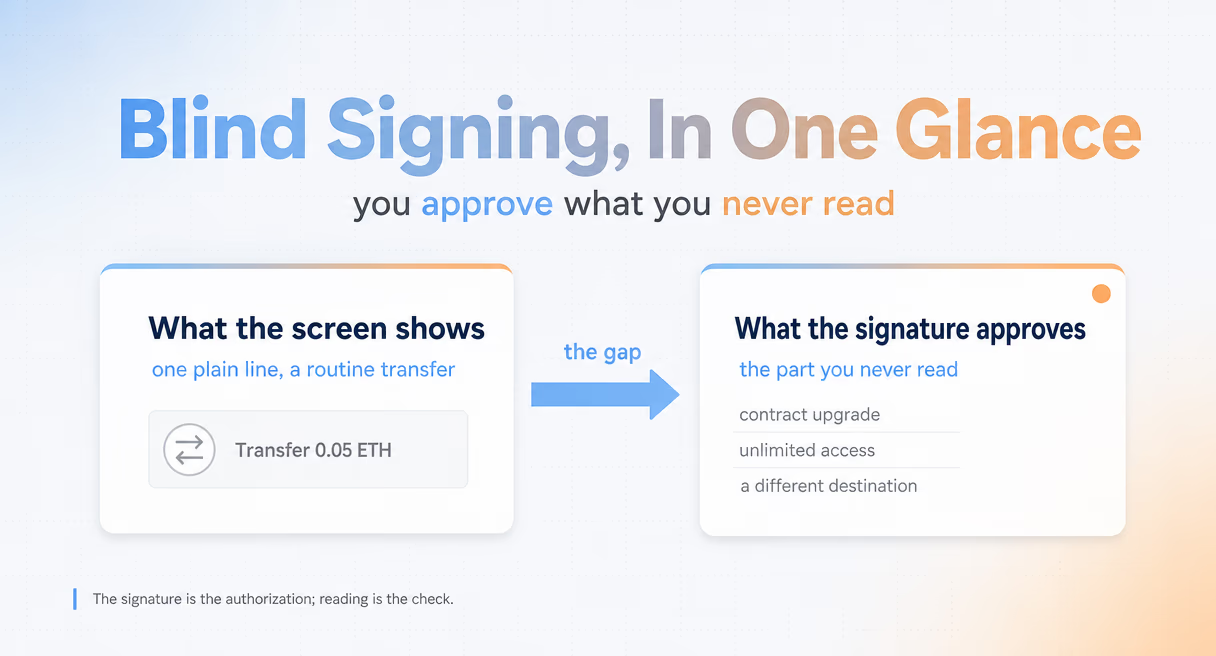
Users in public forum discussions describe this exact moment: confusing, unreadable data on a hardware wallet screen, a transaction they cannot parse, and a signature given anyway. The device is working as designed. The gap is between what the wallet can show and what the transaction actually contains.
The uncomfortable truth is that blind signing is not an edge case. Complex contract actions, token approvals, and upgrades are exactly the transactions most likely to display as raw data, and they are also the ones with the most power over your funds.
Why Your Hardware Wallet Shows Unreadable Data
A transaction to a smart contract is not a sentence; it is machine code. The action and its parameters travel as encoded bytes, and a hardware wallet often cannot turn those bytes back into a description. When the wallet cannot decode the call, it shows the raw data, and that raw data is what you are asked to approve.
A plain transfer is easy: an amount and an address, both readable. A contract call is a function name plus arguments, packed into hexadecimal. To display it in words, the wallet would need to understand every contract's every function, which changes with each new contract deployed. So the device falls back to showing what it can check, the signature request itself, and cannot confirm the meaning.
This is why the danger scales with complexity. An upgrade that hands a contract new logic, an approval that lets a contract spend your tokens without a limit, a multi step operation packed into one call. Each of these is a longer, denser payload, and each is more likely to appear on the screen as characters you cannot read. The question users keep asking in public forum discussions, why the wallet shows unreadable transaction data, has this machine-level answer: the wallet cannot compile machine code back into plain language on that little screen.
Verified source does not fix it either. A contract can be a proxy that loads its logic from elsewhere, so even the code you can read is not the code that will run. Plenty of contracts ship without verified source at all. The display problem is not a bug waiting for a patch; it is a property of how contracts execute.
What You Might Actually Be Signing
The gap between what the interface says and what the signature does is where the large losses happen. In the Bybit incident of February 2025, close to 1.5 billion dollars left the exchange after a routine looking interface masked a malicious contract upgrade. The attacker had deployed and tested the malicious contract two days in advance, per BlockSec's analysis.
The people signing saw one thing and approved another. Two more cases from the same period make the pattern hard to dismiss. Radiant lost about 50 million dollars in 2024 to a malicious transaction that was signed, by its own post-mortem count. WazirX lost over 200 million dollars in 2024 the same way, to a signature that looked ordinary and was not. None of these were private key thefts in the classic sense. The keys stayed with their owners, and the owners signed.
| Case | Year | What the signature approved | Loss |
|---|---|---|---|
| Bybit | 2025 | A contract upgrade shown as a transfer | Close to 1.5 billion dollars |
| Radiant | 2024 | A malicious transaction signed as routine | About 50 million dollars (Radiant post-mortem) |
| WazirX | 2024 | A signature that looked ordinary and was not | Over 200 million dollars |
That last point is the whole risk of blind signing: your signature is the authorization, and it does not check whether you understood. A malicious upgrade disguised as a transfer passes every check you skip. The Cybersecurity and Infrastructure Security Agency tracks this class of interface and supply chain deception, and the FBI's Internet Crime Complaint Center is where losses like these get reported and counted.
How to Stop Blind Signing
Two directions attack the problem. Clear signing, a trend on the wallet and contract side, aims to make transactions display in readable words. Independent translation and warning tools sit alongside your wallet and read the transaction before you sign, turning the hexadecimal into a description and flagging the dangerous ones while there is still time to stop.
Safe{Wallet} Monitor, launched in March 2025 by BlockSec, works the second way. It translates transaction payloads into clear, human-readable explanations and runs a risk check on what the transaction would actually do. It can also send a warning in the window before signing finishes and before the transaction reaches the chain. In the Bybit case (BlockSec's incident analysis), this is the layer that was missing: something that read the real content of the upgrade and said so out loud.
The honest limit matters as much as the tool. Translation and warnings lower the risk of approving what you cannot read; they do not remove every risk. The security of your computer, your wallet software, and your signing routine is still your own ground to hold, and no monitor replaces attention at the moment of approval.
One habit belongs in the routine regardless of tools: treat urgency as a signal. A legitimate transaction can usually wait the minutes it takes to read what it does, and manufactured pressure, a countdown, a support chat, a fading discount, is the standard companion of a malicious one.
If you want the working procedure that goes with this concept, the step by step version lives in How to Check a Multisig Transaction Before You Sign It. The Safe{Wallet} Monitor page covers the tool itself, and the wallet risk hub maps the rest of the family, from multisig decisions to seed phrase storage.