
What Is OFAC?
OFAC is the Office of Foreign Assets Control, a bureau inside the U.S. Department of the Treasury that runs America's economic sanctions. It decides who gets cut off from U.S. money, publishes the lists that enforce it, and penalizes the businesses that deal with listed parties anyway. Crypto firms hear about it constantly, usually from a compliance checklist. The OFAC sanctions hub collects the related guides.
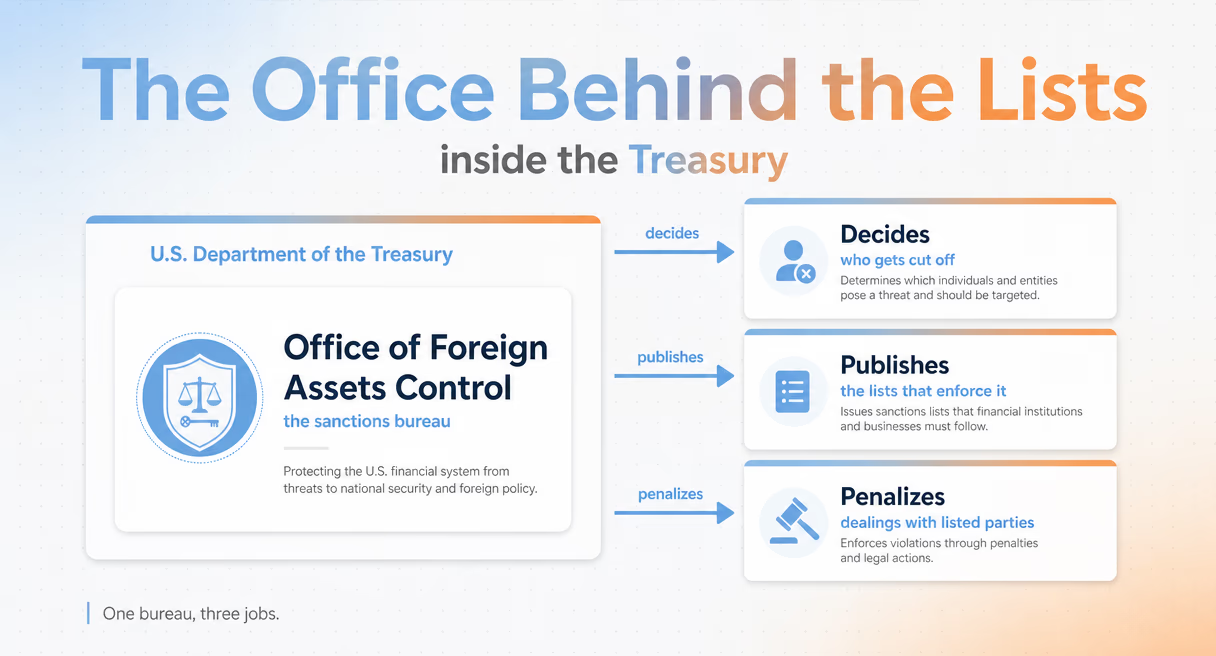
The office sits at a specific crossing: it is part of Treasury, it answers to U.S. foreign policy, and it works through the financial system rather than through courts. Where a regulator like FinCEN, whose legal authorities come from the Bank Secrecy Act, chases hidden money, OFAC blocks defined targets. One office watches for crime in the flow; the other decides who the flow may not touch at all.
For a crypto team, three OFAC artifacts matter in daily work. The sanctions programs, which define who is targeted and why. The SDN list, which turns those programs into names. And the enforcement record, which shows what happens to firms that skip the first two. Each has a guide in this family; this page is the office behind all three.
What Does OFAC Stand For?
OFAC stands for Office of Foreign Assets Control, and each word carries its weight. Office, because it is a bureau of the Treasury Department. Foreign Assets, because it controls property and money linked to foreign targets. Control, because its tool is restriction, not prosecution. The abbreviation hides a simple machine.
Unpacking the name explains the powers. "Foreign assets" points at what is controlled: property, funds, and transactions that touch U.S. reach, wherever the target lives. "Control" is the method: blocking, prohibition, and licensing, imposed administratively. OFAC does not need a criminal case to freeze a target's assets; it needs a designation under a program, which is a legal act the office issues and publishes.
That administrative nature is the surprise for newcomers. The rules bind private businesses directly: an exchange, a payment processor, or a trading desk inside U.S. reach must refuse listed parties, freeze blocked property, and keep records, or answer for the gap. The office publishes its programs and country information on its official page, which is the primary source this guide sticks to.
The office's duties fill this page, and the OFAC sanctions hub rounds out the working picture.
What OFAC Actually Does
OFAC's working life has four moves: build programs under legal authority, designate targets onto lists, license the narrow exceptions, and enforce against firms that break the rules. Every duty a crypto compliance team carries maps back to one of those four moves, which is why understanding them pays.
Programs come first. Each program is built on legal authority, from statutes and executive orders, and targets a country, a sector, or an activity. Designation turns a program into a named party: the entry lands on the SDN list, assets block, and dealing stops. Licensing is the pressure valve: general licenses open defined exceptions automatically, and specific licenses can be applied for case by case. Enforcement closes the loop with civil penalties, which the enforcement guide in this family covers with current numbers.
| Move | What it means for you |
|---|---|
| Programs | The rules that say who is targeted |
| Designations | The list entries you screen against |
| Licenses | The exceptions, if you qualify |
| Enforcement | The cost of ignoring the first three |
The four moves also explain what OFAC is not. It is not an intelligence agency, though it consumes intelligence. It is not a prosecutor, though its penalties feel like punishment. And it is not optional reading for crypto: virtual currency firms fall squarely inside its published expectations for the industry.
Specially Designated Nationals: The Term Behind the List
"Specially Designated Nationals" is the legal label OFAC puts on parties it blocks: people, companies, and vessels whose U.S.-reachable assets freeze and with whom all dealing stops. The SDN list is the register of those parties, and it is the artifact crypto teams touch most often, usually inside a screening alert.
The term confuses on first contact, because a "national" on the list can be a shipping company, a bank, or an aircraft. The label is legal, not descriptive, and the full story of the name, what an entry contains, and how to search it correctly lives in the SDN list guide.
One habit worth forming early: treat the label and the person as separate things. A shared name is a lead to check, not a verdict to act on, and the discipline of matching full identifiers before freezing is what separates working programs from panicked ones. The same discipline scales from a single manual lookup to an automated book, and it is the one move that never changes as the tooling does.
Who OFAC Rules Apply To
OFAC rules bind every person and company with a U.S. nexus: citizens and lawful permanent residents anywhere, firms organized or operating in the U.S., and any transaction touching U.S. dollars, U.S. persons, or U.S. systems. Crypto does not sit outside that line, and OFAC has not carved out DeFi, though courts have limited its reach over immutable smart contracts.
The reach is broader than geography. A non-U.S. exchange serving U.S. users, a desk clearing dollar-backed stablecoins through U.S. banks, a protocol team with U.S. persons in it: all hold the nexus. Once inside, the duties are the same list: screen against the programs, refuse and report listed parties, freeze blocked property, keep the records a regulator can read.
Crypto firms get one more layer: OFAC has published guidance aimed squarely at the virtual currency industry, spelling out that the same expectations apply, from geofencing thinking to sanctions screening at onboarding and after. The full working response, risk assessment through training, is what the OFAC compliance guide in this family lays out.
If your team screens addresses at scale, Phalcon Compliance covers the chain half of these duties, and the Phalcon Compliance page has the plans. For the complete map, start at the OFAC sanctions hub.