
What makes a crypto evidence trail court-ready? Four records, captured as you work: what you checked, what you found, on what basis, and when. Assembled together, those records are the forensic investigation report itself: a structured chain from every conclusion back to a transaction hash or an address a reviewer can inspect again. A trail reconstructed after the fact from screenshots is not evidence; it is a recollection.
What Makes Evidence Court-Ready versus Merely Informative
The difference between informative and defensible is whether the trail survives hostile review. Four standards decide. Reproducibility: another investigator, following your documented steps against the same chain data, reaches the same conclusion. Currency: the record shows when each check ran and against which version of the data, because a label that was true in March may be withdrawn in May. Stated basis: for every claim that addresses belong to one actor, the trail shows the reasoning, shared funding patterns, coordinated timing, or documented clustering method, not just the assertion. Chain completeness: from the raw transaction to the final conclusion, each inferential step is present; no leaps marked as obvious.
These standards come from the environment investigations operate in. Law-enforcement liaison and regulatory audit both probe the same weaknesses: an undocumented conclusion is treated as an opinion, and an opinion is not actionable. The pressure investigators describe, having to explain to a reviewer how a risk determination was reached, is the same habit a court-ready trail formalizes.
These standards have named anchors. In US federal courts, Rules 902(13) and 902(14) of the Federal Rules of Evidence allow records generated by an electronic process, and data copied from an electronic device or file, to authenticate themselves through certification instead of a live witness. Internationally, ISO/IEC 27037 is the reference for identifying, collecting, and preserving digital evidence. A trail built to the four standards above maps onto both, which is why admissibility is decided in the capture habits, not in the courtroom.
The Four Records of a Defensible Case File
The screening log is the first record: for every address checked, a note of when the check ran, what data version it ran against, and what it returned. Screening tools that log automatically produce this as a byproduct; teams that screen ad hoc produce it never, which is the gap.
The path archive is the second: the complete multi-hop trace as it was built, including branches that dead-ended. A dead end is not waste; it is documented exclusion, and in hostile review it answers the question of whether the investigation actually looked. The archive preserves the graph, the hop-by-hop expansion, and the point where each branch terminated, whether at a mixer, a bridge, or a dormant address.
The naming memo is the third: for each decision about who is behind a set of addresses, a short record of the basis. Deterministic clustering, addresses grouped by demonstrable on-chain relationships rather than by similarity scores alone, gives the memo content a reviewer can check. The memo format is short: the addresses, the determination, the evidence, the confidence, and what would change the conclusion.
The timeline is the fourth: the sequence of events from the triggering incident through each discovery to each action taken, with timestamps. For enforcement, the timeline is often the first record read and the one against which all others are checked. A complete timeline also keeps the investigation itself honest, because gaps in time reveal gaps in process.
From Case File to Forensic Report
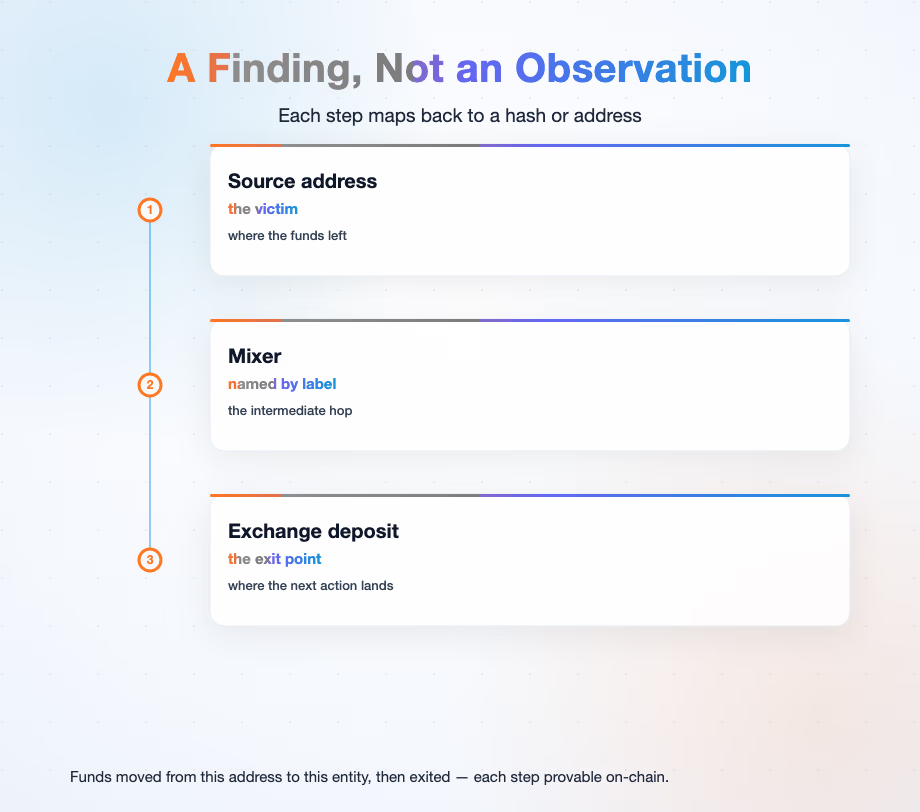
The forensic report is the case file assembled for a reader who has never touched the case, and the four records are its chapters. The fund flow path is shown as a graph rather than a wall of hashes, with entities named by label so the reader sees the exchange, the service, or the cluster behind each raw address. The timeline orders transactions by block height and timestamp so the movement reads as a story. The exit point, the exchange, mixer, or service where funds stopped being traceable on-chain, gets its own emphasis. It is usually the most actionable fact: it is where a follow-up request, a subpoena, or an exchange notification lands. Most investigations stall not at finding the path but at knowing where to direct the next action.
The report is written as the case is traced, not after it is over. Capture the addresses, the charts, and the queries as you run them; memory is the weakest link in a forensic writeup, and an undocumented step looks like an unsupported one under review. The bar for the finished document is the same as for the trail: a reader who has never touched the case should be able to retrace the same path and reach the same conclusion.
Common Evidence Failures and How They Sink Cases
Four failures recur. After-the-fact reconstruction: screenshots without timestamps, assembled days later, which cannot establish when anything was checked; the cure is capture-at-work, and the record habits above exist to make it routine. Single-source assertion: a conclusion resting on a single data provider's label with no cross-check, which fails the moment that label is questioned. The cure is checking material findings against a second source and recording both. Black-box conclusions: an output score with no visible basis, which reads as opinion. The cure is explainable signals, where the scoring shows which factors drove the rating, covered in Explainable Crypto AML Risk Scoring. Version drift: acting on data that was current at check time but silently stale by submission, without the record showing either; the cure is the currency field in every record.
Making It Repeatable
Per BlockSec, MetaSleuth supports the capture side of these records: saved charts and shareable analysis links preserve the path archive and its context as built, rather than as reconstructed. The report then points back to a live, inspectable graph instead of a static snapshot. The platform's adoption by more than one hundred law-enforcement and compliance teams as of 2026 is the relevant proof: the chart format survives the audience it is built for. For teams that report repeatedly, repeatability is the compounding return: the next report starts from a saved state instead of a fresh search. That is what makes the second investigation cheaper than the first, and the tenth cheaper still.
The verdict on evidence is plain: a court-ready trail is not a separate activity from the investigation, it is the investigation conducted with capture habits. Teams that build the four records as they work finish with a report. Teams that investigate first and document later finish with a story.
This piece is part of the MetaSleuth investigations and forensics guide, where the tracing method, evidence handling, and tooling tiers are covered end to end.