
Before a compliance team evaluates a single feature, pricing has already split the KYT market in two. For years the dominant model was the quote-based enterprise subscription: a sales conversation, a custom number, a multi-seat annual contract. That model still exists. But mid-market VASPs, DeFi protocol teams, and payment platforms now have a second option in pay-as-you-go credit pricing, where screening volume maps directly to spend. Choosing between the two is not preference. It is which cost structure matches the team's transaction volume and procurement timeline. This page is part of the KYT Resource Center.
How KYT Tools Are Priced
Transaction monitoring pricing falls into two models, and the difference is structural.
The first is the quote-based enterprise subscription. The vendor does not publish a price. A buyer requests a quote, the vendor scopes the deal on chains, seat count, API volume, and region, and returns a custom annual number. The contract locks the team into a fixed term with a fixed screening allowance. This is the legacy default for large incumbents. It is built around the procurement cycle of a regulated institution needing a master services agreement and a named account team.
The second is pay-as-you-go credit pricing (PAYG). The vendor sells screening credits that draw down as checks run, with no annual commitment and no quote step. The buyer funds a balance, screens against it, and tops up when low. Spend scales with actual volume. A team screening five hundred addresses one month and five thousand the next sees cost move with that volume rather than carrying a flat overhead.
The practical difference shows up in two places. Procurement: a quote-based contract can take weeks to close through legal review, while a PAYG balance funds in minutes. Unit economics: a subscription charges the same whether the team screens its full allowance or half of it, while PAYG charges only for what runs. For predictable, high volume, the subscription is usually cheaper per check; for lumpy or unknown volume, PAYG avoids paying for unused capacity.
Subscription Fatigue: Why Mid-Market VASPs Resist Enterprise Contracts
Subscription fatigue in the mid-market is a consistent pattern in buyer behavior. Pricing for transaction monitoring is negotiated privately, in procurement calls and direct channels rather than in public, and that opacity is itself part of the fatigue: teams cannot benchmark what they are paying. The fatigue is amplified by the regulatory backdrop. Under the FATF risk-based approach for virtual assets, a VASP must demonstrate ongoing transaction monitoring. That turns platform procurement into a compliance obligation rather than a discretionary spend line, and raises the stakes of a slow or opaque quote process. FinCEN's AML program rule (31 CFR 1022.210) and suspicious activity reporting rule (31 CFR 1022.320), taken together, are what makes monitoring non-optional for crypto exchanges and other US money services businesses.
The procurement data is the clearest anchor. Third-party spend records for legacy enterprise vendors show contracts clustering in a wide range, roughly $25,700 to $297,300 per year, with a median around $174,700. These records are surfaced through software procurement platforms such as Vendr. The range is wide because every deal is custom-scoped. But the floor alone is well above what a mid-market VASP or DeFi protocol team can justify for a single compliance line item. The median sits in six-figure territory, the budget profile of an institution with an existing compliance department, not a team building its first program.
The behavioral signal converges. Mid-market teams resist the quote step itself, not just the final number. A quote-based model front-loads cost in procurement time. That time covers scoping calls, legal review of a multi-year term, and negotiation over an allowance that may not match actual volume. For a team that needs to demonstrate compliance readiness quickly, that timeline is itself a blocker. The trigger is often a regulator, banking partner, or exchange listing committee waiting on proof. The fatigue is not only about price. It is the friction between a slow procurement model and a fast-moving compliance deadline.
The turn toward PAYG is the natural response. PAYG collapses the procurement step, lets the team screen against real volume immediately, and converts a fixed annual overhead into a variable cost. For mid-market buyers the appeal is not that PAYG is always cheaper. It is that PAYG matches the cadence of a team that does not yet know its steady-state volume. That team does not want a six-figure contract to find out.
Switch to PAYG: Pay Per Query
PAYG credit pricing is the structural alternative to the quote-based subscription, and Phalcon Compliance uses it as the entry point to its tier structure. The platform exposes five tiers, each aimed at a distinct buyer profile. The PAYG tier lets a team pay per query without a monthly commitment.
| Tier | Pricing shape | What it is built for |
|---|---|---|
| Free | 3 screenings per month, all supported chains | Hands-on evaluation of risk scoring before any spend |
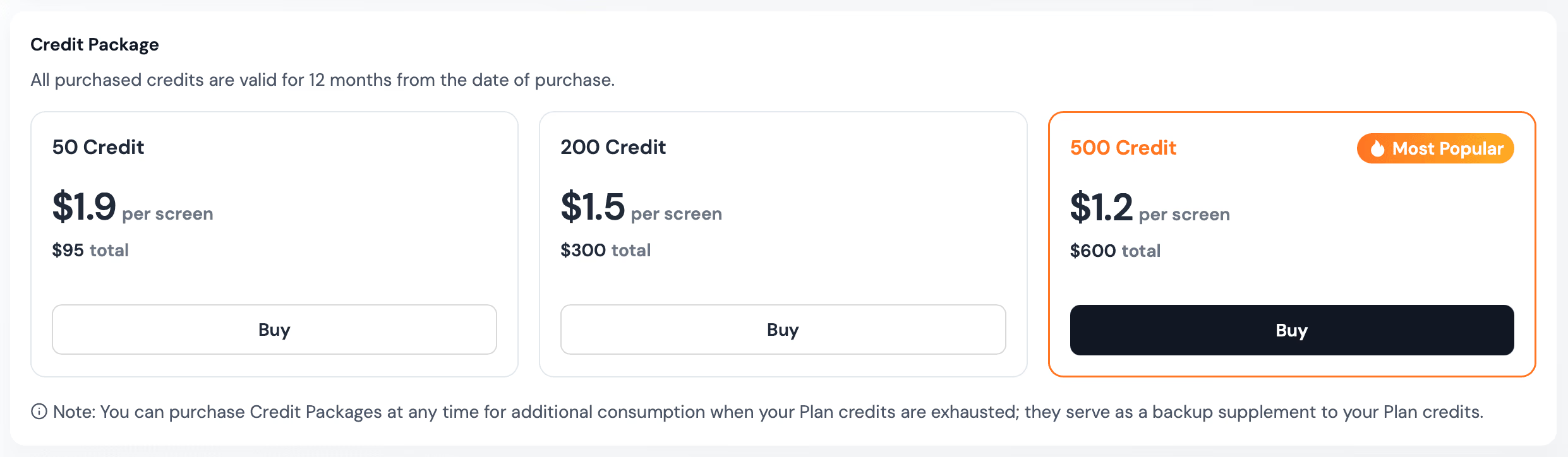
| Screening Packages (PAYG) | Starts at $95, unit price $1.10 to $1.90 per screening | Variable screening volume without a monthly commitment |
| Essential | Starts at $39 per month | Small compliance teams running regular interactive screening |
| Scale | Starts at $699 per month | API integration teams that embed screening in product flows |
| Enterprise | Contact sales | Large operators needing multi-seat collaboration and custom scope |
The Screening Packages tier is the PAYG wedge. A team funds a balance, draws it down as checks run, and tops up when low. The unit price lands between $1.10 and $1.90 per screening depending on package size, so the cost curve is linear rather than opaque. Compared with a quote-based subscription, PAYG charges for actual screening volume. The subscription charges a flat fee for an allowance that may not be fully consumed.
The tiers above PAYG fit teams whose volume has stabilized. Essential, starting at $39 per month, fits a small compliance function running regular interactive screening through the platform interface. Scale, starting at $699 per month, is the API entry point. Teams embedding screening inside a deposit flow, withdrawal gate, or onboarding pipeline move here, because API access is gated to Scale and Enterprise. Enterprise, priced through sales contact, fits large operators needing multi-seat collaboration, custom scope, and a master services agreement. The progression lets a team start at the tier matching its current size and climb as volume and integration depth grow.
Try Before You Procure
The pricing model is only half the procurement story. The other half is how a team evaluates the tool before paying anything, and this is where self-serve evaluation changes the path.
A quote-based subscription typically gates evaluation behind a demo. A buyer fills out a form, a sales rep schedules a call, and the call scopes the deal. Only then does the buyer reach a sandbox. That sequence forces a team to commit procurement time before it can answer a basic question. The question is whether the risk scoring actually matches the addresses this team cares about.
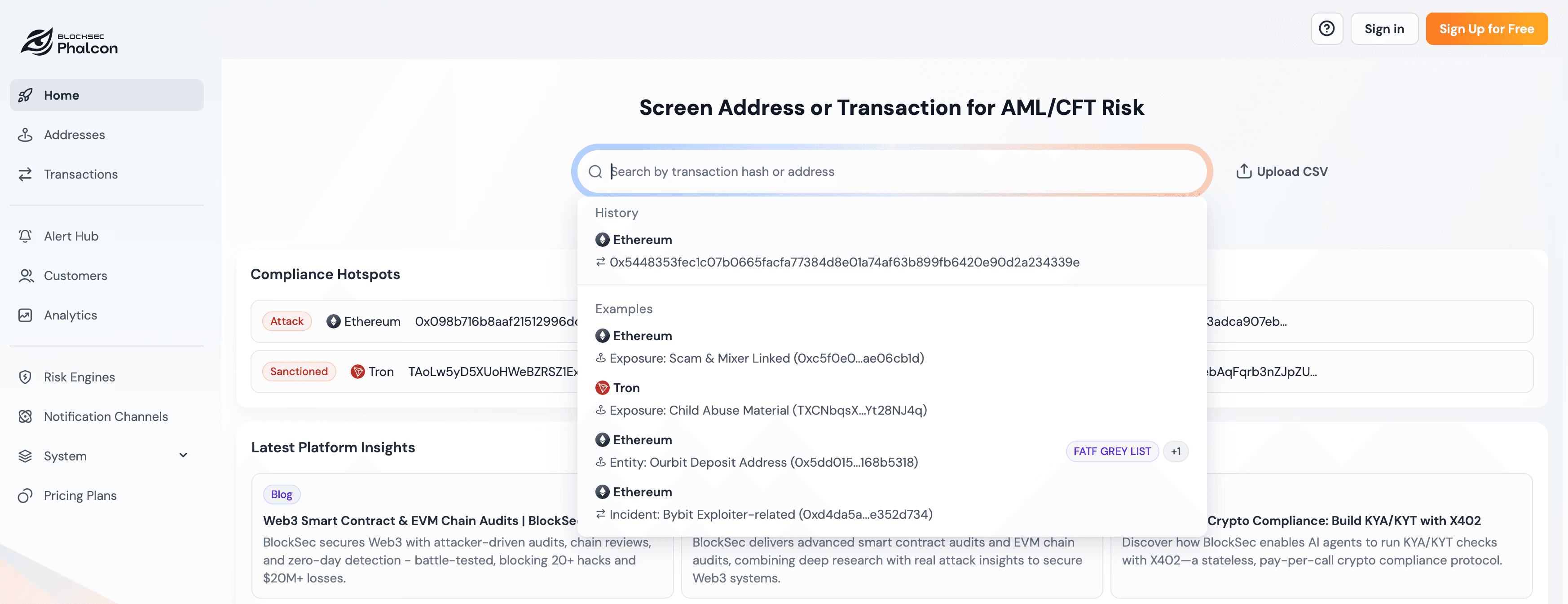
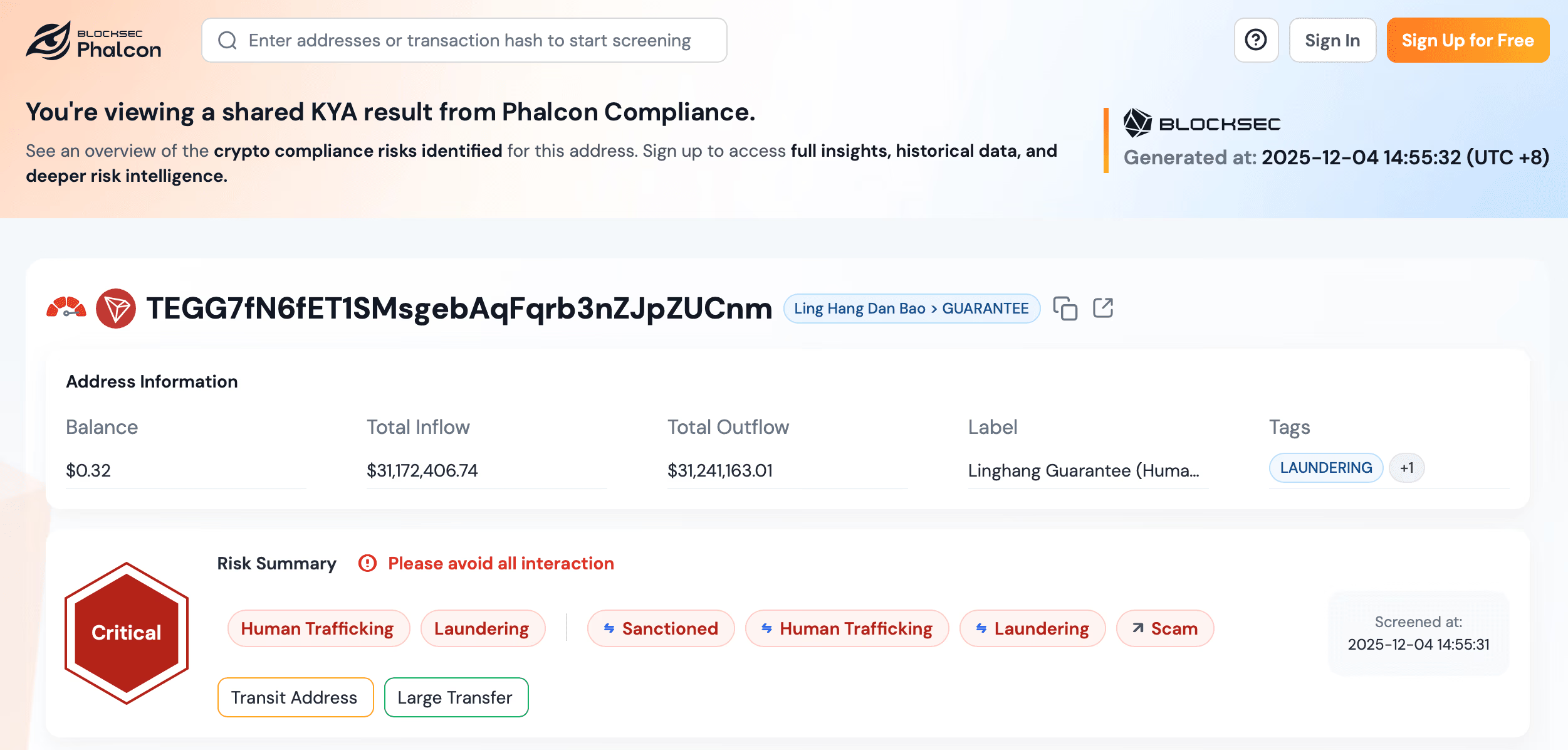
Self-serve evaluation inverts the sequence. The Phalcon Compliance platform accepts an address or transaction hash, runs the screening, and returns the risk score and exposure breakdown. A compliance officer can paste an address tied to a recent incident and read the risk indicators. The officer can judge whether the scoring depth matches the team's threat model before any sales conversation. The Free tier extends the same logic: three screenings per month on all supported chains, no credit card.
The implication for pricing decisions is direct. A team that can evaluate the tool before procuring it makes a better tier choice. It knows whether the risk scoring justifies the Essential fee, and whether volume fits PAYG or warrants the Scale API tier. It also knows whether coverage matches its chain footprint. Self-serve evaluation is the layer underneath the pricing decision. It removes the information asymmetry that quote-based models rely on. That asymmetry pushes buyers into annual commitments before they see the product on their own addresses.
Which Plan Fits Which Team
The five-tier structure maps onto five buyer profiles, and picking the right tier is a function of screening volume, integration depth, and team size.
Free fits the earliest evaluation stage. A compliance officer or protocol founder validating risk scoring against known addresses can run three checks per month on any supported chain at no cost. The same applies to a small team screening a handful of counterparties per month. This tier answers whether the risk model fits before any spend.
Screening Packages (PAYG) fits a team with variable or unknown volume. The fit covers a VASP screening a few hundred addresses in a normal month and a few thousand during an incident. It also covers a DeFi protocol running periodic reviews, or a payment platform whose load tracks transaction spikes. PAYG lets spend move with volume, and the $95 entry with a $1.10 to $1.90 unit price keeps the cost curve linear.
Essential, starting at $39 per month, fits a small compliance team that has moved past ad hoc screening. It runs regular interactive checks through the platform interface. The value is a stable monthly fee in exchange for a higher allowance than PAYG at the same spend. That trade works when volume is consistent enough to justify the commitment.
Scale, starting at $699 per month, is the API tier. A team embedding screening inside a product flow, whether a deposit gate, an onboarding check, or a real-time monitor, moves here. API access is gated to Scale and Enterprise, and the $699 entry reflects the shift from interactive to integrated screening. Webhook access also lands here. Custom Risk Engine configuration is available from the Screening Packages tier upward, with the quota rising from 3 engines on Screening Packages and 10 on Essential to 20 on Scale.
Enterprise fits large operators. The fit covers a regulated exchange with multiple compliance seats. It also covers a multi-jurisdiction operator needing a master services agreement, or a team whose volume and chain coverage exceed the standard tiers. Enterprise is priced through sales contact because scope is custom, and multi-seat collaboration is an Enterprise feature.
The decision path is sequential. Start at Free or PAYG to validate risk scoring and size volume. Move to Essential when interactive screening becomes routine, and to Scale when screening needs to live inside a product flow. Reach Enterprise for multi-seat collaboration, custom scope, or an enterprise contract.
Cost Optimization Tips
Once a tier is chosen, four levers control actual spend against the screening program.
Monitor mode does not consume Screening quota. Monitor runs on a dynamic schedule and re-analyzes already-screened addresses when their risk changes. It works alongside the screening balance without drawing it down. A team wanting continuous coverage on a set of counterparties can leave Monitor on without budgeting it as per-check spend. The balance then funds only the checks the team actively triggers.
Annual billing saves up to 30 percent. Teams past PAYG in Essential, Scale, or Enterprise can choose annual billing over monthly. The saving reaches 30 percent at the highest Scale tier and runs roughly 15 to 17 percent on entry tiers. The trade is the same as any annual commitment: lower unit cost for longer lock-in. For a team whose program is stable and volume predictable, the annual discount is a direct saving.
Referral rewards cap at 20 percent, up to $10,000. The platform returns up to 20 percent of referral-linked spend, capped at $10,000. This is not an uncapped rebate. A team whose referral volume would notionally earn more still receives $10,000, so the marginal value of additional referrals drops to zero past the cap. Treat it as a bounded offset to spend, not an open-ended discount.
Top-up sequencing preserves subscription quota. Screenings draw down in a defined order. Subscription quota resets each cycle, then Top-up Screenings, then Referral Rewards, then Screening Packages. A team that understands this order can time top-ups to preserve subscription quota for the highest-value checks. It can then use Screening Package credits for bulk or backlog work. The order is automatic, but the budget owner controls when to fund each balance. That timing is the difference between a quota that lasts the cycle and one that runs out early.
Together these four levers let a team tune KYT tool spend without changing tiers. Monitor extends coverage without spending quota. Annual billing lowers the effective rate. Referral rewards return a bounded portion of spend, and top-up sequencing preserves the highest-value balance for the highest-value checks.