
No operational question divides crypto compliance teams more than whether alerts can be auto-closed. The short answer is that automated disposition is not categorically prohibited. Whether a specific auto-close practice is defensible depends on the conditions attached to it. Those conditions are explainable scoring, a tamper-evident audit trail, a conservative risk threshold, and a human reviewer reachable when the pattern matters. This page maps the public debate, what regulators expect, and the conditions that separate a defensible automated disposition from a program gap. This page is part of the KYT Resource Center.
Disclaimer: This article explores the auto-close compliance debate and defensibility best practices. It is not legal advice. Automated disposition rules and their acceptability vary by jurisdiction, by the underlying obligation, and by the specific facts of a program. Consult qualified compliance and legal counsel before adopting or retiring any auto-close policy.
Why Compliance Teams Debate Auto-Close
The question of whether auto closures are legally defensible surfaces repeatedly in practitioner discussions. It is most often framed as "Auto closures of AML false positive alerts: is it legally [defensible]?" The framing reveals what the debate is about. Practitioners are not asking whether software can dismiss an alert. They are asking whether a dismissal performed by a rule, without a person looking at the alert, can survive later scrutiny. That scrutiny comes from an examiner, an auditor, or an enforcement action.
The pressure behind the question is operational. Crypto compliance teams generate large alert volumes from transaction monitoring and screening, and a substantial share are false positives. Manually reviewing every alert is the safest path for defensibility but also the most expensive. Across large alert volumes it produces review fatigue, slow cycle times, and reviewer inconsistency. Auto-closing clearly low-risk alerts concentrates human attention on the alerts that warrant judgment. The appeal is real, and so is the risk.
What makes the debate hard to resolve is that auto-close is not one practice. Closing an alert that fired on a known-good internal wallet, with a documented rule and a logged rationale, is one act. Closing an alert on a high-risk jurisdiction exposure using an opaque score nobody can reproduce is a different act. The first is routine and justifiable. The second is a program weakness dressed up as automation.
What Regulators Expect on Automated Disposition
Regulators do not generally publish a bright-line rule that bans automated disposition, and they do not generally endorse it either. What they expect is that a financial institution, including a virtual asset service provider, can identify, assess, and document the decisions it makes about alerts. That expectation holds whether a human made the decision or a rule did.
The FATF risk-based approach for virtual asset service providers anchors this expectation. The risk-based approach obliges a VASP to identify and assess its money laundering and terrorist financing risks. It must then calibrate controls to those risks, including ongoing monitoring of transactions. The obligation is to monitor on a continuing basis and to show how risks were identified and how the institution responded. An automated disposition rule sits inside that obligation. The rule has to be traceable to a risk assessment, calibrated to a defined threshold, and supported by records. Those records show what was closed and why.
FinCEN frames a related expectation through its AML program rule for money services businesses (31 CFR 1022.210). The duty FinCEN sets out is ongoing monitoring rather than a fixed real-time threshold. But ongoing monitoring implies that the institution maintains an auditable record of what it monitored and what it did with the results. An auto-close rule that produces no auditable record is in tension with that duty.
The common thread is that disposition, automated or manual, has to be identifiable and reviewable. Automation is acceptable where the institution can show the rule, the threshold, the inputs, and the resulting action, and reproduce that record on demand. The auditability of the decision is the defense.
When Auto-Close Can Be Defensible
Auto-close is defensible when it operates inside conditions that make the decision reviewable, reproducible, and conservative. Three conditions do most of the work.
The first is explainable scoring. An auto-closed alert has to rest on a risk assessment the institution can explain, not on an opaque score from a black box. If an examiner asks why an alert was closed, the answer has to point to the indicators that drove the score. It must also point to the threshold rule that authorized the close, and the data available at the time. An explainable score is what makes an automated disposition auditable rather than merely fast.
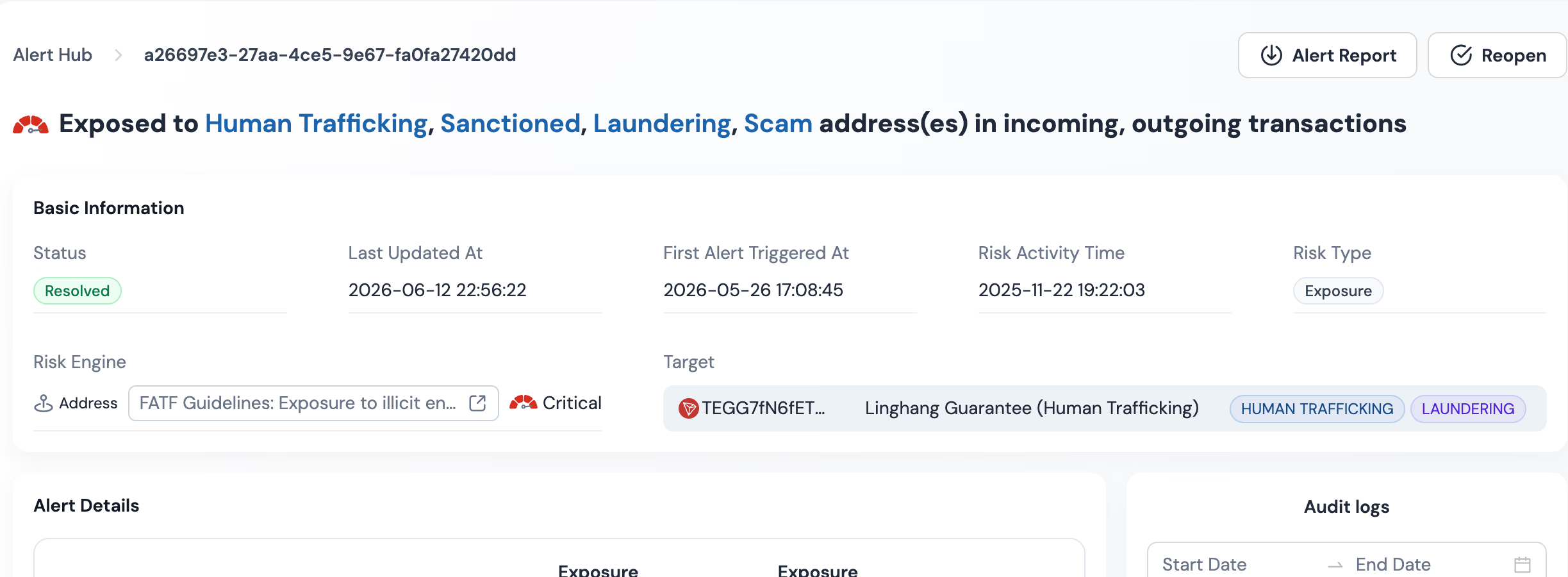
The second is a tamper-evident audit trail. Every auto-close event has to be logged with enough detail to reconstruct the decision later. That log includes the alert, the score and its risk indicators at the moment of disposition, and the rule that authorized the close. It also includes a timestamp and a link back to the underlying screening event. The audit trail turns an auto-close from an invisible deletion into a documented decision. Without it, the absence of record is itself a finding.
The third is a conservative risk threshold. Auto-close is defensible when confined to a narrow, low-risk band where the cost of a wrong dismissal is low. Closing alerts on addresses with negligible exposure, on internal wallets already cleared, or on patterns confirmed benign many times is a narrow proposition. Auto-closing anything tagged medium risk is a different proposition. The threshold has to be set deliberately, documented, and revisited as the risk profile changes.
When Auto-Close Is Risky
Auto-close becomes risky, and hard to defend, when any of those three conditions are missing. The riskiest pattern is black-box scoring with no explainable layer. If the institution cannot say which indicators drove a score, it cannot defend the close, and it cannot improve the rule when it goes wrong. A black box that auto-closes alerts is a program gap an examiner will identify quickly.
The second risky pattern is no audit trail. An auto-close that produces no record is functionally indistinguishable from the alert never having fired. If a transaction later turns out to be connected to illicit activity, the institution has no evidence that it reviewed the alert. It has no evidence that it made a documented decision either. The absence of a record is read as the absence of a control.
The third risky pattern is automated disposition on high-risk alerts. Auto-closing anything above a clearly low-risk band shifts the institution's risk posture without acknowledging the shift. High-risk alerts are precisely where a wrong dismissal carries the most downstream cost, and where an examiner will look hardest at the disposition rationale.
A fourth pattern, related but distinct, is auto-close without a human path back into the workflow. Even a well-calibrated rule will eventually encounter an edge case or a novel pattern. A program that auto-closes alerts and never routes any to a human reviewer has no feedback loop. The rule never improves, the thresholds never adjust, and the institution has no signal that the automation is still calibrated.
Human-in-the-Loop Best Practices and Defensibility
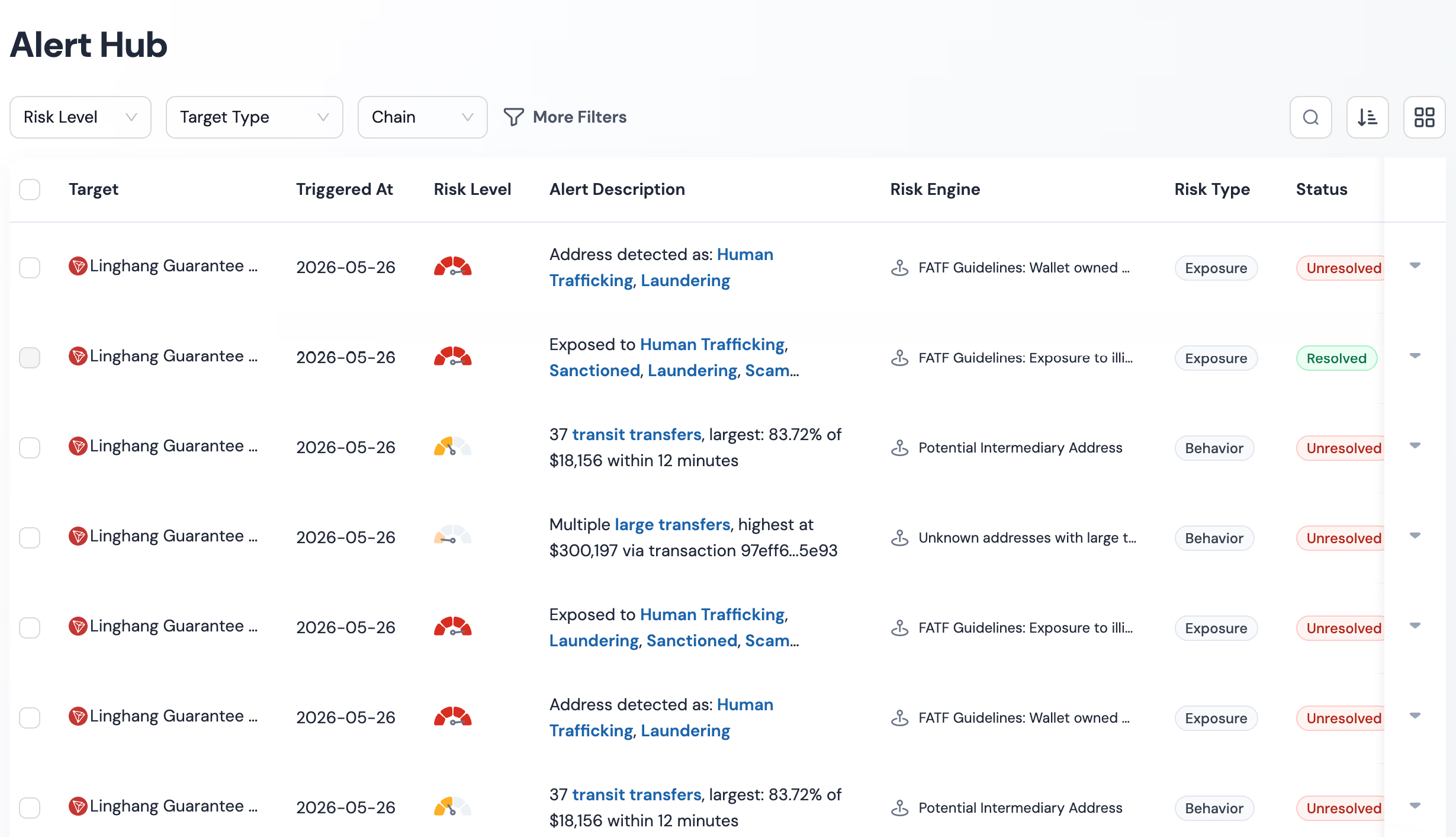
A defensible auto-close practice is not a hands-off practice. It is a practice where the automated layer handles clearly low-risk volume and a human reviewer handles the judgments. A clear handoff sits between the two. Phalcon Compliance supports this structure through a glass-box risk engine and a tamper-evident audit trail that make every disposition explainable and reviewable.
It surfaces 17 Risk Indicator categories behind each address risk score rather than returning a single opaque number. When an alert is auto-closed inside a conservative threshold, the institution can show which indicators were present and which were absent. It can also show how the score was composed. That detail turns a close from a system decision into a documented decision. It is what an examiner asks for when reviewing a sample of dispositions.
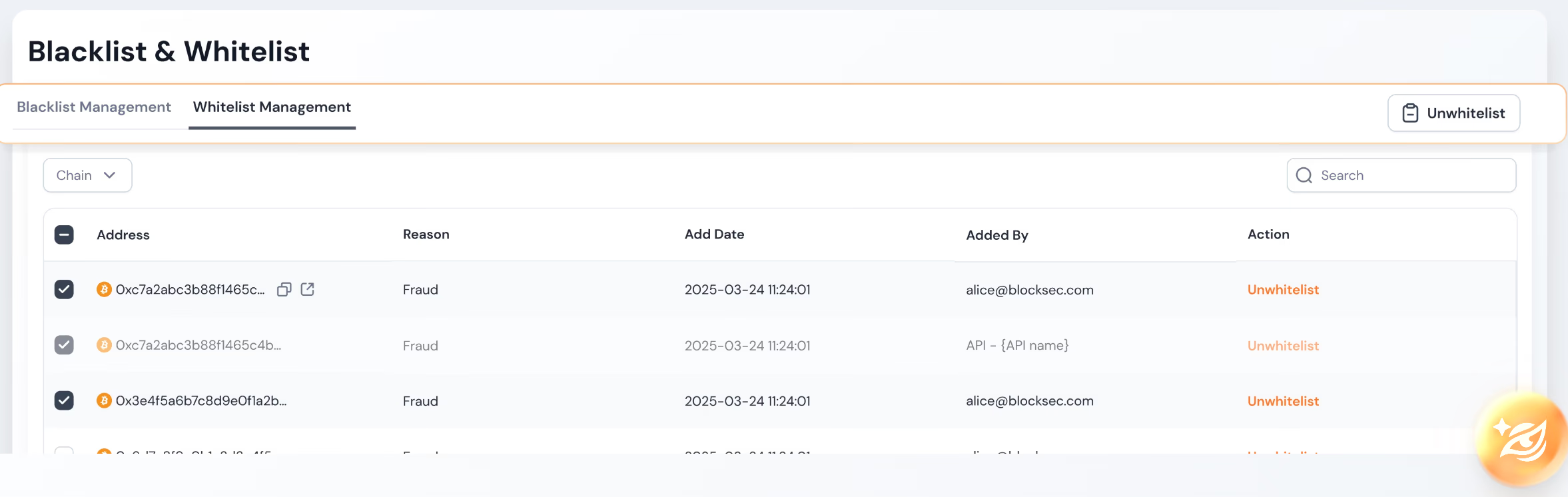
The audit trail in the platform records the screening event, the risk score and its indicators at the moment of disposition. It also records the rule that authorized the action and the resulting state. The Audit Trails and Logs are reproducible. A disposition from weeks or months earlier can be reconstructed, which is the property that makes automated disposition justifiable over time. The same record supports the human-in-the-loop layer, because a reviewer examining closed alerts can see what the rule saw when it closed them.
The practical pattern is tiered disposition. Low-risk alerts, defined by a conservative threshold and a clean indicator profile, are auto-closed with full logging. Medium-risk alerts are routed to a human reviewer with the score, the indicators, and the exposure context attached. High-risk alerts are held for manual review and escalated where appropriate. Phalcon Compliance supports this tiering because the glass-box indicators and the audit trail work the same way across all three bands. The institution therefore operates one disposition discipline. For the full workflow, see Phalcon Compliance KYT Compliance.
Documenting Your Disposition Policy
A defensible auto-close practice has to be written down before it is operated, not reconstructed after an examiner asks. The disposition policy ties the risk assessment, the thresholds, the rules, and the audit trail together. That is what makes the program legible to an outside reviewer.
A workable policy covers at least five elements. First, the risk bands and the action attached to each, including which is eligible for auto-close. Second, the indicators and exposure context that define each band, so thresholds are traceable to specific risk signals. Third, the audit trail requirements, including what is logged for every disposition and retention periods. Fourth, the human review path, including how sampled auto-closed alerts are selected for second-line review and how the rule is recalibrated. Fifth, the change-control process, so any adjustment to a threshold or rule is documented and dated.
The policy is also where the institution records the boundary between justifiable and risky automation. It should state explicitly that high-risk alerts are never auto-closed and that black-box scores are not used for disposition. It should also state that any change to the auto-close band requires sign-off. That stance is what separates a program that uses automation deliberately from one that drifts into it.
The objective is not to avoid automation. Manual review of every alert is not feasible in production. A program that refuses to automate low-risk disposition will spend its reviewer capacity on the wrong alerts. The objective is to automate inside conditions that make the automation defensible. Those conditions are explainable scoring, a tamper-evident audit trail, a conservative threshold, and a documented policy tied to the institution's risk assessment. Done that way, auto-close is a defensible practice. Done without those conditions, it is a finding waiting to be written.