Back to Blog

Phalcon Supports Mantle Network: Pioneering Unbreakable Ecosystem Security

Phalcon
July 31, 2024

We are pleased to announce that our attack monitoring and blocking platform, Phalcon, now supports Mantle Network, ensuring hack-free security for the Mantle Ecosystem at the post-launch stage.

Phalcon: Elevate Mantle Ecosystem Security to New Heights

Code audits significantly enhance the security of a protocol. However, once a DeFi protocol is live, it faces numerous risks, including external dependencies, zero-day attacks, and unaudited smart contract upgrades. Recognizing these risks, an increasing number of blockchains understand that code audits alone are insufficient. Consequently, they are adopting proactive defense measures to secure their ecosystems at the post-launch stage.

Currently, most post-launch security solutions rely on attack monitoring platforms. However, upon detecting an attack, protocol teams often need to engage in multi-party discussions and manually authorize responses, which often proves to be too late.

Our attack monitoring and blocking platform, Phalcon, now supports Mantle, offering robust security for the entire Mantle Ecosystem. Phalcon is the world’s first and only platform that not only monitors attacks but also automatically blocks them. This capability has been battle-tested, with a proven record of blocking over 20 hacks and rescuing over $20 million worth of assets.
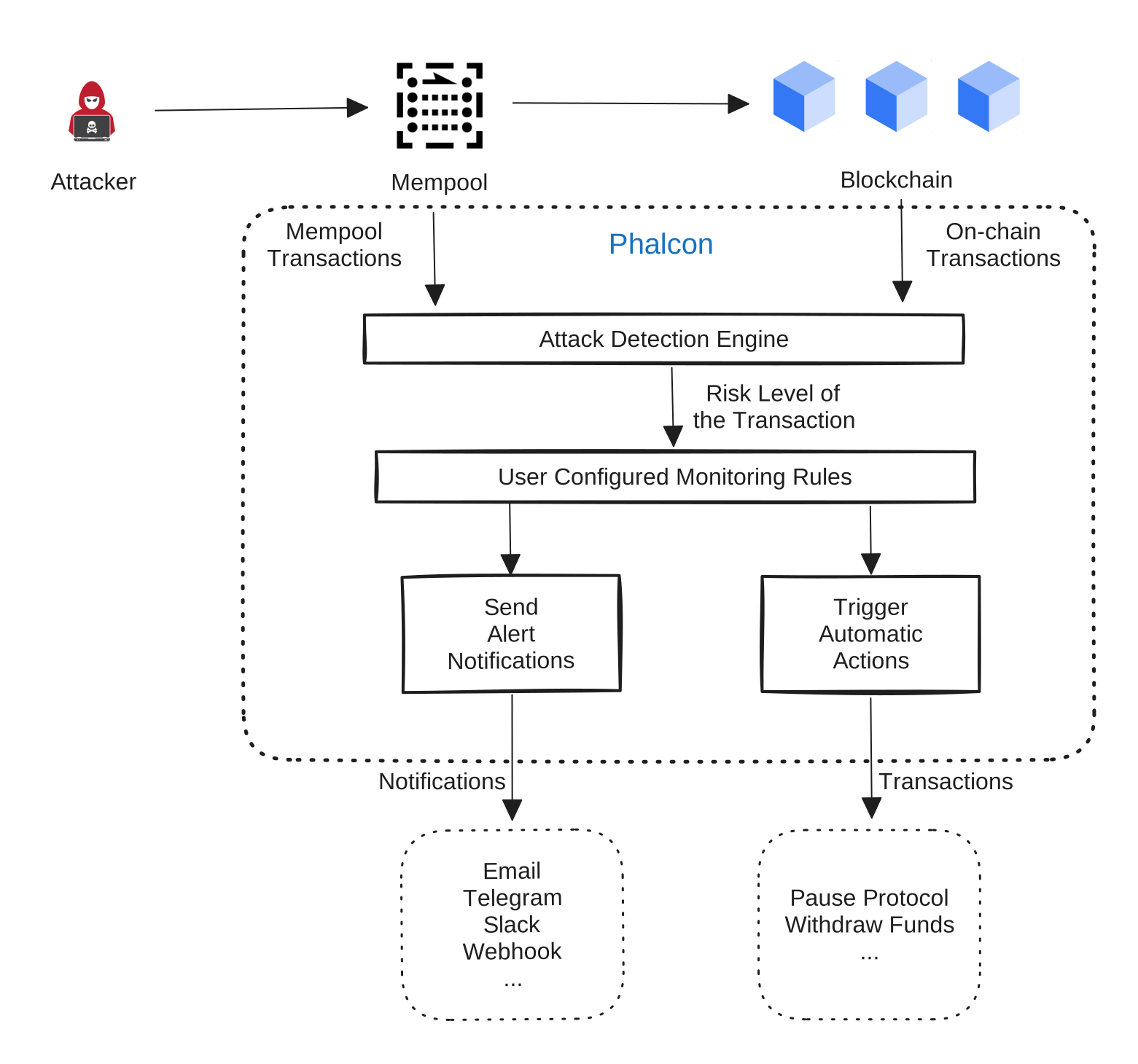
Phalcon's Architecture

How Phalcon Empowers Mantle Ecosystem

  • For the Ecosystem: Mantle can deploy monitoring for protocols on Mantle Network, allowing it to immediately detect any suspicious activity and inform protocol teams to take in response.

  • For Protocols: Protocols on Mantle can use Phalcon to monitor for attacks and automatically pause the protocol if an attack is detected. Additionally, protocol operators can leverage Phalcon to monitor sensitive operations such as changes to admin keys, role grants, key variables, and more.

  • For LPs: Liquidity providers can use Phalcon to receive notifications if their investment protocols are hacked. At the same time, the system will automatically withdraw funds to minimize potential losses.

Phalcon is a SaaS platform that allows users to check prices and subscribe directly after logging in. We also invite you to book a demo with our security experts to learn more about how Phalcon can protect your protocols or assets.

Phalcon's Inbuilt Tool for Superior Security and Usability

To make it easier for project teams to understand what happened with each triggered transaction, we have integrated Phalcon Explorer into Phalcon, which allows users to seamlessly switch to Phalcon Explorer to view the invocation flow, balance changes, fund flow, and other details of the transactions.

Click the triggering tx:
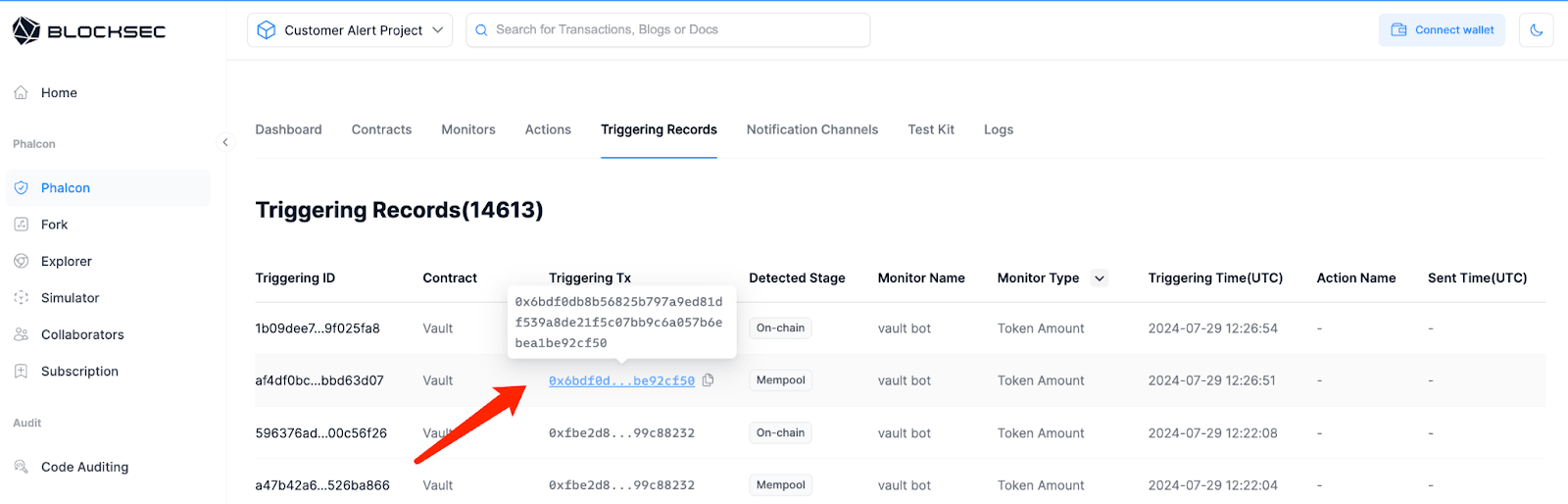
Phalcon's Triggering Records dashboard

Then jump into the tx page on Phalcon Explorer:
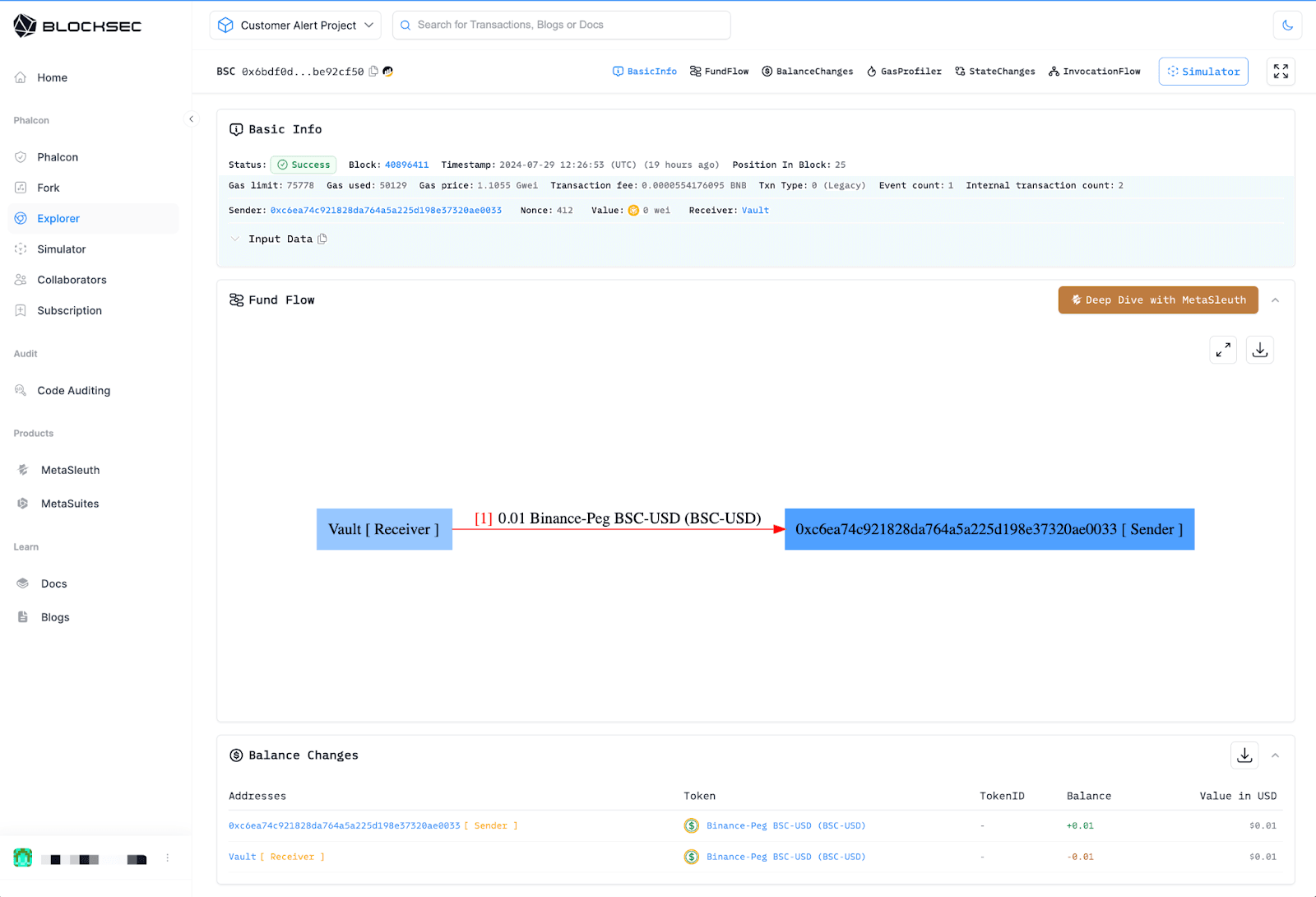
Phalcon Explorer: Phalcon's inbuilt transaction visualization tool

Conclusion

Phalcon's mission is to deliver unmatched ecosystem security through our state-of-the-art attack monitoring and blocking platform. By supporting Mantle Network, we offer unparalleled protection to its ecosystem participants, effectively safeguarding them from potential threats. Our battle-tested solutions have successfully prevented numerous real-world hacks, underscoring our effectiveness. Looking ahead, this partnership is poised to continue innovating and setting new benchmarks in blockchain security.
Sign up for the latest updates
Newsletter - April 2026
Security Insights

Newsletter - April 2026

In April 2026, the DeFi ecosystem experienced three major security incidents. KelpDAO lost ~$290M due to an insecure 1-of-1 DVN bridge configuration exploited via RPC infrastructure compromise, Drift Protocol suffered ~$285M from a multisig governance takeover leveraging Solana's durable nonce mechanism, and Rhea Finance incurred ~$18.4M following a business logic flaw in its margin-trading module that allowed circular swap path manipulatio

~$7.04M Lost: GiddyDefi, Volo Vault & More | BlockSec Weekly
Security Insights

~$7.04M Lost: GiddyDefi, Volo Vault & More | BlockSec Weekly

This BlockSec weekly security report covers eight attack incidents detected between April 20 and April 26, 2026, across Ethereum, Avalanche, Sui, Base, HyperLiquid, and MegaETH, with total estimated losses of approximately $7.04M. The highlighted incident is the $1.3M GiddyDefi exploit, where the attacker did not break any cryptography or use a flash loan but simply replayed an existing on-chain EIP-712 signature with the unsigned `aggregator` and `fromToken` fields swapped out for a malicious contract, demonstrating how partial signature coverage turns any historical signature into a generic permit. Other incidents include a $3.5M Volo Vault operator key compromise on Sui, a $1.5M Purrlend privileged-role takeover, a $413K SingularityFinance oracle misconfiguration, a $142.7K Scallop cross-pool index injection, a $72.35K Kipseli Router decimal mismatch, a $50.7K REVLoans (Juicebox) accounting pollution, and a $64K Custom Rebalancer arbitrary-call exploit.

Weekly Web3 Security Incident Roundup | Apr 13 – Apr 19, 2026
Security Insights

Weekly Web3 Security Incident Roundup | Apr 13 – Apr 19, 2026

This BlockSec weekly security report covers four attack incidents detected between April 13 and April 19, 2026, across multiple chains such as Ethereum, Unichain, Arbitrum, and NEAR, with total estimated losses of approximately $310M. The highlighted incident is the $290M KelpDAO rsETH bridge exploit, where an attacker poisoned the RPC infrastructure of the sole LayerZero DVN to fabricate a cross-chain message, triggering a cascading WETH freeze across five chains and an Arbitrum Security Council forced state transition that raises questions about the actual trust boundaries of decentralized systems. Other incidents include a $242K MMR proof forgery on Hyperbridge, a $1.5M signed integer abuse on Dango, and an $18.4M circular swap path exploit on Rhea Finance's Burrowland protocol.