A compliance analyst pastes a deposit address into a manual research tool. The analyst opens a block explorer, cross-references a sanctions list, scrolls through transaction history, and documents the findings. The screen returns a verdict minutes to hours later, depending on chain complexity and fund flow depth—even for one address on one chain. Now consider a centralized exchange processing thousands of deposits per hour during a market rally. Manual turnaround at that cadence is not viable, yet "how long does AML address screening take" is a question every compliance officer must answer before go-live.
The answer has two layers. Manual screening runs from minutes to hours. Automated screening against a prebuilt label library returns a risk verdict in the milliseconds range Phalcon Compliance Docs, Risk Levels. The rest of this article unpacks what drives that gap, what happens inside an automated screen, and which edge cases can slow a system.
Manual Screening vs. Automated API Screening: A Time Comparison
Two screening modes sit at opposite ends of the latency spectrum, and the choice between them determines whether a platform can screen at deposit-and-withdrawal speed or only at batch-review speed.
| Dimension | Manual Screening | Automated API Screening |
|---|---|---|
| Typical turnaround | Minutes to hours per address | Milliseconds per address Phalcon Compliance Docs, Risk Levels |
| Throughput ceiling | Single analyst, serial work | High concurrency, parallel calls |
| Data freshness | Limited by analyst's update cadence | Prebuilt label library, periodically refreshed |
| Failure mode | Fatigue, missed chains, inconsistent documentation | Deterministic, logged, auditable |
| Fit | Low-volume investigations, edge-case review | Real-time deposit, withdrawal, and transaction screening |
Manual screening has its place. Forensic work on a fraud ring, litigation support, and second-line review of a flagged address all benefit from human judgment. The problem is latency. Every minute spent on a manual lookup is a minute the customer waits, and in crypto, customers wait poorly. Withdrawal requests that stall get escalated to support, then to social media, then to churn.
Automated screening compresses the same job into an API call. The address goes in, the risk verdict comes back, and the downstream decision (approve, quarantine, or escalate) executes without an analyst in the loop. The latency difference is the difference between a compliance function that scales with trading volume and one that becomes the bottleneck.
Inside the Millisecond: What an Address Screen Actually Does
The screen runs the four-step mechanism, address input, label matching, indicator hit, and scoring, detailed in our Crypto Address Risk Screening guide. What matters here is why the whole sequence fits inside a single API call's latency budget, landing in the milliseconds range Phalcon Compliance Docs, Risk Levels.
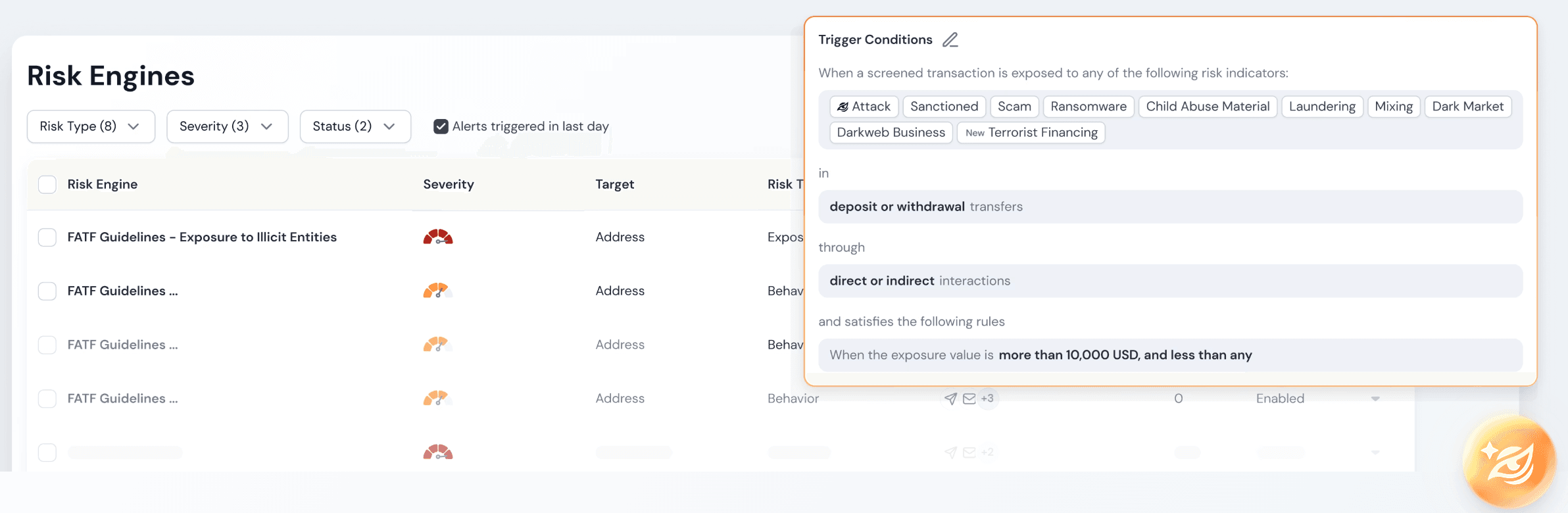
Two design choices make that speed structural rather than optional. First, the label library is prebuilt and indexed ahead of time, so the API runs a lookup, not a live trace against the chain. It does not wait on real-time indexing.
Second, the scoring is deterministic. The same address, with the same exposure, returns the same verdict on every call. No probabilistic model retrains, and no human re-checks.
Those two properties let a platform screen every deposit without adding perceptible latency. Speed becomes a property of the architecture, not a tuning knob, which is what "how long does AML address screening take" measures in an automated context. For how this fits into a broader wallet screening workflow, see Crypto Wallet Screening.
Where Address Screening Slows Down: Edge Cases and Fixes
Edge cases exist, and a competent answer to "how long does AML address screening take" has to account for them rather than promise a flat milliseconds figure under every condition.
The first edge case is a brand-new address with no on-chain history. A fresh address has no transaction record to score against, so the verdict leans entirely on direct label matches. Screening is fast, but the risk picture is thin. Most systems return a neutral score and re-screen once the address begins transacting.
The second edge case is concurrency. During peak load, say a viral token launch or a market drawdown, simultaneous screening calls can spike by orders of magnitude. If the screening backend scales horizontally and the label library is cached, latency stays flat. If it does not, a request queue builds, and a screen that normally returns in milliseconds can take longer. The fix is architectural, not analytical: the label library has to be prebuilt and indexed so that higher call volume raises throughput, not per-call latency.
The third edge case is network and integration overhead. The screening API itself may be fast, but if the calling system adds retries or synchronous steps in front of the call, the end-to-end latency the user feels is longer than the API time alone. The FATF Recommendations set the obligation to screen, but how a platform implements the call determines the latency the customer experiences.
None of these edge cases break the core promise of automated screening. They do mean that the "milliseconds" figure is a property of a well-architected integration, not a number that holds automatically under any deployment.
Choosing a Screening Mode That Matches Your Transaction Speed
The practical takeaway is that screening time is a design decision, not a fixed constant. A platform that screens manually will measure turnaround in minutes and will cap its throughput accordingly. A platform that screens via a prebuilt, indexed label library will measure turnaround in milliseconds and will scale with volume.
Three questions help a compliance team pick the right mode. What is our peak deposit and withdrawal rate? What latency can our user experience tolerate before support tickets spike? How many chains do we need to cover? If the answers point to high volume, tight latency, and multi-chain coverage, automated screening is not optional. If they point to low-volume investigative work, manual screening may be sufficient.
Regulators have made the speed question explicit. The FinCEN statutes and regulations page lays out AML program expectations for money services businesses, including virtual asset service providers. Those expectations assume screening happens at the speed of the transaction, not at the speed of a nightly batch. A screening process that cannot keep up with deposit flow is, in practice, missing transactions.
For how the wider AML compliance stack fits together beyond a single screen, the AML Compliance for Crypto guide covers the full picture. When the workflow is ready for an operational platform, Phalcon Compliance provides the KYA and KYT engine that runs the screens described above.
→ Book a Phalcon Compliance demo and run millisecond address screening on your deposit flow: Book a demo
FAQ
What latency should a compliance team expect from automated screening? For a well-integrated automated screen against a prebuilt label library, expect a response in the milliseconds range Phalcon Compliance Docs, Risk Levels. The figure the end user feels includes network and integration overhead on top of the API call time.
Why does manual screening take so much longer? Manual screening requires a human to open explorers, cross-reference lists, read transaction history, and document findings. Each step is serial and cognitive. Manual turnaround runs minutes to hours depending on chain complexity and fund flow depth, and that figure grows with the number of chains checked.
Can high transaction volume during market spikes slow screening down? It can, if the screening backend does not scale horizontally or if the label library is not cached. With a prebuilt, indexed library and horizontal scaling, higher call volume raises throughput rather than per-call latency.