A wallet deposits 50 ETH into a lending pool at 14:22 UTC. The wallet has no name, no KYC file, no registered owner. Yet within milliseconds the protocol knows it has moved funds through a sanctioned mixer in the past 30 days, holds proceeds from a phishing drainer, and is linked to a hacks-attributed cluster. The transaction is queued for review before the block finalizes. That is KYA at work in DeFi, without ever asking the user who they are.
DeFi protocols face a structural problem traditional finance never had. Their users are blockchain addresses, not verified identities. KYC, the onboarding process that verifies customer identity through documents, does not apply at the smart-contract layer. There is no human in the loop to present a passport. But the address itself leaves a permanent, public trail of every transaction it has touched. KYA (Know Your Address) reads that trail and turns it into a risk decision. This article walks through how KYA works for DeFi and the regulatory backdrop that makes address screening unavoidable in 2026.
The DeFi AML Challenge: No User Identity, But On-Chain Addresses Exist
Regulators stopped treating DeFi as an unregulated corner of finance some time ago. The FATF's virtual asset guidance extends AML obligations to virtual asset service providers. A growing number of jurisdictions now read DeFi front-ends, lending pools with admin keys, and DEXs with off-chain screening logic into that perimeter. Stablecoins now account for the majority of illicit crypto transaction volume, which means the same rails DeFi depends on for liquidity carry the bulk of laundered proceeds.
The hard part for a DeFi team is that they cannot run the standard compliance playbook. A CEX can hold deposits until the customer uploads an ID, sanctions-screens the name, and signs an attestation. A DeFi protocol cannot. The user interacts directly with a smart contract, and the contract executes deterministically. There is no compliance officer at the door. What the protocol does have is a richer signal than any CEX ever sees: the full on-chain history of the address in front of it. Every deposit, every swap, every hop through a bridge is recorded on a public ledger. KYA is the layer that converts that public history into a go-or-no-go decision at protocol entry and exit points.
This is where DeFi AML compliance diverges from the CEX model. The compliance unit of analysis is not a person, it is an address. The control point is not an onboarding interview, it is a pre-transaction screening call inside the smart contract or the front-end. For DeFi-specific risk patterns and protocol-level controls, the DeFi AML Compliance solution page covers the deployment surfaces.
What KYA Means for DeFi: Address Risk Screening at Protocol Level
KYA in a DeFi context is the practice of querying a wallet address against a labeled database the moment it tries to interact with the protocol. The query returns a risk score that drives a protocol-level decision. The decision can be a hard block at the router, a deposit quarantine, a withdrawal hold, or a silent flag to a compliance queue. None of it requires the protocol to know the human behind the address.
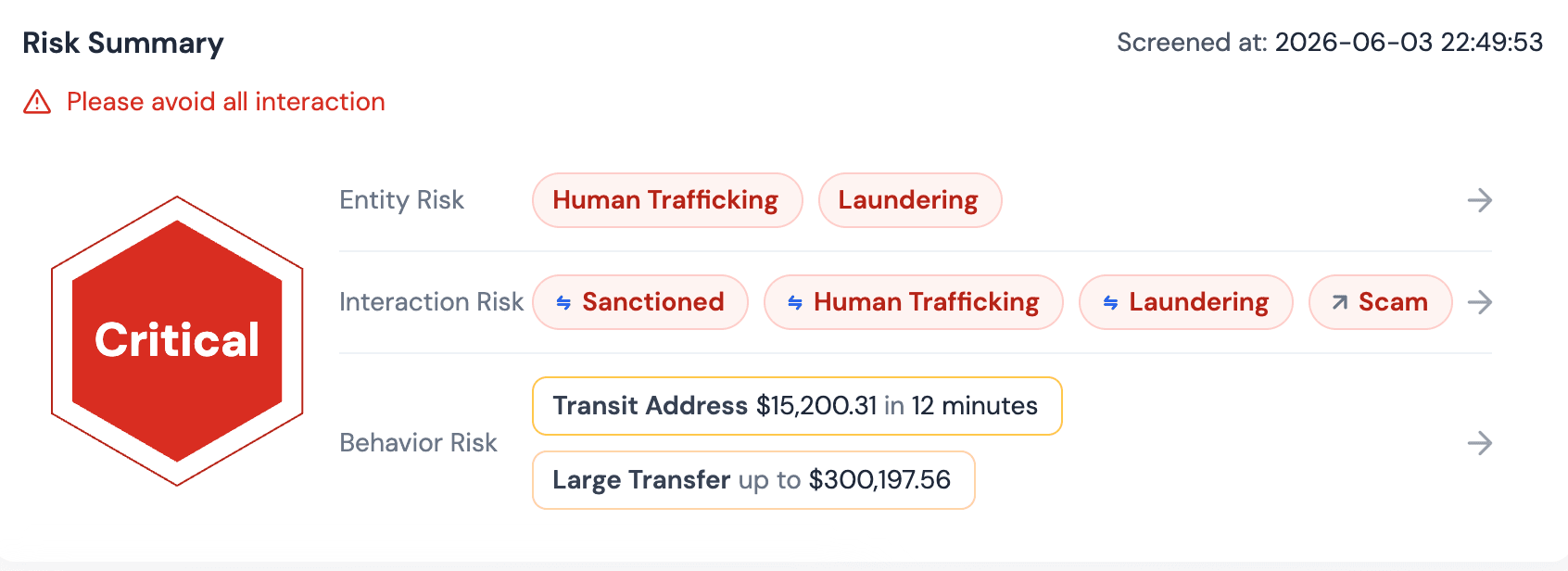
The signal source matters. Phalcon Compliance's KYA engine draws on 600 million+ labeled addresses and 200+ risk signals (Phalcon Compliance Docs). The labels span sanctioned entities, mixer exit addresses, phishing drainer contracts, pig-butchering cash-out clusters, hacker-attributed fund flow, and terrorist-financing linked wallets. Each label type maps to a risk category DeFi protocols care about for different reasons. A sanctioned-entity label exposes the protocol to enforcement action. A hacker-attributed label means the deposit could be stolen funds a victim or insurer will claw back. A mixer-linked label signals elevated laundering intent. The output is not a binary yes or no, it is a structured risk profile the protocol routes into tiered handling.
| Address Risk Type | What It Means for the Protocol | Typical Protocol Response |
|---|---|---|
| Sanctioned entity (OFAC SDN) | Direct enforcement exposure, potential license loss | Hard block at router, freeze on balance |
| Mixer-linked (Tornado Cash, Sinbad) | High laundering probability, sanctions contagion | Deposit quarantine, manual review |
| Hacker-attributed address | Stolen funds, clawback or blacklisting risk | Withdrawal hold, balance escrow |
| Phishing drainer contract | Receipt of scam proceeds, reputational risk | Front-end warning, deposit rejection |
The tiered structure is what makes KYA usable in DeFi. A binary block list would either freeze out too many legitimate users or let too much risk through. A risk score with discrete thresholds, mapped to discrete responses, lets the protocol balance UX and compliance the same way a CEX balance does, but at address granularity.
KYA Screening Workflow for DeFi Protocols: Step by Step
The core screening mechanism, from address input through label matching, indicator hit, and composite scoring, is covered in our address risk screening guide. Here we focus on how DeFi protocols wire that screen into the transaction lifecycle and the audit trail that makes it defensible.
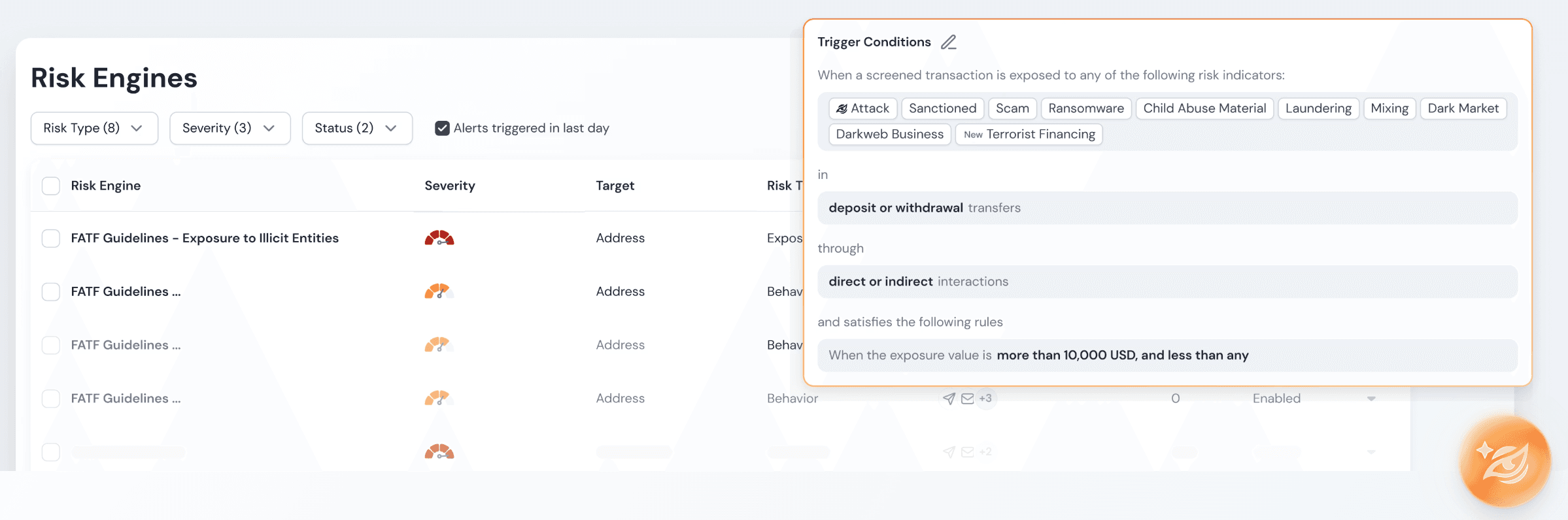
In DeFi the trigger point is protocol-native. A user action at the front-end or a direct contract call fires the screening call before the transaction commits on-chain. The decision logic compares the returned score against thresholds the protocol sets for each entry and exit point.
DeFi volume is bursty, and a compliance layer that serializes the user flow is one the protocol will eventually disable. Screening must sit between click and broadcast without a perceptible delay, or the team turns it off under load. The latency budget is not a nice-to-have; it is the difference between a screen that ships and one that gets pulled the week of a popular launch.
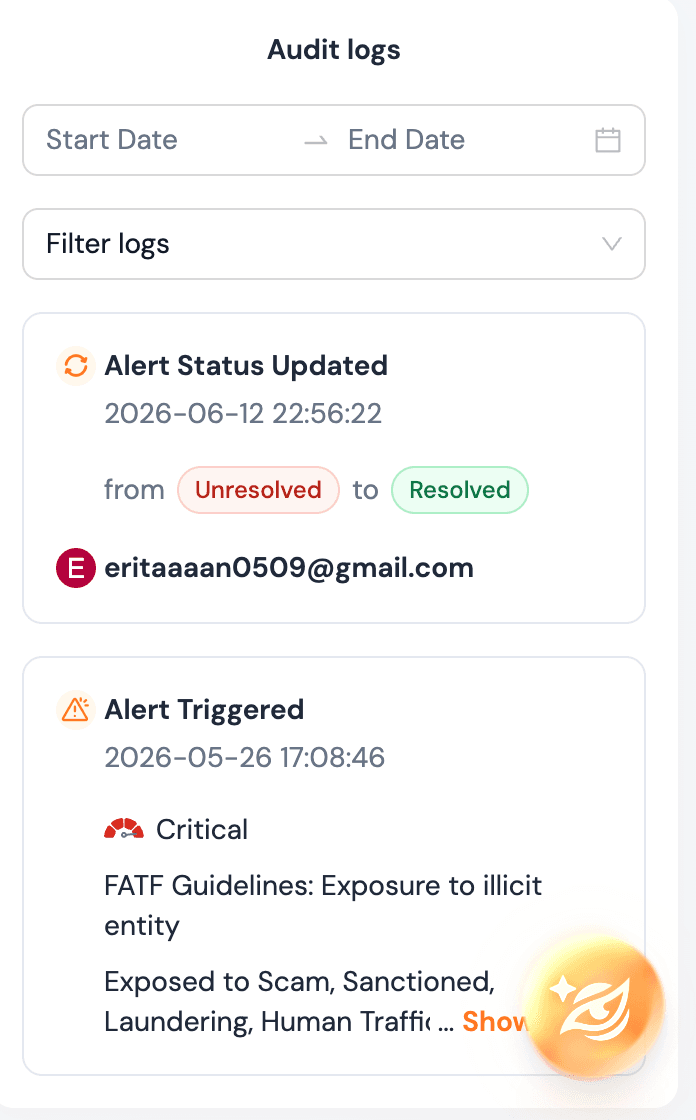
The audit log converts a screening system into a defensible compliance program. Every call, score, and decision is recorded with a timestamp and the label version. When a regulator or banking partner asks the protocol to prove it screened a specific address on a specific date, the audit log is the deliverable.
Cobo, a digital-asset custody platform that co-built cross-border payment security with BlockSec, has wired KYA into its DeFi wallet lifecycle. The pattern generalizes: any protocol that surfaces a "deposit" or "swap" button is a KYA candidate at that boundary.
Regulatory Backdrop: Why DeFi Protocols Need Address Screening Now
Three regulatory developments have closed the window for DeFi protocols that treat address screening as optional. First, the FATF has repeatedly confirmed that VASPs must apply a risk-based approach (Recommendations 1 and 15) to virtual asset activity, including DeFi front-ends they operate. Second, the EU's Markets in Crypto-Assets Regulation (MiCA) brings crypto-asset service providers into a consolidated AML perimeter. National supervisors are reading DeFi access points into that scope. Third, the UAE's VARA and similar regulators in Asia have published rulebooks that explicitly require address-level risk screening for crypto-asset activity. The common thread: if a protocol can read an address before it transacts, the protocol should screen that address.
The enforcement signal is just as clear. OFAC has added individual cryptocurrency addresses to the SDN list, treating an address as a designated person in its own right, as clarified in OFAC FAQ 561 on digital currency addresses. The US Treasury has sanctioned mixers directly. Regulators are not waiting for protocols to identify the human behind an address before holding the protocol accountable for transacting with it. For DeFi teams mapping obligations across these frameworks, the 2026 DeFi compliance technical framework walks through the protocol-level controls each regime expects.
The practical takeaway: the question for DeFi protocols in 2026 is no longer whether to deploy KYA, but how to deploy it without breaking the permissionless UX that defines DeFi. The protocols that get this right treat KYA as a protocol primitive, not a bolted-on compliance widget.
→ Book a Phalcon Compliance demo and map KYA onto your DeFi protocol's transaction lifecycle: Book a demo
FAQ
What is the difference between KYA and KYC for DeFi? KYC verifies a human identity through documents at onboarding. KYA screens a blockchain address against a labeled risk database. DeFi protocols cannot run KYC because users interact directly with smart contracts. KYA is the address-level equivalent that fits the DeFi model.
Can KYA identify the human behind a wallet? No. KYA returns the risk profile of the address itself, based on its on-chain history and label matches. It does not deanonymize the user. Identity attribution happens through separate law-enforcement channels.
Does KYA slow down DeFi transactions? No. Phalcon Compliance handles 500+ queries per second (Phalcon Compliance rate limits). The screening step stays invisible even during high-volume launches.
What risk types does KYA screen for in DeFi? Sanctioned entities, mixer-linked addresses, hacker-attributed fund flow, phishing drainer contracts, pig-butchering cash-out clusters, and terrorist-financing linked wallets. Each maps to a protocol-level response, from hard block to tiered monitoring.
Where should a DeFi protocol deploy KYA? Three control points: the front-end before broadcast, the router contract before funds move, and the withdrawal path before funds leave. Most protocols start with front-end and router, then add withdrawal screening as a second phase.