A compliance officer sees "money laundering" in a regulator letter and in a textbook. The textbook describes three stages: placement, layering, integration. The regulator cites a statute. Only one of those answers whether a specific transaction is a federal offense. To define money laundering in a way a legal or compliance team can act on, the source is 18 U.S.C. §1956, not the three-stage narrative. This article reads the statute the way a U.S. federal prosecutor would, then connects each element to its on-chain form.
The Legal Definition of Money Laundering (18 U.S.C. §1956)
Under 18 U.S.C. §1956, money laundering is knowingly conducting, or attempting to conduct, a financial transaction involving property from a Specified Unlawful Activity, with one of the intents the statute lists:
-
to conceal the source, ownership, location, or control of the proceeds
-
to promote the underlying unlawful activity
-
to evade a reporting requirement
-
to commit a tax offense
The statute, enacted by the Money Laundering Control Act of 1986, frames money laundering as an offense against financial transparency, not as a process narrative.
The predicate is the Specified Unlawful Activity, or SUA. §1956(c)(7) enumerates the SUA set, which includes fraud, drug trafficking, and a long list of underlying crimes. Without a SUA, there is no §1956 money laundering, however suspicious the transaction looks. The legal definition is therefore conditional on a predicate offense. A compliance screen that labels a transfer "risky" is not the same as a legal determination that the transfer is laundered proceeds. For a plain-language overview of how the process works in practice, see Money Laundering Meaning.
The Supreme Court narrowed the concealment reading in Cuellar v. United States (2008), holding that concealment must be the purpose of the transportation, not merely its effect. The statute cares whether four elements can be evidenced, not whether the funds passed through three stylized stages. For the federal prosecutorial reading, see the DOJ Criminal Resource Manual §2101 Money Laundering Overview.
The Three Types of Money Laundering Offenses
§1956 splits into three subsections that share a knowing-conduct and intent core but differ in where the transaction happens and how the intent is framed. Each subsection is a distinct offense, and prosecutors often charge them in the alternative.
| Subsection | Scope | Elements in brief | Typical scenario |
|---|---|---|---|
| §1956(a)(1) | Domestic money laundering | Knowing conduct of a U.S. financial transaction involving SUA proceeds, with conceal, promote, or evade intent | Structuring cash deposits to stay under the currency transaction reporting threshold |
| §1956(a)(2) | International money laundering | Knowing transport, transfer, or transmission of funds across a U.S. border, to promote a SUA or conceal SUA proceeds | Moving fraud proceeds through a cross-border wire to obscure the origin jurisdiction |
| §1956(a)(3) | Undercover or sting money laundering | A transaction designed with law enforcement, where the actor intends to promote a SUA or conceal its nature | A government-controlled operation in which the target's intent satisfies the mens rea |
A common thread runs through all three. The mental state, or mens rea, is knowing conduct plus a specific intent. Mere movement of funds is not enough. The prosecution must prove the actor knew the property came from a SUA and acted with one of the listed intents. That intent requirement is what separates a §1956 charge from a §1957 charge, which the FAQ below addresses. The federal enforcement perspective tracks the same statutory scope, as FinCEN's published definition confirms.
How On-Chain Transactions Trigger §1956
The statutory question for a crypto-asset transfer is whether it qualifies as a "financial transaction" under §1956. The definition is broad. A transfer of crypto assets can satisfy it when the transfer involves SUA proceeds and the actor acts with a listed intent. A domestic on-chain transfer that moves SUA proceeds while concealing origin can trigger §1956(a)(1). A cross-chain or cross-border transfer that obscures where the funds came from can trigger §1956(a)(2).
The evidentiary difficulty is not the transaction. It is the two mental elements: knowing that the property is SUA proceeds, and acting with a concealment or promotion intent. On a public ledger, the transaction is visible, but intent is not labelled on the block. Compliance teams need to reconstruct the on-chain form of those elements. They trace where funds came from, how many hops they took, and whether they passed through a mixer or a sanctioned entity. They check whether the flow matches a layering pattern.

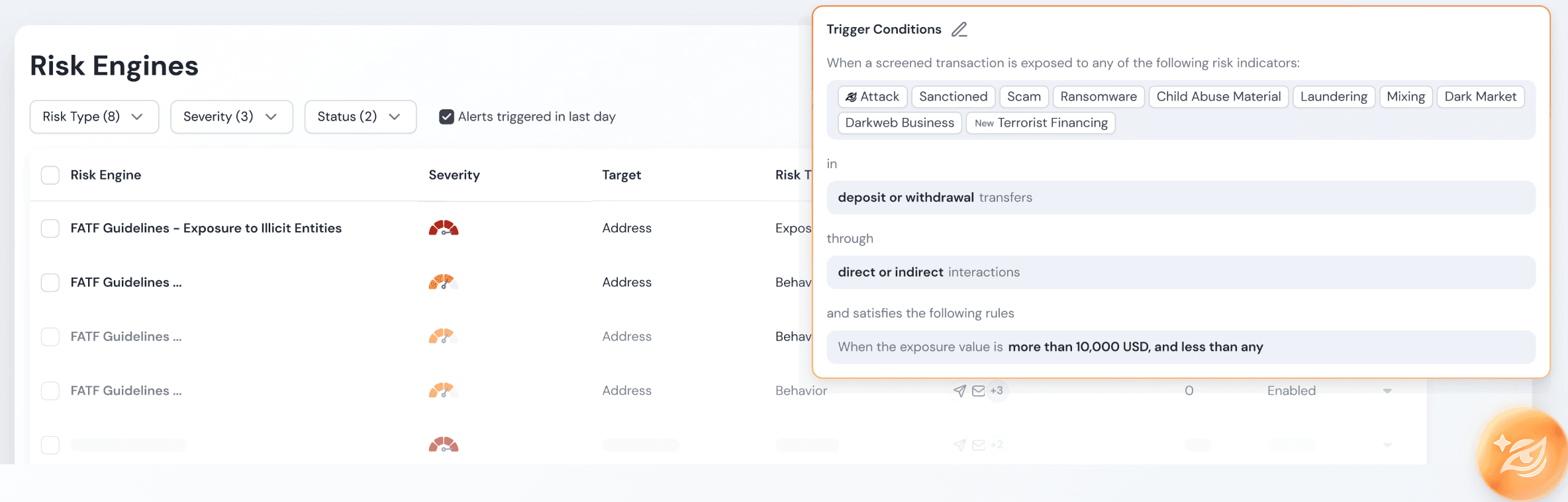
This is where the legal definition meets a compliance workflow. Phalcon Compliance provides chain-level monitoring that can identify on-chain indicators of the §1956 elements, without making the legal determination itself. KYA (Know Your Address) screens a wallet against seventeen risk indicators, including Sanctioned, Mixer, Scam, Laundering, and Dark Market, to flag interactions with known risk entities. KYT (Know Your Transaction) applies a behavioral model to the transaction level, flagging rapid transit, address peeling, and layering patterns that correspond to the on-chain form of §1956(a)(1) concealment intent. Cross-chain tracing follows funds across bridges, the movement that §1956(a)(2) reaches. Per-transfer STR report export, aligned with major regulatory jurisdictions and exportable through a region-specific template for direct filing, connects the on-chain evidence to the reporting obligation.
The boundary is explicit. Phalcon Compliance is a compliance-side identification and evidence tool. It does not make a legal determination that a transaction is money laundering. It does not prosecute. It does not verify identity. Legal characterization and enforcement belong to law-enforcement and judicial bodies. What the platform produces is the on-chain trace that a compliance team or an investigator can read against the four statutory elements. To see how that workflow sits inside the wider AML program, read the AML Compliance for Crypto hub.
Reading the Statute, Then Watching the Chain
→ Book a Phalcon Compliance demo and produce the on-chain trace that maps to the statutory elements: Book a demo
Frequently Asked Questions
How does §1956 differ from §1957?
§1957 creates a standalone offense of conducting a monetary transaction exceeding $10,000 in property derived from a SUA. Its intent requirement is less demanding: it does not require the specific conceal, promote, or evade intent that §1956 demands, but it applies only to monetary transactions above the $10,000 threshold. Prosecutors often charge the two together, because the same transaction can satisfy both.
Does passively receiving risky funds constitute money laundering?
§1956 requires both knowing that the property is SUA proceeds and a specific intent to conceal, promote, or evade. Mere passive receipt, without that knowledge and intent, does not satisfy the mens rea element. Continued holding or onward transfer, however, can trigger separate reporting or recordkeeping obligations. This article does not provide legal advice; specific facts require case-by-case review.
Do all on-chain transactions count as "financial transactions" under §1956?
The statutory definition is broad. It is not limited to transactions handled by traditional financial institutions. An on-chain transfer can qualify when it involves SUA proceeds and the required intent. Whether a specific transfer satisfies the elements is a question courts decide case by case.
What counts as a Specified Unlawful Activity?
§1956(c)(7) enumerates the SUA list, which includes a wide range of underlying federal crimes such as fraud, drug trafficking, and extortion. The SUA is the predicate. Without a qualifying predicate offense, a §1956 charge does not attach, however suspicious the transaction appears.
From Statute to On-Chain Evidence
Reading the statute is the entry point. The next question is what the four elements look like when the transaction lives on a public ledger. That deeper read belongs on the AML Compliance hub, where the KYT main line covers deployment points, cross-chain tracing, and the STR export that ties on-chain evidence to the reporting obligation. For the behavioral, three-stage definition that complements this legal reading, see What Is Money Laundering.