
A DeFi protocol meets its AML obligation by screening risk at the exact points where users deposit, borrow, swap, or withdraw assets. It does not need to stand up a centralized compliance desk. The integration pattern is a set of real-time API checks at those entry and exit points, plus ongoing monitoring of addresses after the first interaction. That combination closes the gap between DeFi and exchange compliance. This guide lays out where those checks go and how the workflow differs from a centralized exchange. For the broader workflow, see Phalcon Compliance. This page is part of the AML Compliance Hub.
The New Compliance Pressure on DeFi Protocols
The regulatory perimeter around DeFi is no longer theoretical. The FATF virtual assets framework extends anti-money-laundering obligations to any entity that exercises effective control over financial services. That language reaches DeFi protocols that control user funds, pausable pools, or admin keys. A growing share of jurisdictions have turned Recommendation 15 into national law, so the screening obligation reaches DeFi protocols whether those teams carry a compliance title or not. FinCEN's Customer Due Diligence rule sets the same expectation in the United States, framing continuous monitoring as a condition of covered institutions' compliance programs. Separately, in the EU, the screening and reporting duties for crypto-asset transfers sit in the Anti-Money Laundering Regulation (AMLR) and the Transfer of Funds Regulation (TFR), with MiCA itself limited to licensing and market-conduct rules. Both frameworks converge on the same practical ask: prove that the protocol screens counterparty risk before funds move, and prove it continuously.
The on-chain crime picture sharpens the pressure. FATF and national regulators have repeatedly flagged that a non-trivial share of illicit crypto funds now moves through DeFi venues. That means protocols which ignore screening are not just noncompliant but exposed to being named as a conduit. Regulators do not need a DeFi protocol to be a regulated entity in the classical sense. They need it to behave like one at the transaction layer, which is exactly where a DeFi team has the least built-in tooling.
The team constraint is the other half of the problem. A DeFi protocol team usually has no dedicated compliance staff, a tight budget, and a need for real-time risk control at the transaction nodes that actually move funds. Compliance work falls on developers or security engineers who are already shipping protocol upgrades, managing oracle risk, and handling incident response. A compliance program that assumes a full-time compliance officer is therefore a program designed for an org chart the protocol does not have. The realistic path is to push screening into the contract flow itself, so the protocol screens by default rather than by staffing.
How DeFi Compliance Differs from CEX
Most public guidance on crypto compliance is written for centralized exchanges, and it assumes a buyer profile that DeFi teams do not match. Centralized exchanges operate dedicated compliance desks, run full backend integration with screening vendors, and can justify six-figure annual subscriptions against their volume. DeFi protocols sit at the opposite corner on every one of those dimensions. Copying the CEX playbook wholesale produces a program that the protocol cannot staff, cannot pay for, and cannot finish integrating.
| Dimension | Centralized exchange (CEX) | DeFi protocol |
|---|---|---|
| Compliance staffing | Dedicated compliance team | Usually none; developers or security engineers carry it |
| Integration surface | Full backend batch and real-time | API at deposit, borrow, and swap contract nodes |
| Budget posture | Can sustain six-figure annual subscription | Tight; needs pay-as-you-go alignment |
| Screening cadence | Full real-time across all flows | Real-time at high-risk nodes, continuous Monitor on the rest |
 The implication is that a DeFi protocol should not try to screen everything everywhere. It should screen the contract nodes where exposure actually enters the protocol. Deposit, borrow, and swap are the three points at which a counterparty address binds risk onto the protocol, so screening at those nodes is the minimum viable coverage. Everything else can be handled by continuous monitoring on addresses the protocol has already interacted with, plus on-demand verification for edge cases. That split is what makes DeFi compliance tractable on a small team and a thin budget.
The budget dimension is where most CEX-oriented guidance misleads a DeFi team the most. A rigid annual subscription assumes a stable, predictable screening volume, which is the opposite of what a DeFi protocol sees. On-chain activity swings with market cycles, new pool launches, and incentive programs, so a fixed-capacity contract either wastes spend in quiet periods or hits overage fees in busy ones. The cost model that fits DeFi is one where spend tracks volume, not one where volume has to be predicted a year ahead.
DeFi Integration: API Screening at Deposit, Borrow, and Swap Nodes
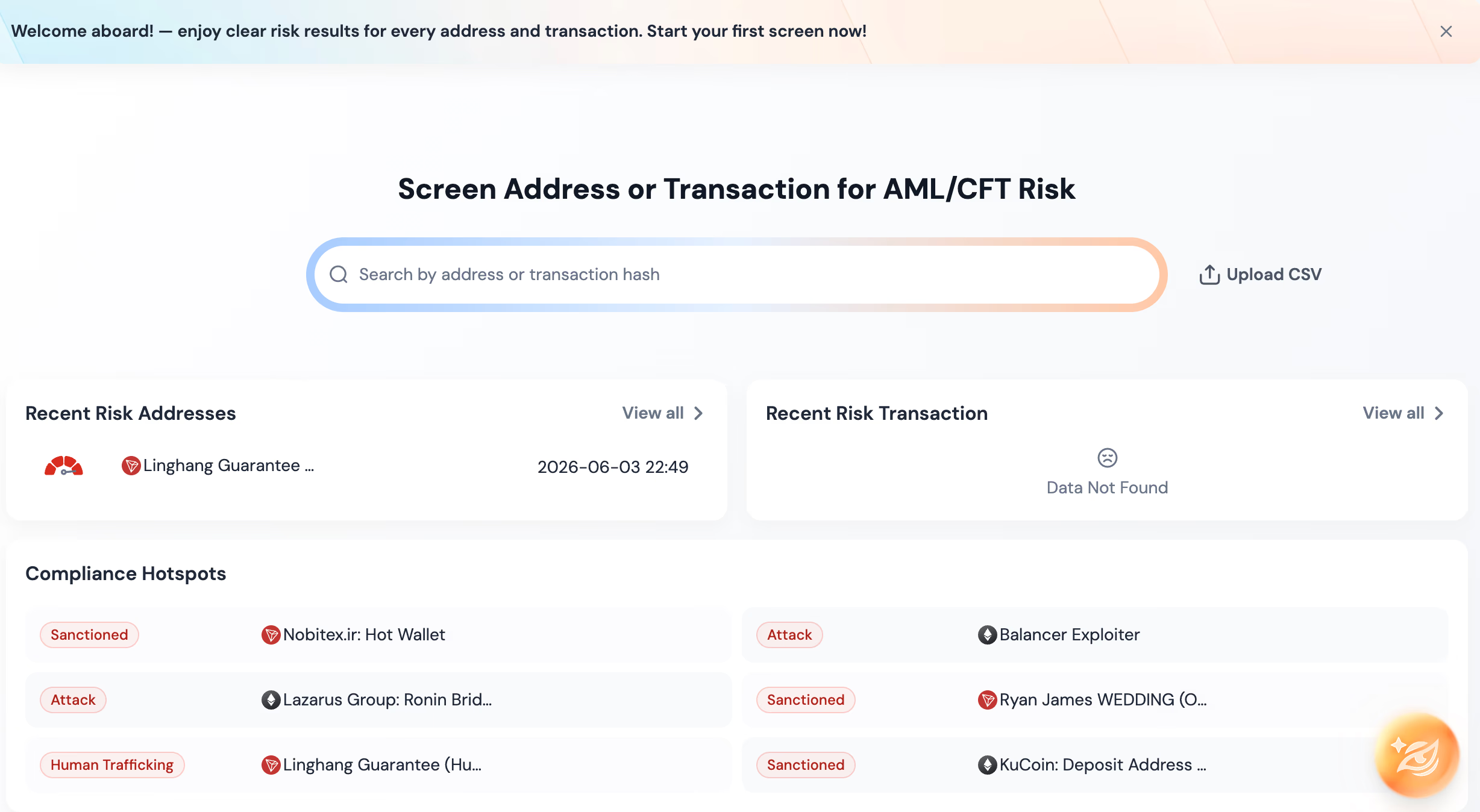
DeFi teams can use the Phalcon Compliance KYA and KYT API to screen addresses at deposit, borrow, and swap points. The application checks the returned risk result before allowing or holding the transaction. Monitor then watches the address for later changes in risk.
The integration point is the contract node, not the dashboard. When a user deposits into a pool, borrows against collateral, or swaps through an aggregator route, the protocol can call the Phalcon Compliance KYT and KYA API endpoints before the transaction is released. Phalcon Compliance exposes KYT and KYA API endpoints that return a real-time address risk score and risk indicators at deposit, borrow, and swap contract nodes. The returned score lets the protocol decide whether to clear, hold, or block the interaction. The risk indicators attach traceable evidence to that decision so it survives an audit later. The same API surface that a centralized exchange wires into its deposit and withdrawal gate applies here at contract nodes instead of at an order book. That exchange integration is documented in the KYT API integration blueprint for crypto exchanges.
 The cost alignment is what makes that integration realistic for a DeFi budget. Screening Packages PAYG credit starts at $95 for 50 to 2000 credits, valid for 12 months. A protocol whose screening volume swings with incentive cycles can buy credits when volume is high and let the balance sit when volume is low. There is no contract lock-in, and the protocol can graduate to a subscription tier once volume stabilizes. API integration is available only on the Scale tier starting at $699 per month and on the Enterprise tier. A team planning to embed API calls at contract nodes needs to confirm that tier before writing code. Multi-seat collaboration and referral rewards are covered in the FAQ below.
The lightweight alternative exists for protocols that are not ready to embed an API. Interactive screening through the platform interface lets a DeFi team verify a counterparty address on demand without API integration, which fits lightweight or audit scenarios. A security engineer running a manual review on a flagged address, or a treasury multisig signer checking a counterparty before a large transfer, can use it as the zero-integration path.
Deployment Patterns: Node-Level Screening, Monitor, and Self-Service Verification
The full deployment pattern for a DeFi protocol has three layers, and each one answers a different screening question. None of the three is optional if the protocol wants a program that holds up under examination, but each one carries a different engineering and quota cost.
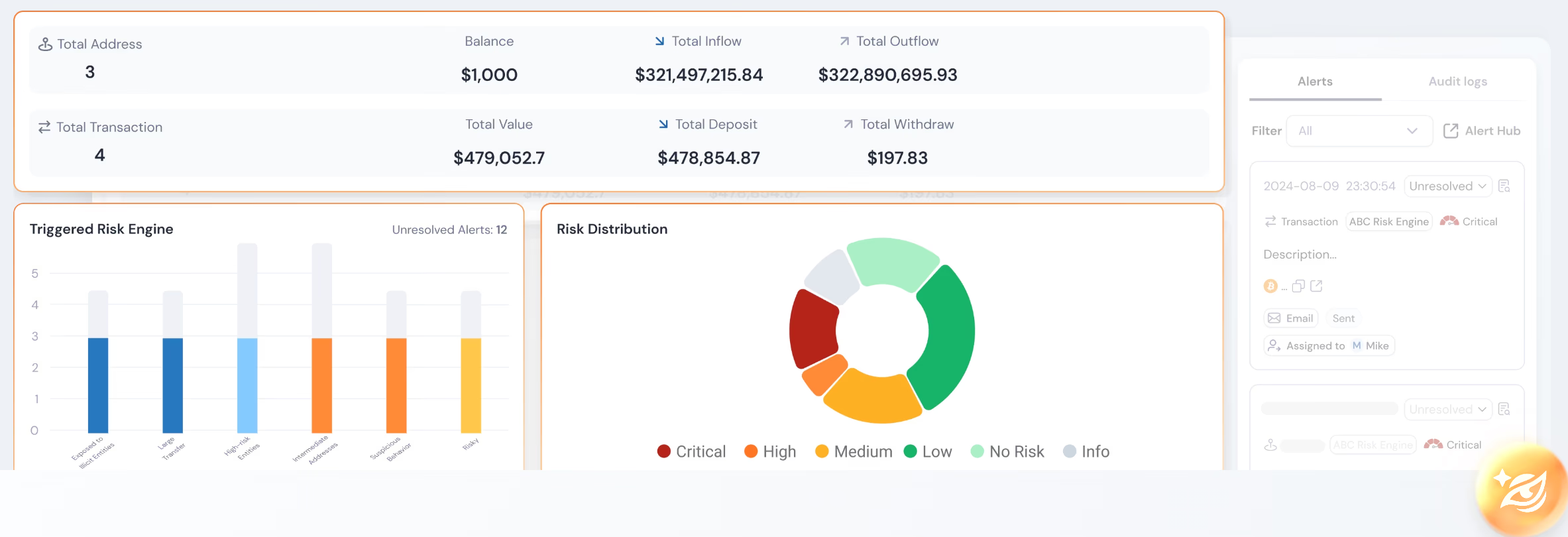
The first layer is node-level screening at the contract nodes that move funds. Before a deposit, borrow, or swap call is released, the protocol calls the KYT and KYA API with the counterparty address and reads the returned risk score. The threshold routing is defined in the contract or in an off-chain keeper that the contract defers to, so the protocol clears low-risk addresses, holds medium-risk ones for manual review, and blocks high-risk ones outright. This is the layer that closes the real-time laundering window, and it is the only layer that consumes per-check quota.
The second layer is continuous monitoring on addresses the protocol has already interacted with. Monitor mode re-analyzes already-screened addresses on a dynamic schedule when their risk changes and does not consume the Screening quota. For a DeFi protocol this is the layer that catches the address that was clean at first deposit but later transacts with a sanctioned entity or a known bad actor. Because it does not consume the Screening quota, the protocol can leave it on across the full set of historically interacted addresses without growing the per-check budget linearly.
The third layer is on-demand self-service verification through the platform interface. It is the path a security engineer uses during an incident, a manual review, or a pre-deployment counterparty check on a new oracle or partner contract. It needs no API integration, so it covers the long tail of one-off checks that do not justify contract-level embedding. The three layers together produce a program that screens in real time at the nodes that matter, watches the rest continuously for free, and gives the team a manual escape hatch for edge cases.
Start Phalcon Compliance for DeFi Protocols
A DeFi protocol does not need a centralized compliance desk to meet its AML obligation. It needs screening at the contract nodes that move funds, continuous monitoring on the addresses it has already touched, and a cost model that tracks volume rather than a fixed annual contract. Phalcon Compliance delivers all three through one KYT and KYA API surface, a Monitor mode that does not consume screening quota, and a pay-as-you-go credit entry point starting at $95. Start Phalcon Compliance for DeFi protocols and map the screening pattern to the deposit, borrow, and swap nodes before the next protocol upgrade.