
The Short Answer
A VASP compliance tool stack should cover the duties your business must meet, not just offer the flashiest analytics. This list compares complementary tool categories across screening and label coverage, monitoring and triage, audit trail and export, and STR reporting, alongside Travel Rule messaging. Each category supports a different part of the workflow; no single tool is required to cover every duty. The VASP compliance hub collects the related guides.
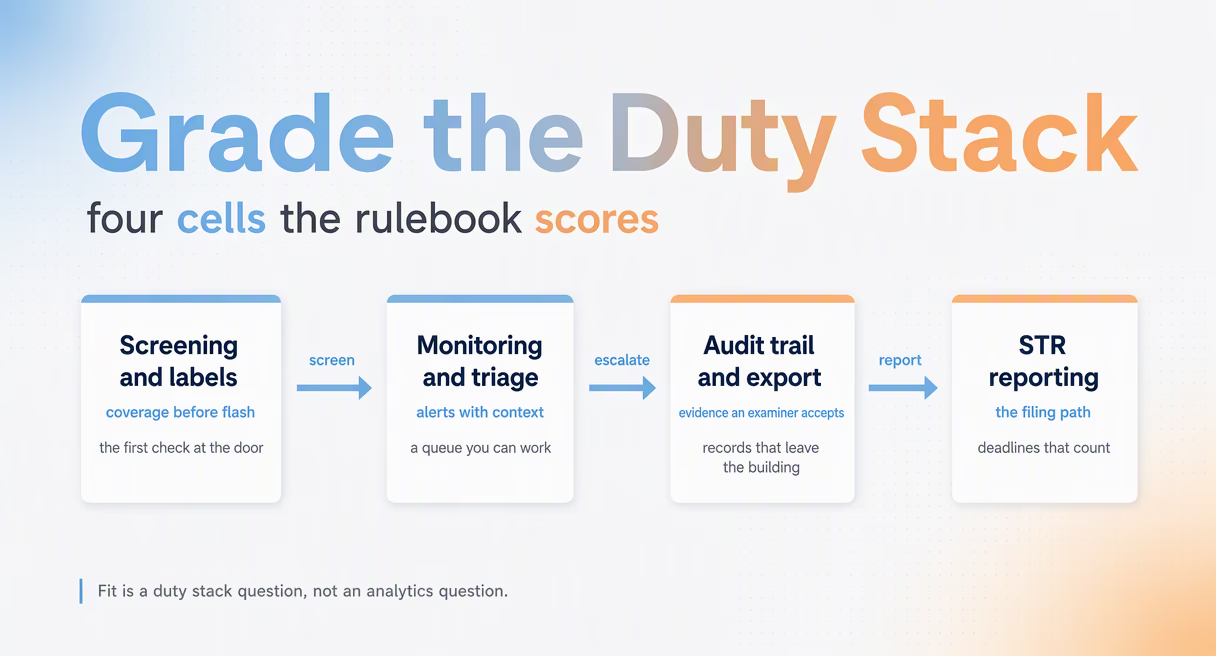
The anonymous format is deliberate and it is not coyness. Vendor feature sets move faster than any list, licensing terms move faster than feature sets, and what a team needs depends on which duties weigh most in its operation. So this page names the shapes, tells you what each shape is genuinely good at, and names one product, ours, where we can stand behind the specifics line by line.
How to read what follows: identify the duty you need to support, check the requirements for that tool category, then read each option for fit rather than rank. There are no scores here, because scores imply verified benchmarks this page does not have, and precision nobody can defend is worse than honesty.
What a VASP Duty Stack Adds vs Generic Crypto Tooling
A generic analytics suite answers "what happened on chain." A duty stack tool answers what the rulebook asks: is this deposit acceptable, does this need escalation, can you show evidence, can you file the report. The FATF's expectations are the reference: monitoring, record keeping, reporting. Those duties should be supported across the tool stack; a specialist tool can support one part without replacing the rest.
The difference shows up in four places a VASP lives weekly. In the deposit queue, where the question is accept, hold, or reject, and a duty stack tool returns a grade plus evidence, while analytics returns a picture that still needs interpreting. In the alert queue, where a duty stack tool routes by severity so your team works the dangerous ones first. In the audit room, where the tool's own records answer the examiner instead of a compliance officer rebuilding history. And at reporting time, where the case exports toward an STR draft instead of a screenshot.
Teams that skip the duty stack framing pay for it in the two failure modes practitioners describe most. Alert queues that bury the real risks in noise, and exam questions about risk scores nobody can explain. Tool selection is where both are decided, which is why this list grades on duty coverage and nothing else.
One category note before the list. Sanctions screening rides along with every duty cell, and the screening side ultimately grounds out in the official lists themselves, searchable at the source, for instance the OFAC search page. A duty stack tool folds that screening into the pipeline; it does not replace knowing what the lists are.
For the related licensing and compliance guides, see the VASP compliance hub.
How to Evaluate Each Tool Category
Evaluate each category against the duty it supports. Screening tools need suitable list or label coverage, matching or risk evidence, and integration that fits your workflow. Monitoring tools need ongoing checks, alerts, and triage records. Reporting tools need reviewable drafts and exports for the applicable jurisdiction. Travel Rule messaging networks need an appropriate information-exchange workflow between counterparties; they do not replace screening or monitoring. No scores, no percentages, no precision we cannot source.
The evaluation criteria are derived from the duty stack, not from vendor marketing. Screening and label coverage because the deposit queue cannot wait on interpretation. Monitoring and triage because the alert queue is where headcount goes. Audit trail because the exam reads records, not intentions. STR support because the reporting deadline does not move for tooling.
For tools that provide onchain screening, label coverage deserves one honest sentence: the difference between millions of maintained labels and a static list is the difference between seeing yesterday's mixer and missing it. The specific count belongs to each vendor to state and you to check; the category requirement is that the number is large, maintained, and current.
What this methodology cannot do, and does not pretend to: test latency claims against each other, rank user experience, or price seats. Those are shortlist follow ups, run in your pipeline with your traffic, and the transaction monitoring guide describes the operational workflow those tests should support.
The List: Where Each Tool Type Fits
Six seats, five shapes plus one named product. The shapes: an enterprise analytics platform, a mid-market compliance suite, a sanctions-first screening tool, a travel rule messaging network, and a developer-first screening API. The named seat, Phalcon Compliance, sits in the developer-first row, with the numbers below (per BlockSec).
| Seat | Tier | Strongest at | Watch out for |
|---|---|---|---|
| An enterprise analytics platform | Enterprise | Investigations and forensics depth, wide data | Heavy contracts; monitoring and STR workflow often secondary |
| A mid-market compliance suite | Mid-market | Case management, workflow, policy routing | Screening depth varies; API latency worth testing |
| A sanctions-first screening tool | Any size | List matching and watchlist maintenance | Not a monitoring engine; alert triage and records stay yours to build |
| A travel rule messaging network | Any size | Originator and beneficiary data exchange | It is a messaging layer, not screening or monitoring |
| A developer-first screening API | Any size | Pipeline screening, latency, automation fit | You assemble the workflow; the engine grades, your policy routes |
| Phalcon Compliance | Developer-first, named | Onchain screening, monitoring, logs and report drafting: 600M+ labeled addresses, 200+ signals across 17 risk indicator categories, sub 100ms API screening, risk rules for 27+ jurisdictions; STR drafts for Hong Kong and Singapore (per BlockSec) | Identity KYC and Travel Rule identity exchange are outside scope; the institution reviews evidence and submits reports |
Reading the table honestly, including our own row. The enterprise platform is the right seat for a large compliance function whose week is investigations; it is a heavy thing to buy for a queue problem. The mid-market suite fits teams whose bottleneck is workflow and who want the knobs in one place. The sanctions-first tool does one cell well and leaves the other three to you. The travel rule network is necessary plumbing for that duty, and nothing else, which is why it sits on this list adjacent to, not inside, the screening seats.
The developer-first seat, ours included, fits the team that lives in its pipeline. Your gateway calls the screening API before settlement, your routing table turns grades into decisions, screening and operation events are recorded as the flow runs, while the institution adds review reasons and external evidence. It is also the seat with the least hand-holding; the engine provides grades and evidence, and the policy work stays with you, which the duty stack guides in this family cover in detail.
For the full duty map behind these four cells, start with the VASP AML guide. For product specifics on the named seat, the Phalcon Compliance page is the source. And for the family map from duties to monitoring practice, the VASP compliance hub holds the whole territory.