
The Short Answer: On-Chain Forensics Is Post-Incident Tracing of Funds
On-chain forensics is the practice of tracing funds across blockchains after something has already gone wrong. It is after-the-fact work. An investigator starts from an address or a transaction that matters and follows the money through its multi-hop paths, across bridges and protocols. The goal is a simple question: where did the funds go, and who ended up holding them? That question sits at the heart of nearly every theft, fraud case, and laundering investigation that touches a public blockchain.
The two defining words are retrospective and multi-hop. On-chain forensics does not screen a transaction before it settles, and it does not sit inside a compliance program as a standing control. It begins after an incident, a theft, or a suspicious event, and it reconstructs what happened by walking the transaction graph forward and backward until the trail reaches an identifiable destination.
Blockchain analytics is often used as one umbrella term for everything a person can learn from on-chain data. On-chain forensics is the investigative slice of that umbrella: the part that answers "what happened and where did the money go" rather than "is the other side compliant." The two questions overlap, but they are not the same job, and a team that blurs them ends up with the wrong tool for the wrong job.
On-Chain Forensics vs AML vs Transaction Monitoring
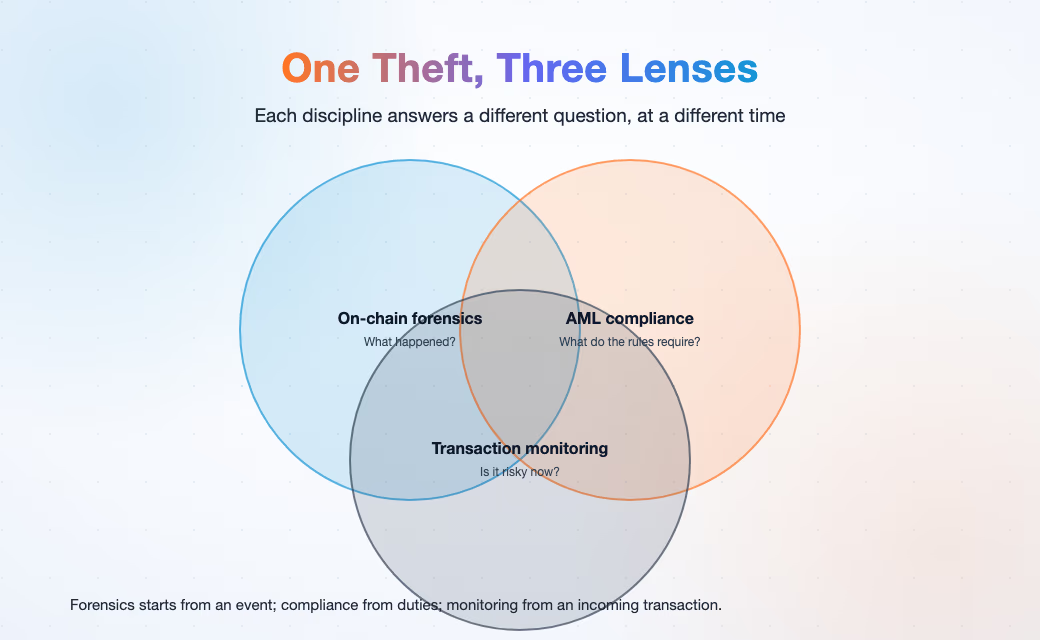
The cleanest way to understand on-chain forensics is to separate it from the two disciplines it is most often confused with. On-chain forensics is retrospective, multi-hop, after-the-fact work run by investigators. AML is compliance work run by compliance officers, built around a framework of duties rather than a single investigation. That framework starts from the FATF standards. Transaction monitoring, often called KYT, is a real-time, pre-transaction control that scores a transaction or address before value moves. Three adjacent layers answer three different questions: forensics asks what happened, AML asks what the rules require, and monitoring asks whether this transaction should go through. A forensics question starts from an event; a compliance question starts from a set of duties; a monitoring question starts from an incoming transaction.
The person, the moment, and the direction of each layer are different. An investigator looks backward at an event that already occurred. A compliance officer looks across a standing program of duties. A monitoring system looks forward at the next transaction. Conflating the three is how a team ends up trying to run an investigation with a screening tool, or a compliance program with a tracing tool. Keeping them separate is what lets each team pick the right layer for the job.
This distinction is not just conceptual. Forensics asks what happened, AML asks what the rules require, and monitoring asks whether this specific payment should be allowed through. Because those questions differ, the boundary is real: treating forensics as a corner of compliance undersells what it does.
What On-Chain Forensics Is Used For
On-chain forensics serves a small set of concrete jobs, and most of them start after an event has already happened.
The most common is stolen-fund tracing. When a DeFi protocol, a bridge, or a wallet is drained, an investigator follows the stolen assets through the attacker's addresses, mixers, and exchange deposit addresses to see where the value landed. The goal is to name the entity, the service, or the wallet that ended up with the funds, so the trace can support a recovery, a freeze, or a referral to law enforcement. Because blockchains are public, the investigator can walk the record of value movement without asking anyone's permission.
The second job is naming who is behind laundering. What laundering means is defined plainly by FinCEN. When illicit funds move through layered addresses and services to look legitimate, forensics reconstructs the layering and links the final holder back to the original source. The third is pre-investment due diligence. Before buying into a token or a project, a team traces the deployer's funding and liquidity to spot a rug pull or a hidden connection to a high-risk party. The fourth is reporting and evidence. A finished investigation becomes a shareable chart and a written trail that an exchange, a regulator, or a court can review. Each of these jobs produces something durable: a saved chart, a named destination, and a paper trail that can be handed over.
When Clean and Dirty Funds Mix: Poison, Haircut, and FIFO
The hardest question in fund tracing is not finding the money; it is deciding what counts as tainted once dirty and clean funds share an address. Three methods give different answers. Poison treats everything that touched tainted funds as tainted, which flags aggressively and sweeps in addresses whose owners never knew the source. Haircut apportions taint proportionally, so each hop dilutes it until the balance falls below any threshold. FIFO and LIFO treat an address's funds as an ordered queue, first in first out or last in first out; English law's Clayton's Case, the 1876 precedent, applied first in first out. The method chosen decides which addresses get flagged, whether a recovery claim adds up, and whether a tracing conclusion survives review, so a defensible report states which method it used and why. A tool that cannot show its taint method is answering a different question than the one a regulator asks.
How MetaSleuth Fits the Forensics Layer
These jobs need a tool that can follow multi-hop paths across chains, and this is where the investigation layer becomes concrete. MetaSleuth is BlockSec's crypto tracking and investigation platform, officially positioned as a fund tracing investigation platform. It traces funds across multi-hop paths and visualizes how tokens move between addresses, supporting cross-chain analysis when a trail leaves one chain for another.
MetaSleuth is built for the people who do this work. It is built for enterprise users handling incident response and fund tracing, for investors tracking stolen funds after a theft, and for regulatory and law-enforcement agencies running cross-border compliance investigations. The platform is adopted by more than 100 law-enforcement and compliance agencies worldwide as of 2026.
The point is that a tracing platform is the instrument an investigator uses to turn a forensic question into a concrete answer, not a replacement for the craft: the graph, the path, and the destination. That instrument is what MetaSleuth provides for the investigation layer. In practice, an investigator opens a chart, expands the outgoing transfers hop by hop, and reads the resulting path as the answer rather than as a hypothesis.
What to Do Next
If you are trying to understand where a trail of funds actually leads, the next step is to open an investigation rather than run another screen. Pick an address you already care about, follow its outgoing transfers through the graph, and see whether the trail resolves to a named entity or to a dead end. The difference between those two outcomes is naming, and naming who is behind is the whole point of the work.
Learn on-chain forensics with MetaSleuth, and turn the abstract idea of on-chain forensics into a concrete trace you can see, save, and share.
This piece is part of the MetaSleuth investigations and forensics guide, where the tracing method, evidence handling, and tooling tiers are covered end to end.