
Blockchain monitoring tools are good for keeping watch in real time, not for doing the investigation itself.
A monitoring tool tracks target addresses in real time, surfaces label updates the moment the data changes, and turns raw chain activity into leads an investigator can chase. The investigation itself, the part that rebuilds fund paths and builds findings that hold up, needs forensics depth that monitoring tools do not carry.
What Onchain Investigations Actually Require
On-chain investigations come down to four jobs: naming who is behind an address, rebuilding the fund path, capturing the evidence, and reporting. Each job pulls on a different skill. First, naming who is behind an address: connecting it to a person or service worth knowing about. Second, rebuilding the fund path: following value across hops, bridges, and clusters to see where funds went. Third, capturing the evidence: recording what the trail showed, in a form that survives scrutiny. Fourth, reporting: turning the trail into something a regulator, an exchange's compliance team, or a court can act on. The duty to report at all traces back to the FATF standards that national regulators implement.
Independent investigators demonstrate the work regularly, and the enforcement backdrop is easy to see: Treasury's OFAC sanctions programs on one side, and the Bank Secrecy Act rules enforced by FinCEN on the other. When a social-engineering scheme drains nineteen million dollars from victims, the tracing that follows is exactly this chain: name who owns the receiving cluster, follow the hops, capture the evidence, publish the trail. The work is real, recurring, and manual at its core, which is why the tooling question matters: investigators want to know which parts a monitoring tool can carry and which parts it cannot.
Where Monitoring Tools Help: Live Tracking and Alert Coverage
Monitoring earns its place in investigation work on three specific jobs. Live tracking keeps a watch on addresses already identified as interesting, so when target funds move, the movement surfaces within the monitoring cycle rather than whenever an analyst happens to re-check. Label updates matter just as much: investigations run against a picture that keeps changing, and a wallet newly linked to a sanctioned entity or a hacking operation changes the meaning of every hop it touched. Monitoring tools that keep labeled address data in the hundreds of millions, updated around the clock, keep the picture current.
Alert-driven leads are the third job. A well-tuned monitoring layer flags previously unknown relationships, an address interacting with a cluster under investigation, a new link forming mid-case, and hands those flags to the investigator as starting points. In practice this is where monitoring tools are strongest: shortening the distance between an event on-chain and an investigator knowing about it.
Where They Stop: The Investigation Gap Monitoring Does Not Cover
The gap appears when the work shifts from watching to proving. Monitoring reports that something happened; forensics establishes what it means. Rebuilding paths through mixing services, peel chains, and cross-chain bridges requires tracing depth that monitoring screens do not expose. Deciding that five addresses are one actor, and being able to defend that claim, belongs to forensics work with its own evidence standards. And the final output of an investigation is a story backed by evidence, which monitoring tools do not produce.
The split tracks the tool tiers the market already recognizes. Enterprise analytics platforms bundle the forensics depth and charge accordingly. Mid-market API tools, the tier where screening and monitoring live, carry the signal layer. Neither tier substitutes for the other, and an investigation team that buys monitoring expecting forensics will hit the wall at exactly the moment the case gets hard.
The four investigation jobs and the two layers' shares:
| Investigation job | What monitoring contributes | What forensics adds |
|---|---|---|
| Naming who is behind an address | Label updates that flag new entity links | Findings that tie addresses to one owner, defensible under evidence standards |
| Rebuilding the fund path | Alerts that target funds moved | Tracing through mixers, peel chains, and bridges |
| Capturing the evidence | A current picture of the data | The captured trail, in a form that survives scrutiny |
| Reporting | Not carried by monitoring | The story backed by evidence |
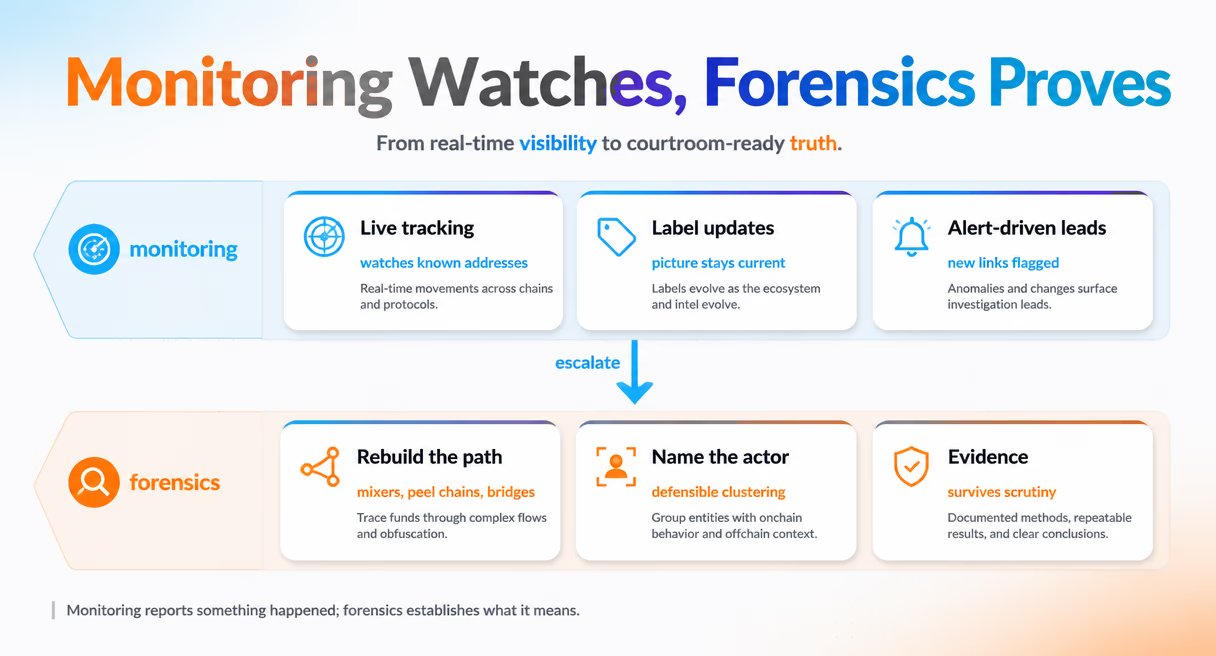
The Verdict: Good for Investigation Support, Not the Investigation Itself
The short answer for onchain investigations: monitoring tools are good for the support layer and not for the proof layer. The support layer is live tracking, fresh labels, and leads from alerts. The proof layer is rebuilding paths, tying addresses to one owner, and evidence packages, and it needs forensics depth. Serious programs run both layers and keep them separate on purpose, and teams carrying large exposure cross-check critical findings across data sources rather than trusting any single provider's picture. For the support layer that keeps investigations fed with current signal, Phalcon Compliance provides screening depth across the major chains. Its labeled address data covers over six hundred million addresses, per BlockSec technical specifications, updated continuously. For the proof-layer workflow end to end, see How to Trace Stolen Crypto Funds Across Chains.
This piece is part of the MetaSleuth investigations and forensics guide, where the tracing method, evidence handling, and tooling tiers are covered end to end.