
The Short Answer: An API Makes Tracing Programmable
Yes. A crypto fund tracing API turns a manual investigation into a service that a compliance or incident response system can call directly. Instead of an investigator opening a dashboard and clicking through every address, every hop, and every stop on the other side, the tracing logic itself becomes a function that your own system can invoke.
A tracing API turns a manual, screen-by-screen investigation into a programmable service: a system calls the tracing logic directly and acts on the result in milliseconds. The manual workflow and the programmatic workflow answer the same question: where did these funds go. The difference is who does the work, and how fast the answer arrives.
Programmable means the trace is a call, not a click. The analyst's judgment stays in the loop, but the repeated reading of the graph moves into software, where it can run continuously and consistently.
For a DeFi protocol team or a blockchain investigator, that difference is the whole point. A manual trace happens once, in one window, on one case. An API trace can run on every transaction, in the background, as part of a risk query that never needs a human to press the button.
Why Investigators and Protocols Need a Tracing API
Manual tracing works when the investigation is a single, open-ended question with no deadline. It does not work when the question repeats hundreds of times a day. An investigator who has to follow a funds path for one case can afford to click through a graph. A protocol that has to check every incoming interaction cannot.
Scale is only part of the reason. Consistency matters too. Two analysts following the same funds path on different days can read the graph differently, and a manual trace is only as fresh as the moment it was run. An API makes the trace repeatable: the same address, the same hops, and the same logic, every time.
MetaSleuth is used by enterprise teams to strengthen real-time AML/CFT work for incident response and fund tracing, in the terms the FATF standards set for regulated virtual-asset businesses. The same engine, delivered as an API, moves from a tool an analyst opens after something goes wrong to a control that runs before the transaction settles. That is the shift from investigation to integration.
Three concrete situations make the programmatic path necessary. The first is automated interception, where a protocol wants to halt or flag a risky interaction the moment it appears. The second is millisecond-level risk querying, where a wallet or address has to be checked against a tracing graph in the time a single transaction takes to confirm. The third is batch tracing, where an investigator has to follow not one funds path but hundreds at once. Each of these is a job for a system, not for a person at a screen.
What a Tracing API Enables
A tracing API lets the trace run inside a system the team already owns. The result is a risk decision the team can act on, not a picture the team has to remember to check.
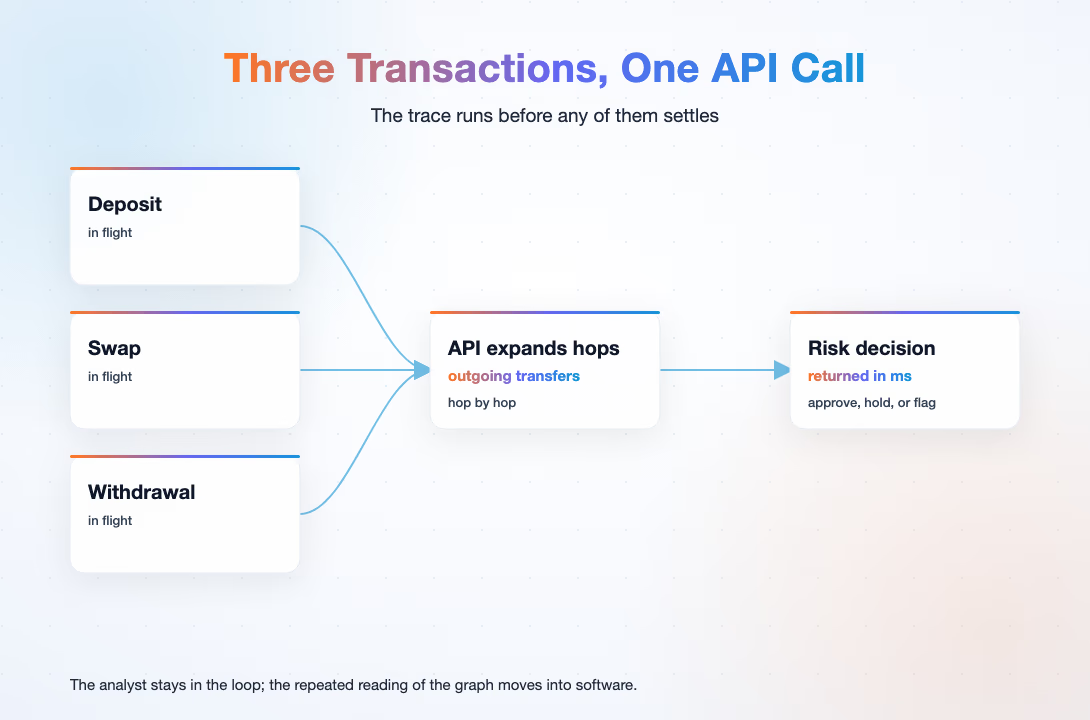
MetaSleuth traces funds across multi-hop paths, expanding outgoing transactions step by step so an investigator can follow where funds moved. Exposed as an API, that step-by-step expansion becomes a callable path: ask for an address, receive its outgoing hops, then ask again for the next hop until the funds reach an endpoint. A compliance hook in a DeFi protocol can wrap that call so that a deposit, a swap, or a withdrawal is checked before it completes.
The same call fits a deposit screen, a withdrawal gate, or a swap check. The protocol decides the policy, and the API supplies the trace behind it. Batch tracing follows from the same interface: when an investigator has a list of suspect addresses, a programmatic trace walks each one in turn and returns a ranked picture of where the funds concentrate.
Incident response is the same pattern under time pressure. When a protocol is exploited, the team needs the destination of the stolen funds now, not after an afternoon of manual chart work. An API call can trace the first hops automatically while the response team decides what to freeze, what to pause, and what to report. Risk control systems can use the same calls to keep an address-risk view current as new transactions land.
None of this changes what the investigator knows. It changes when they know it, and whether the knowledge is already sitting inside the system that has to act on it.
How MetaSleuth's API Fits
MetaSleuth provides an integrated investigation tool and an API, so the same tracing engine used inside the product can be called programmatically from a team's own systems. This is what MetaSleuth's integrated tool and API layer does. The investigator gets the interactive graph, the saved charts, and the shared links. The engineering team gets the same tracing logic behind a programmatic interface, ready to be wired into a risk query, a compliance hook, or an incident response playbook. In the United States, the obligations those hooks serve are set out in FinCEN's statutes and regulations.
The practical value is that the two surfaces stay in sync. An analyst can open the MetaSleuth interface to verify what the API returned, and the API returns the same fund-tracing logic the analyst would have used by hand. That shared logic is what keeps the programmatic answer consistent with the human-reviewed answer. Keeping the two surfaces on one logic also helps the audit trail: the answer an analyst reviews is the same answer the system produced.
The Two API Products, With Prices
BlockSec exposes its compliance data through two API products, and both are wired for self-service rather than a sales cycle.
x402 Compliance API: per-call, no account, no API key. The x402 service at x402.blocksec.ai lists every endpoint with its per-call price at a free discovery entry, so a team can read the full menu before spending anything. Label queries cost $0.10 per call, light screening $0.20, and deep multi-hop screening $1.00, paid in USDC on Base. The screening endpoints cover 25 chains, listed with chain IDs in the official documentation, against the 12 chains of the visual platform. Deep screening follows the documented /screen/deep/{chain}/{address} pattern:
# No account, no API key. Endpoint list and prices are at
# the discovery entry: https://x402.blocksec.ai
curl "https://x402.blocksec.ai/screen/deep/eth/<address>"
MetaSleuth Crypto AML API: monthly tiers for steady volume. When volume is predictable, the Crypto AML API bills monthly instead of per call: Basic at $699 per month for address labels, Standard at $1,199 per month for labels plus risk scores, both covering 10,000 addresses per day at 5 queries per second. The official documentation carries the endpoint reference and the full supported-chain table.
Where the MetaSleuth platform fits. The interactive graph, the saved charts, and the shared links remain the investigator's surface; the APIs above are the system's surface. The two stay in sync because they read the same engine and the same label library: an analyst can open MetaSleuth to verify what an API call returned, and the audit trail shows the same answer both surfaces produced.
What to Do Next
If you are building a compliance hook, an incident response workflow, or an address-risk control, the next step is to stop treating tracing as a manual task and start treating it as an integration point. Map the places where a trace already has to run, then wire the API into those places.
Start at x402.blocksec.ai to read the endpoint list and run a first call, or integrate the MetaSleuth API for monthly-volume screening.
This piece is part of the MetaSleuth investigations and forensics guide, where the tracing method, evidence handling, and tooling tiers are covered end to end.